
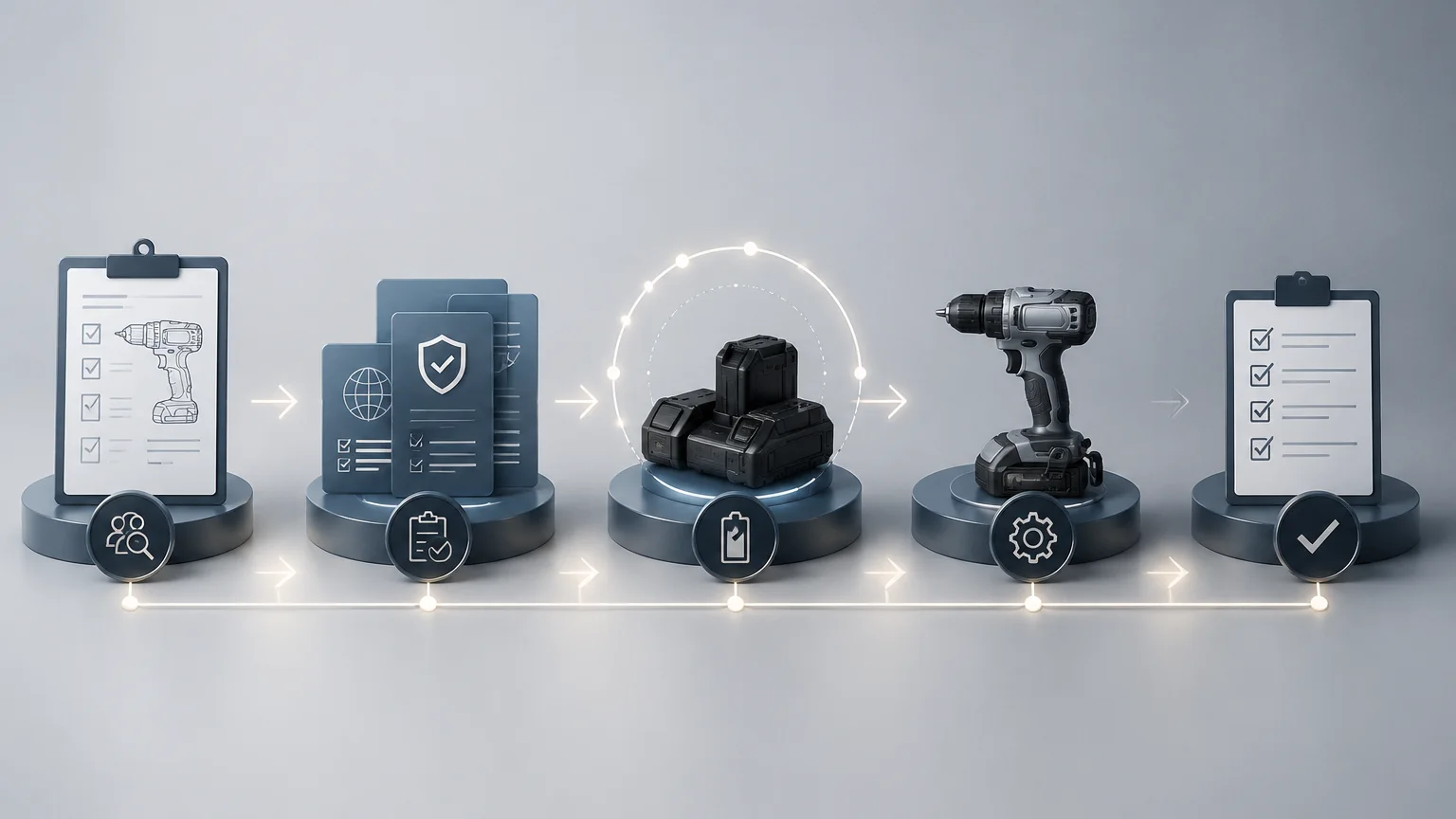
The key to supplier selection for European private-label cordless power tool projects is not the first-order quotation, but whether the factory can consistently deliver compliant products to the agreed sample standard over multiple sales cycles. The core differences between private-label procurement and one-off OEM orders center on mass-production consistency, document traceability, and the allocation of after-sales responsibility. This article takes requirement definition, EU compliance verification, battery platform, sample validation, and release checklist as its main thread, providing a neutral, reusable B2B factory screening framework to help importers, wholesalers, and brand owners complete elimination and release decisions without committing to large-volume orders.
Procurement Goal: Move Comparison Upstream — From Quotes to Process
In European retail private-label projects, the lowest first-order factory quote does not equal the lowest total procurement cost. A one-off OEM order focuses on unit price within the contract, first-batch lead time, and defect rate. A retail private-label project, on the other hand, focuses on consistent appearance across the entire sales cycle, component traceability, and the ability of every subsequent batch to reproduce the performance and feel of the initial samples. The hidden cost structures behind these two sets of goals are fundamentally different.
1. Hidden costs caused by poor mass-production consistency
- Returns, replacements, and after-sales service costs are typically borne by the brand owner; the factory generally assumes only factory-side responsibility.
- Random regulatory inspections of CE, RoHS, and other compliance documents in EU markets can lead to immediate withdrawal of an entire shipment.
- Once retail-store trust in a private-label product drops, leverage in next-quarter replenishment negotiations is weakened.
- Re-tooling, re-certification, and re-producing packaging all raise the actual cost of the next batch.
2. Why a factory quote alone cannot surface these risks
A quotation reflects the factory's contract unit price. It does not reveal whether the factory can continue to deliver to sample standard after mass production begins, nor whether the factory will switch suppliers on the fly when its component supply chain fluctuates. A seemingly "cheapest" quote may correspond to a production model in which the sample line and the bulk-production line are separated, or to component channels whose long-term supply relationships have not yet been confirmed.
Whether a factory can "make it once" and whether it can "keep making it to the same standard" are two entirely different questions. European private-label buyers need to answer the latter.
2. Requirements Definition: Writing a Private-Label Project as a Verifiable Specification
A qualified private-label specification exists so that any factory receiving it can only reply in terms that can be verified. It typically does three things at once: define the product boundary, set the compliance baseline, and leave traceable fields for downstream verification.
2.1 Minimum mandatory fields for a private-label specification
- SKU scope: Initial SKU count, platform coverage (impact wrench only, or a drill + impact + grinder combination), and the planned SKU expansion over the next 12 months.
- Target channel and retail positioning: DIY entry-level, professional retail, or e-commerce only, which drives decisions on housing materials, color schemes, and printing finishes.
- Target market and launch window: Requirements for manual languages, energy labels, and recycling marks differ between Germany, France, the Nordics, and Southeast Europe.
- Battery platform: Voltage (12V / 18V / 20V Max), whether batteries are shared across SKUs, and whether compatibility with an existing aftermarket platform is required.
- Motor and functional baseline: Whether 100% brushless is required, and whether torque or speed ranges must be specified.
- Compliance baseline: Mandatory certifications such as CE (MD + LVD + EMC), RoHS, and UN38.3.
- Customization points for housing and packaging: Housing color, surface finish, brand logo placement, color box material, transport packaging, and barcode scheme.
- Manuals and regulatory documents: Number of languages, whether a CE Declaration of Conformity template is required, and whether detailed safety sections in the user manual are needed.
- Quantity and delivery expectations: First-order quantity, annual rolling volume, first-batch delivery window, and replenishment cycle.
- Inspection and release rules: AQL sampling standard, inspection timing, and whether a designated third-party inspection body is required.
2.2 Splitting fields into "non-negotiables" and "negotiables"
- Non-negotiables: Mandatory certifications applicable to the target market, the number of manual languages, battery platform ownership, boundaries for logo and brand asset use, and inspection and release rules.
- Negotiables: Housing color, surface finish, color box printing process, mold cost amortization method, and first-batch quantity tiers.
3. Supplier Verification: Eliminate Unqualified Factories in the First Round Using EU Compliance and Traceability
For cordless power tools (complete machine + battery pack + charger) targeting the EU market, the following documents are part of the standard requirements. The factory should provide original scans, validity periods, and issuing body reference numbers. Any missing item should be raised during the first round of clarification. Note: the certification and registration requirements below represent a general industry framework; buyers should independently verify the latest regulations of their target sales country.
- CE Technical Documentation and Declaration of Conformity (DoC): covers the Machinery Directive (MD), Low Voltage Directive (LVD), and Electromagnetic Compatibility Directive (EMC).
- RoHS Test Report: Restriction of Hazardous Substances, applicable to battery packs and plastic components.
- Battery and Transportation Documents: UN38.3, MSDS, and the required 1.2-meter drop test report.
- REACH Declaration: declaration concerning Substances of Very High Concern (SVHC), commonly relevant for battery and motor materials.
- Battery Directive (2006/66/EC) Compliance Statement: battery producer registration and recycling obligations; buyers should also review the transition arrangements under the new Batteries Regulation 2023/1542.
- WEEE Registration Statement: registration entity and reference number under the EU member state in line with the Waste Electrical and Electronic Equipment Directive.
- Packaging and Labeling: packaging recycling marks compliant with 94/62/EC, and chemical warning labels compliant with the CLP Regulation (where applicable).
3.1 A Certificate Photo Is Not the Original Certificate
The verification path should include: identifying the issuing laboratory or certification body name, reference number, signature, and validity period on the certificate; cross-checking the certificate number, applicant company name, product model, and test standards directly through the certification body's official website or by phone; requiring the factory to clarify the actual production model and the corresponding circuit/battery configuration; and requesting the full PDF test report for each certificate, rather than only the declaration page.
3.2 Situations That Remove a Factory from the Shortlist
- Unable to provide any original CE/RoHS/UN38.3 test report, or only able to provide photos while refusing to share reference numbers.
- The applicant, production enterprise, or product model on the certificate does not match the current project, or the factory refuses to clarify the discrepancy.
- The issuing body cannot be found through public channels, or the factory refuses to provide contact details that allow reverse verification.
- The UN38.3 report is missing or issued by an unauthorized laboratory.
- Battery and complete-machine certificates are mixed up—for example, attaching the charger's EMC report to the battery pack.
- The factory is unclear about its own registration status under the Battery Directive, or asks the buyer to handle all EU compliance obligations on its behalf without disclosing relevant information.
3.3 Compliance Verification Questions to Raise with the Factory
| Verification Category | What to Request from the Factory | Buyer Reverse-Verification Path |
|---|---|---|
| CE Technical Documentation and DoC | PDF of MD/LVD/EMC test reports matching the complete machine model, plus the original DoC | Enter the certificate number on the issuing body's website and confirm the applicant, model, and standards |
| RoHS | RoHS test report for mass-produced products issued within the last 12 months | Verify the report date and sample origin, and confirm coverage of the project's housing, PCBA, and battery |
| UN38.3 / MSDS | UN38.3 test summary and MSDS for the cell or battery pack | Confirm that the tested cell model matches the cell used in the project, paying attention to the T.1–T.8 series |
| Battery Directive Registration | Battery producer registration entity, registration number, and countries covered | Search the EU Member State recycling organization website to confirm the registration number is valid |
| WEEE Registration | Importer or producer WEEE registration number in the country of sale | Verify the registration number on the environmental authority website of the target country of sale |
| REACH / SVHC | SVHC declaration and list of high-risk substances | Confirm the declaration covers all SKUs and accessories |
| Packaging Markings | Recycling marks, CE logo, and warning-language artwork on the packaging | Request the final artwork and actual photos of the color box from the factory |
The certifications, registrations, and other requirements listed above are an overview of common industry frameworks and the scope of EU regulations. The specific documents a factory actually holds, along with their validity periods and coverage, must each be independently verified by the buyer through the issuing bodies, EU Member State registration platforms, and third-party inspection agencies before a large order is placed.
IV. Battery Platforms: What 12V, 18V, and 20V Max Mean for Private-Label Programs
The battery platform is the most underestimated decision in European retail private-label projects — it determines SKU count, working capital tied up in inventory, after-sales compatibility, and long-term stock risk rather than how well a single tool sells. Once a retail private label commits to either 18V or 20V Max, its chargers, spare batteries, and subsequent new models will follow that line for years.
1. How the three platforms affect private-label programs
- 12V platform: Low unit price, suited to DIY and light household use, with a small SKU range and low entry risk; torque and runtime ceilings are limited, so it cannot cover mid- to high-intensity scenarios such as renovation work or outdoor gardening.
- 18V platform: Wider torque and runtime coverage, suited to construction support and semi-professional users; the SKU range can be extended broadly with good compatibility, but the inventory of batteries and chargers grows accordingly.
- 20V Max platform: "20V Max" on the market typically refers to a 5-cell pack with a peak of about 20V and a nominal 18V, which is not necessarily interchangeable with the common 18V brand platforms in Europe; packaging, manuals, and e-commerce listings should clearly mark "Max" to avoid misleading buyers.
2. Should a single private-label project lock in only one battery platform?
For most small and mid-sized European retail private labels, locking in a single platform is recommended: each additional platform adds a full set of battery capacities, chargers, and packaging specifications, with inventory tied up and procurement complexity rising roughly linearly; after-sales service usually depends on local European repair points, so a more fragmented platform raises spare-parts inventory and training costs; retail consumers are more willing to make repeat purchases around "one battery system for the whole tool family," and crossing platforms weakens that stickiness.
3. Does the factory offer an in-house BMS solution, and what is the cell source?
The Battery Management System (BMS) is one of the most critical hidden components in a private-label project. Buyers can raise the following questions with the factory: BMS chip brand and whether the algorithm is developed in-house, along with the specific protection parameter thresholds (overcharge, over-discharge, overcurrent, short circuit, temperature); cell brand and pack assembler, together with consistency data across consecutive batches of the same model; whether the cells carry traceable reports such as UN38.3, MSDS, and IEC62133, and whether the product model on those reports exactly matches the model in actual production; and whether the factory is willing to contractually commit to cell batch locking or to a designated cell supplier.
4. Battery platform decision comparison table for factories
| Decision item | 12V platform | 18V platform | 20V Max platform | Questions the private-label project needs the factory to answer |
|---|---|---|---|---|
| Typical SKU range | Drills, impact drivers, screwdrivers, light saws | Drills, impact drivers, angle grinders, circular saws, gardening tools | Drills, impact drivers, angle grinders, circular saws, gardening tools | Whether the factory's available model list covers the planned SKUs |
| Battery capacity tiers | 1.5/2.0/2.5Ah common | 2.0/4.0/5.0Ah common | 2.0/4.0/5.0Ah common | Battery capacity tiers that can be shared within one platform |
| Charger compatibility | Usually universal within the platform | Usually universal within the platform | Usually universal within the platform | Whether chargers for new and legacy SKUs are backward compatible |
| BMS solution | Off-the-shelf or in-house | Off-the-shelf or in-house | Off-the-shelf or in-house | Whether algorithms are developed in-house and protection threshold documentation is available |
| Cell source | Factory must specify | Factory must specify | Factory must specify | Cell brand, pack assembler, UN38.3 reports |
| European retail labeling | 12V is clear | 18V is clear | Must mark "20V Max" to avoid confusion with 18V | Labeling plan for packaging and manuals |
| After-sales spare-parts complexity | Low | Medium | Medium | Which spare parts the factory can supply and minimum order quantities |
5. Sample and Quality Verification: Aligning the Factory's Sample Line with Mass Production
The biggest risk at the sampling stage is not that the sample fails to work, but that after presenting a carefully tuned sample, the factory cannot deliver products of the same standard during actual mass production. The objective at this stage should move beyond "evaluating whether the sample works well" to "determining whether the factory can repeatedly produce this sample using the same quality process."
1. Document Sample Test Conditions as Traceable Load and Cycle Tables
- Battery cycle conditions: Repeatedly deep-discharge from full charge to cut-off voltage, recording cycle count and remaining capacity curve.
- Mechanical load conditions: Specify the load material, hole diameter, or bolt specification for drills, impact wrenches, angle grinders, and similar categories.
- Temperature rise and continuous operation: Continuously trigger the switch until motor thermal protection or the temperature limit is reached, recording the temperature rise curve and recovery time.
- Noise and vibration: Measure no-load and load data on a standard test bench using a decibel meter and vibration tester.
- Drop and packaging: Conduct sample-level testing under the pallet stacking and handling drop conditions commonly found in EU retail channels.
2. Use a Small Trial Batch to Assess Consistency
- Random sampling test: Randomly select at least 5 units from the trial batch and send them to a third-party laboratory for retesting under the same load and cycle conditions.
- Production line video: Require the factory to provide real-time video from the trial production day, with emphasis on assembly stations, torque tightening, battery pack pairing, and factory aging testing.
- Component traceability: Take BMS boards, cells, gearboxes, and motors from the trial batch and verify whether lot numbers match the certified alternative suppliers committed by the factory.
- On-site failure data: Request the trial production failure records from the factory, including defect rate, rework cause distribution, and line stoppage count.
- Outbound inspection documents: Verify that the trial shipment includes a complete factory inspection report, batch serial numbers, and a corresponding CE technical file checklist.
3. Lock Sample and Trial Production Findings into the Contract as Attachments
Buyers should attach the following four documents to the mass production contract: the sample test report and third-party retest report; trial batch sampling results and a summary of failure records; the factory's process rectification feedback and supplementary mass production SOP clauses; and the sample baseline parameter table (temperature rise, noise, cycle count, etc.), which serves as the acceptable lower limit for batch sampling inspection during mass production.
6. Quotation and Customization: Common Pitfalls in Private-Label Execution
6.1 The True Composition of MOQ
An OEM factory's MOQ generally consists of three components: the minimum order quantity per SKU, the amortization of color or housing tooling, and the minimum order quantity for private-label packaging materials. Procurement teams are advised to clearly state the SKU breakdown method in the requirements specification and ask the factory to provide minimum order quantities across three dimensions—SKU, color, and printed materials—to prevent "bundled quotations" from obscuring the real threshold.
6.2 Manuals and Multilingual Versions
- Placement of compliance markings: the CE mark, year of manufacture, and manufacturer/importer information must appear on the product, manual, or packaging in accordance with EU regulations.
- Battery and charger section: transport, storage, and disposal notices should be stated in line with UN38.3 and the relevant Battery Directive requirements.
- Illustration numbering and layout: private-label manuals are often built on the factory's existing multilingual templates; inconsistent layouts will increase translation and proofreading workload.
- Division of translation responsibility: the factory provides the template languages and illustrations, while the buyer is responsible for localization and regulatory proofreading in the target market language. The responsibility boundary should be clearly defined in the contract.
6.3 Packaging, Shipping Marks, and Barcodes
- Color box material and finishing: coated paper, corrugated board, kraft paper, and lamination all significantly affect cost and minimum print runs.
- Barcode ownership: EAN/UPC codes must be applied for by the buyer and provided to the factory. If the factory's quotation already includes a barcode fee, ownership and cancellation terms should be specified in the contract.
- Outer carton marks and logistics markings: European retail channels typically have strict requirements for the position of carton marks, their content, and pallet stacking methods.
- EU Authorised Representative: this party bears product liability and market surveillance interface duties under CE compliance. The contract should clearly specify who acts in this role and the scope of their responsibilities.
6.4 Private-Label After-Sales and Recall Liability
- Which party is named on the product nameplate as the EU Authorised Representative or EU importer.
- Which party carries the obligation to take out product liability insurance, including the geographic scope of coverage and minimum insured amount.
- Allocation of recall costs where a recall is triggered, and whether the allocation distinguishes between design defects, material defects, and defects in supplied battery cells.
- Spare parts supply lead time and price protection period, particularly for critical wear parts such as gears, switches, and motors.
- Handling and cost allocation for returned goods—whether the factory collects, returns, or destroys them locally.
7. Risk, After-Sales and Release Checklist: The Final Table Before Approval
7.1 Mandatory Hard Criteria That Must All Be Passed
- CE test reports match the shipping product: the model, motor specifications and battery configuration on the CE (MD/LVD/EMC) report must correspond one-to-one with the SKU about to enter mass production.
- RoHS, UN38.3, MSDS and REACH documents are within their validity period, and the tested samples share the same source as the mass-production samples.
- Battery Directive registration and WEEE registration can be reverse-verified on the official EU website.
- The battery platform is locked to a specific cell model and BMS solution.
- The sample line and the mass-production line follow the same set of quality procedures.
- The final versions of the multilingual manual, barcode ownership and packaging marking can be locked down before mass production.
- The EU authorised representative and the policyholder of product liability insurance are clearly stated in the contract.
7.2 Soft Criteria That Can Be Remedied Through Contract Terms
- Only 1–2 alternative suppliers are available for certain components: a development timeline and transition period for switching to the alternative supplier can be agreed in the contract.
- Trial-production consistency data is at the borderline: the contract should include the AQL sampling plan, third-party inspection milestones, and the division of responsibility for rework or return of non-conforming batches.
- The true MOQ cost composition (packaging, printing, manual) is relatively high: cost-sharing for the first batch of customised parts and a tiered reduction in unit cost can be agreed.
- After-sales and recall responsibilities are not yet defined: the contract should specify recall cost-sharing, spare-parts supply period and customer complaint response timelines.
- The factory does not directly handle logistics and import documents: a designated freight forwarder, HS code attribution and certificate-of-origin processing procedure can be agreed.
7.3 Release Decision Table
| Dimension | Verification Item | Outcome | Evidence / Document No. | Owner |
|---|---|---|---|---|
| EU Compliance | CE (MD/LVD/EMC) test report matches the mass-production SKU | Pass / Fail | Report number + issuing body | Compliance / Legal |
| EU Compliance | RoHS / REACH / UN38.3 / MSDS are within validity and sourced from the same batch as mass-production samples | Pass / Fail | Report number + validity period | Compliance / Legal |
| EU Compliance | Battery Directive and WEEE registration numbers can be verified by reverse lookup | Pass / Fail | Registration number + verification screenshot | Compliance / Legal |
| EU Compliance | EU Authorised Representative and product liability insurance policyholder are clearly identified | Pass / Fail | Contract clause number | Legal |
| Battery Platform | Platform (12V / 18V / 20V Max) is locked down; cell model and BMS scheme are confirmed | Pass / Fail | Battery BOM + BMS specification | Engineering / Procurement |
| Samples & Pilot Run | Sample line and mass-production line follow the same quality workflow | Pass / Fail | Process flowchart + pilot run records | Quality / Engineering |
| Samples & Pilot Run | Pilot-run consistency data meets the contractual AQL | Conditional / Fail | AQL report | Quality |
| Private-Label Launch | Multilingual instruction manual versions are finalised | Pass / Fail | Manual version number | Channel / Marketing |
| Private-Label Launch | Barcode ownership and packaging artwork are finalised | Pass / Fail | Packaging artwork | Channel / Marketing |
| Private-Label Launch | Real MOQ composition and first-order price breakdown are transparent | Conditional / Fail | Quotation + itemised BOM | Procurement |
| Supply Chain Resilience | Number of qualified backup suppliers for core components meets contractual agreement | Conditional / Fail | Backup supplier list | Procurement / Engineering |
| After-Sales & Recall | After-sales responsibility, recall costs, and spare-part supply period are written into contract annexes | Conditional / Fail | Contract clause number | Legal / Procurement |
4. How to Align the Release Checklist with Procurement, Legal, and Channel Teams
- Procurement fills the table first: Procurement completes the "Outcome" and "Evidence / Document No." cells for each row.
- Legal reviews compliance and after-sales rows: Legal focuses on confirming that certifications, the EU Authorised Representative, and after-sales and recall clauses cover EU product-liability exposure.
- Channel reviews market-facing and artwork rows: Channel or Marketing checks that the multilingual manuals, packaging artwork, and barcode ownership meet European retail listing requirements.
- Three-way sign-off before entering mass-production negotiation: Only when every "hard requirement" row shows "Pass" and every "Conditional" row is backed by a corresponding contract clause is Procurement authorised to enter final negotiations with the factory on mass-production pricing and payment terms.
This release-decision table is a neutral framework grounded in EU compliance and consistency risk. It does not reference any specific factory model, price, capacity, or delivery commitment. When applying this table, buyers should layer the "must-pass hard requirements" with additional regulations of the target market (for example UKCA in the United Kingdom, Nordic ecolabels, or local recycling rules) before moving into mass-production negotiation. To further refine private-label customisation and quality-control processes, review OEM, ODM, and quality capabilities, then request a factory quote to convert this checklist into a project-level verification template.
Reference sources
- Top 10 Power Tools Manufacturers for Wholesale Buyers in 2026
- Cordless Power Tool Manufacturer in China | OEM & Private Label | FirstRate
- Batavia Private Label | Custom Power Tools & DIY Solutions for Your Brand
- Who Is the Best Cordless Power Tool OEM Manufacturer for European Retailers? An Honest Answer from Inside the Industry
- Private Label | FEIN Power Tools, Inc.
- OEM & Private Label Power Tools | DRAKO Tools