
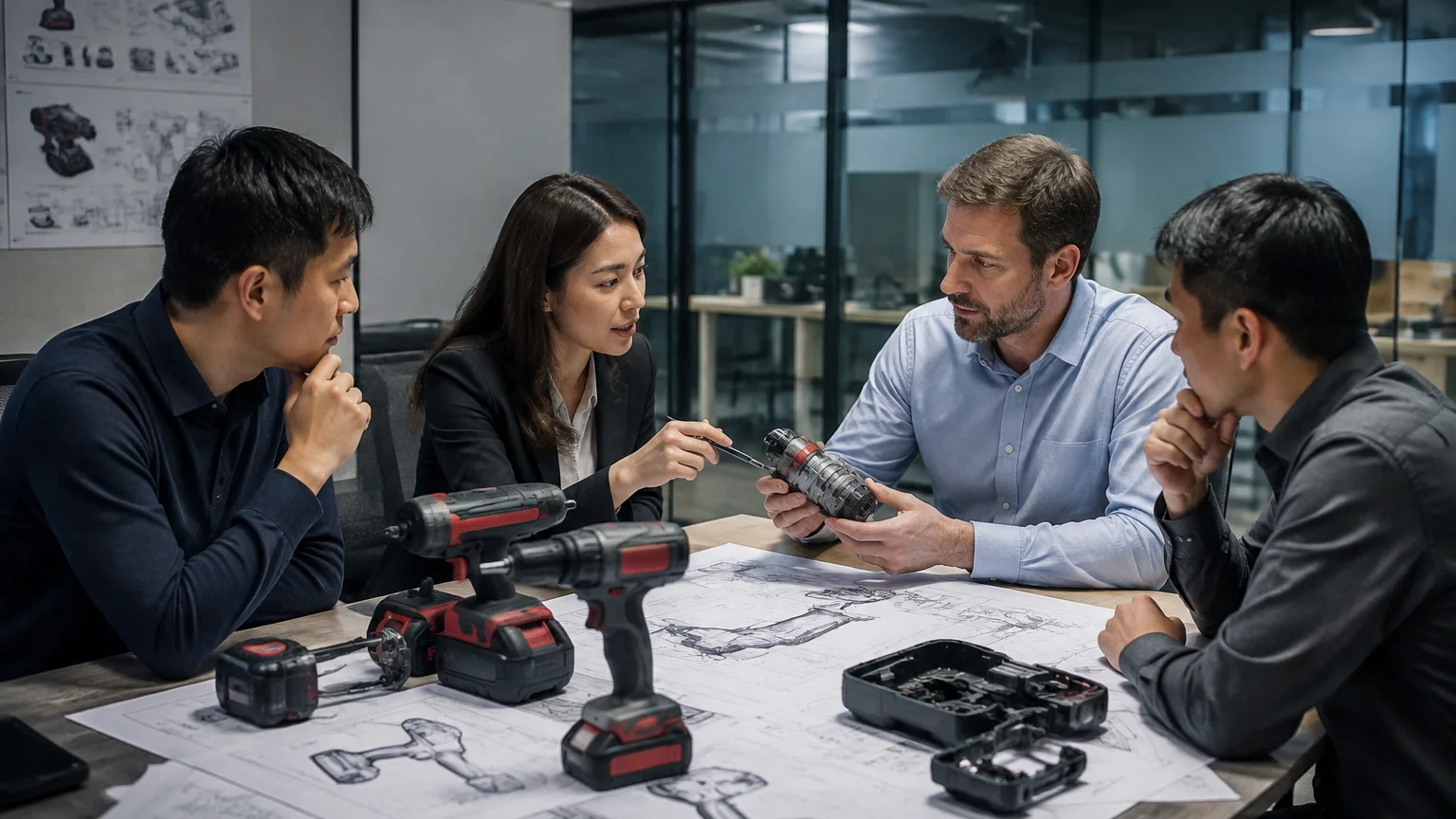
Choosing an ODM power tool supplier is not about finding the largest factory; it is about finding a partner whose engineering support, quality control systems, and commercial terms align with your business needs. This article provides importers, wholesalers, and brand owners with a complete evaluation framework—from defining requirements to verifying before signing—to reduce procurement risk and support better decisions.
Why ODM Power Tool Sourcing Depends More on Supplier Engineering Capability Than OEM
In power tool procurement, OEM and ODM are two distinctly different collaboration models. Understanding the difference is the first step in evaluating a supplier and determines where you should focus your negotiation efforts.
Core Differences Between OEM and ODM
| Dimension | OEM (Contract Manufacturing) | ODM (Original Design Manufacturer) |
|---|---|---|
| Product design | Buyer provides complete drawings or specifications | Supplier designs or deeply modifies based on existing platforms |
| Engineering responsibility | Buyer leads; supplier manufactures to drawings | Supplier bears primary responsibility for engineering implementation and optimization |
| Buyer involvement | Shallow; mainly focused on production and delivery | Deep; requires participation in design reviews, testing, and validation |
| Risk distribution | Design risk borne by buyer | Design risk shared by supplier, but buyer must verify supplier capability |
Simply put, OEM means “you design, we build”; ODM means “you specify the need, we propose the solution and build it.” In ODM, the supplier's engineering team directly determines product performance, safety, and manufacturability.
Why Engineering Support Matters More Than Production Capacity in ODM
Production capacity answers “can it be built?” while engineering support answers “is what is built correct, good, and marketable?” In ODM sourcing, you are buying not just capacity but the supplier's engineering judgment.
- Requirement translation: An ODM supplier must convert your market positioning, target price, and functional requirements into a concrete technical solution. This requires a team with product definition skills, not just execution capability.
- Platform-based development: Mature ODM suppliers typically have modular platforms for motors, battery packs, and transmission structures. Their engineers can quickly combine these platforms to create products that meet your needs, shortening development cycles and controlling costs.
- Design for manufacturability: The engineering team must consider assembly efficiency, yield rates, and supply chain stability during the design phase. A well-designed product that is difficult to mass-produce is a disaster for the buyer.
- Compliance and certification foresight: Requirements for electrical safety, electromagnetic compatibility, and environmental directives in target markets must be anticipated during design, not patched after samples are produced.
Where an ODM Supplier's Engineering Team Should Be Involved
A competent ODM engineering team's scope goes far beyond “drawing” and “mold modification.” Throughout the collaboration, you should see them involved in:
- Requirements review: Confirming target market, use cases, competitor benchmarking, and cost targets, then delivering a feasibility assessment.
- Solution design: Completing overall structural design, key component selection (motors, switches, gearboxes), and preliminary thermal and safety analysis.
- Prototype building and testing: Producing engineering prototypes and conducting internal tests for durability, temperature rise, vibration, and drop, with test reports.
- Trial production and process optimization: Resolving assembly issues during pilot runs, refining processes, and ensuring mass-production consistency.
- Certification support: Providing technical documentation and test samples to support certification applications in target markets.
When evaluating an ODM supplier, do not focus only on factory size or line count. Examine the size of the engineering team, the complexity of past ODM projects, their ability to participate in early requirement definition, and their willingness to invest resources in validation during the prototype stage. These factors determine whether an ODM partnership will run smoothly.
Five Requirement Dimensions to Define Before Sourcing ODM Power Tools
Before contacting any ODM supplier, take time to document your requirements clearly. The vaguer the requirements, the wider the quote variance and the higher the risk of project delays. These five dimensions should be clarified before you send an inquiry.
1. Product Specifications and Performance Parameters
Define the tool type (drill, angle grinder, saw), power source (corded or cordless), voltage, speed, torque, battery capacity, and other core parameters. Do not write “high-end” or “economy”; provide quantifiable metrics. For example, a cordless drill needs battery voltage (12V, 18V, 20V) and maximum torque values. These parameters directly affect the supplier's quote and development timeline.
2. Target Market Compliance Requirements
Different markets have different requirements for voltage, plug types, and certifications. For example, exporting to Europe typically requires CE marking, while North America may require UL certification. Before inquiring, confirm the specific regulatory requirements for your target market and include them in your requirements document. A supplier's experience with relevant certifications directly affects whether your product clears customs and reaches the market smoothly.
3. Design Responsibility Boundaries
In ODM collaboration, how design responsibility is divided is critical. Clarify: Who handles industrial design? Who handles internal structural design? Who pays for mold development? If your brand provides the exterior concept and the supplier handles engineering implementation, the boundaries of responsibility and intellectual property ownership must be written into the contract. It is advisable to list “supplier responsible” and “brand responsible” items in the requirements document to avoid disputes later.
4. Branding and Packaging Requirements
Private-label sourcing requires clarity on brand marks, packaging design, manual language, and barcode requirements. Does the supplier support custom packaging? What is the minimum packaging quantity? These details affect cost and lead time. If your target market is multilingual, confirm whether manuals and packaging can support multiple languages.
5. Order Volume and Delivery Expectations
Define expected initial order quantity, annual purchase volume, and desired lead times. Supplier quotes are typically tied to order volume—the larger the volume, the lower the unit price. Lead time affects inventory planning. If the initial order is small, confirm in advance whether the supplier accepts a low minimum order quantity (MOQ) and whether a low MOQ will increase unit price or extend delivery.
Procurement tip: Before sending inquiries, compile the five dimensions above into a request for quotation (RFQ) document. The more specific the document, the more accurate the supplier's quote, and the smoother the subsequent sample approval and mass production.
If some parameters are not yet determined, mark them as “TBD,” but at least provide a range or reference value. Vague requirements only produce vague quotes, and ultimately it is your project timeline that suffers.
How to Verify an ODM Power Tool Supplier's Engineering Support Capability
The core value of ODM collaboration lies in whether the supplier can turn your product concept into a manufacturable design. To judge whether a supplier has genuine ODM engineering capability, do not rely on “R&D strength” claims in brochures. Verify through specific questions, documents, and on-site observation. Here is an actionable checklist.
Step 1: Confirm Whether the Supplier Has Self-Developed Product Lines
A supplier with true ODM capability typically has its own brand or self-designed product series, not just contract manufacturing to customer drawings. You can assess this by:
- Requesting a list of design or appearance patents for their own products and verifying the patent numbers are real and searchable.
- Asking which models in their product line are self-designed versus customer-customized. A higher share of self-designed products usually indicates deeper engineering experience.
- Checking whether their website or catalog shows continuously updated new products rather than fixed models unchanged for years.
If a supplier can only offer OEM contract manufacturing and cannot show any self-designed cases, it may not have the ODM engineering depth you expect.
Step 2: Understand the Engineering Team's Size and Structure
The structure of the engineering team directly affects project response speed and problem-solving capability. During inquiries or factory visits, ask directly:
- How many people are on the engineering team? Are there separate roles for structural design, electronic/circuit design, industrial design, and testing/validation?
- Is there a dedicated project manager or engineer responsible for ODM customer liaison?
- What is the average years of experience among engineers? Do they have a background in the power tool industry?
- Does the team have end-to-end capability from concept sketches to 3D modeling, prototype making, and mold development?
If the answer is “we outsource to a design company” or “engineers handle both production and R&D,” assess whether that model will affect project progress and communication efficiency.
Step 3: Verify Complete Design Support Capability
ODM projects typically involve structural, electrical, and aesthetic design. Confirm item by item whether the supplier can provide the following support:
| Design Dimension | Verification Question | Evidence to Request |
|---|---|---|
| Structural design | Can they adjust internal structure for target market voltage, frequency, and plug standards? | Structural drawings, exploded views, or mold lists from past projects |
| Electrical design | Can they independently design motor control boards and battery management systems? | Circuit schematics, PCB design files, or EMC test reports |
| Industrial design | Can they provide custom exterior styling, color, silk-screening, and packaging solutions? | Design renderings, CMF (color/material/finish) proposals, or sample photos |
If the supplier can only provide one or two of these design capabilities, clarify the boundaries and write into the contract which design work the supplier handles and which you must resolve yourself.
Step 4: Test Engineering Responsiveness with a Specific Project Scenario
Before placing a formal order, test the supplier's engineering responsiveness with a hypothetical or small-scale requirement. For example:
- Propose a need to modify the battery pack interface or adjust handle ergonomics, and observe whether they can provide an initial solution within a reasonable timeframe.
- Ask whether they can adjust designs for target market voltage standards (110V/220V) or certification requirements (CE, UL).
- Request development timelines and milestone plans from past ODM projects to assess their project management capability.
A qualified ODM supplier should answer these questions clearly, not vaguely or with outright refusal.
Step 5: On-Site Visit or Video Factory Audit
If conditions allow, visit the supplier's R&D department and production lines in person. Focus on:
- Whether there is a dedicated R&D office or laboratory, not just a single drafting workstation.
- Whether test equipment (durability test rigs, temperature rise meters, drop testers) is available for design validation.
- Whether engineers participate in on-site production issue resolution or only sit in the office drawing.
If an on-site visit is not possible, request video or photos of the R&D area and arrange a video conference with engineers to discuss technical issues directly.
Core principle for verifying engineering support: Do not trust verbal claims. Require verifiable documents, cases, or samples. If a supplier cannot show any self-designed results or engineering team information, it may be better suited as an OEM contract manufacturer than an ODM partner.
After completing these checks, you will have a clearer picture of the supplier's engineering capability. Next, shift your attention to sample quality validation and quote details to ensure design capability translates into products that meet expectations.
Quality Control Systems: How to Audit an ODM Power Tool Supplier's Inspection Process
For ODM power tool sourcing, the supplier's quality control system directly determines product consistency and your brand reputation. The following framework helps you systematically audit a supplier's inspection process, avoiding being misled by surface-level certifications or verbal promises.
Verifying Testing Equipment and Capability
A supplier should have basic testing equipment to verify product performance and safety. Confirm whether their equipment covers the following key inspection areas:
| Inspection Stage | Key Inspection Items | Questions to Ask the Supplier |
|---|---|---|
| Incoming quality control (IQC) | Dimensions, materials, and performance of key components: motors, batteries, switches, housings | What sampling standard is used for incoming inspection? How are non-conforming batches handled? |
| In-process quality control (IPQC) | Torque, speed, noise, vibration, and other key parameters during assembly | Is there first-article inspection and patrol inspection? Are there mistake-proofing measures at critical processes? |
| Final quality control (FQC) | Complete unit function, safety performance (insulation resistance, dielectric withstand), appearance | What sampling plan (e.g., AQL) is used for final inspection? Is it 100% inspection or sampling? |
| Outgoing quality control (OQC) | Packaging integrity, accessory completeness, label and manual accuracy | Is there a final inspection before shipment? Is an inspection report provided? |
Confirming the Real Effectiveness of Quality Control Processes
Having testing equipment does not mean the process is effective. Verify through the following:
- Request a written quality control plan (QCP): Ask the supplier for a product-specific QCP that includes detailed standards, methods, and responsible persons for each inspection stage.
- Review inspection records: Request records from the past several months for incoming, in-process, and final inspections. Confirm the records are complete, authentic, and traceable.
- Observe on site: During a factory visit or video audit, focus on whether inspectors follow standard procedures, whether testing equipment is within calibration validity, and whether non-conforming products have clear segregation and disposition processes.
- Ask about problem-handling mechanisms: Understand how the supplier handles customer complaints and internally discovered quality issues. Look for systematic improvement processes such as 8D reports or corrective and preventive actions (CAPA).
The Role of Third-Party Inspection
For ODM orders—especially first-time collaborations or large volumes—third-party inspection is an effective risk-reduction tool. It provides an objective quality assessment independent of the supplier.
- Timing: Typically during production (DUPRO) and before shipment (PSI). Mid-production inspection catches issues early and avoids batch rework; pre-shipment inspection ensures the final product meets requirements.
- Scope: Third-party inspectors use international standards (such as AQL) for sampling, covering appearance, function, safety, and packaging.
- Selection: Choose qualified inspection companies (such as SGS, BV, TUV) and clearly define inspection standards and sampling plans. Specify in the contract how inspection results relate to payment or shipment.
Note: Third-party inspection cannot replace the supplier's own quality control system. It is a supplementary verification of internal processes, not a substitute. A supplier that relies on third-party inspection to ensure quality may have weak internal processes.
Make quality control system verification a core part of supplier evaluation. By assessing equipment, processes, records, and third-party verification, you can more accurately judge a supplier's quality assurance capability and build a solid foundation for long-term cooperation.
Flexible MOQ and Quote Structures: Cost Negotiation Strategies for ODM Power Tool Sourcing
ODM power tool quotes are not a single number; they are the sum of multiple cost components. Understanding these components helps you identify what is negotiable and what is fixed, enabling a more pragmatic procurement strategy.
What Determines MOQ
Minimum order quantity (MOQ) is typically determined by the following factors, not arbitrarily set by the supplier:
- Product complexity: The more complex the structure and the more components, the higher the mold and setup costs, and thus the higher the MOQ.
- Degree of customization: MOQ for simple re-branding is usually lower than for ODM projects involving appearance, structural, or electrical changes.
- Material procurement lead times: Custom colors, special cables, or dedicated battery packs require separate purchasing, so suppliers set MOQ based on minimum material purchase quantities.
- Production line efficiency: Line changeovers have fixed costs; suppliers calculate a minimum volume that absorbs these costs.
Which Cost Items Are Negotiable
Quotes typically include the following cost categories, each with different negotiation flexibility:
| Cost Item | Nature | Negotiation Advice |
|---|---|---|
| Mold/tooling fees | One-time investment | Negotiate amortization, such as rebates per order or installment payments |
| Material costs | Mostly fixed | Affected by copper, steel, plastic resin prices; limited supplier flexibility |
| Labor and manufacturing | Partially negotiableReference sources |