
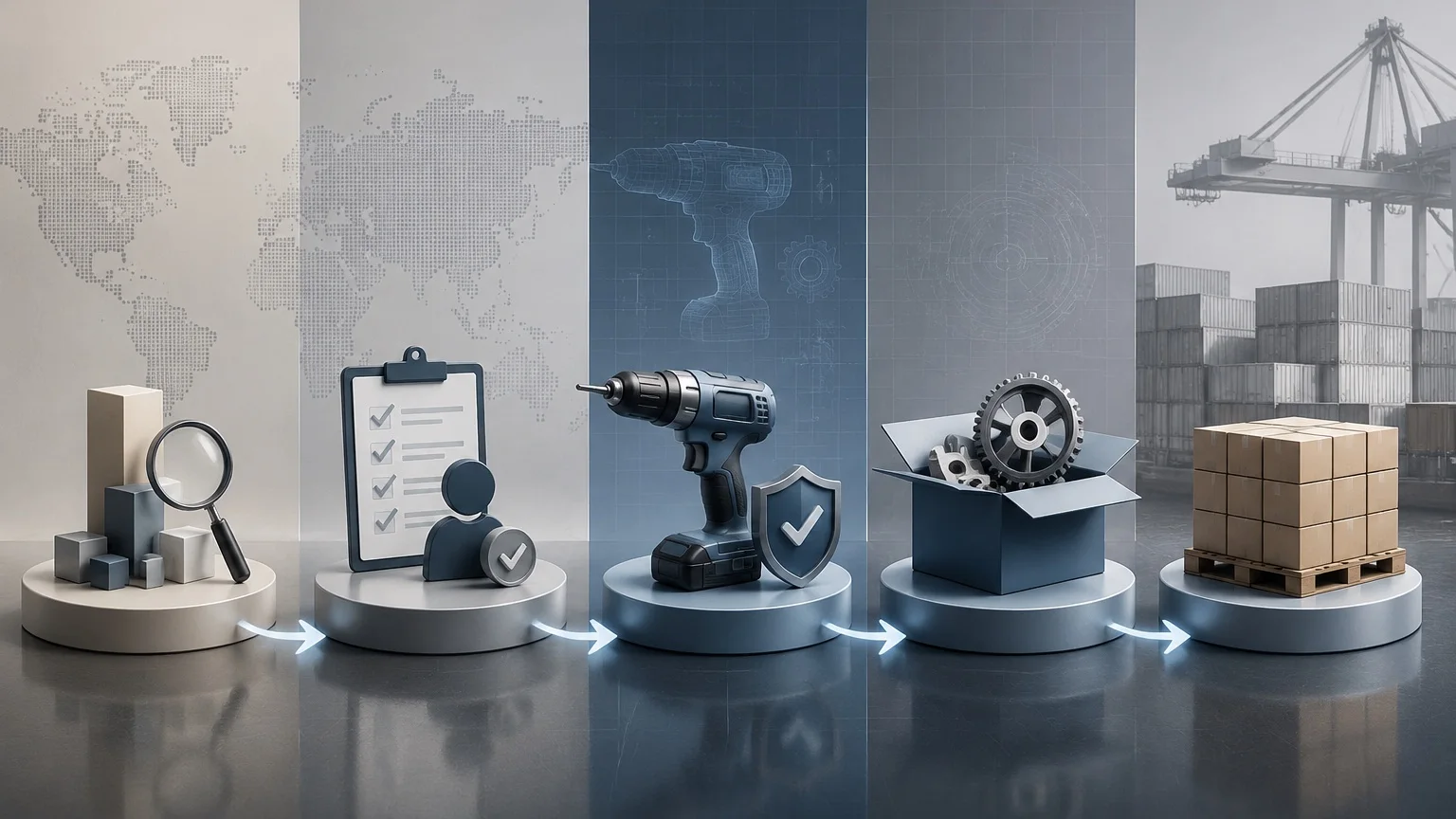
Why ODM Power Tool Procurement Needs an Evaluation Framework
The practical difference between ODM and OEM in power tool procurement determines that your evaluation priorities are completely different. OEM typically means contract manufacturing according to your drawings or specifications; the factory handles production, but product design, technical parameters, and compliance responsibility rest mainly with you. ODM means the factory has ready-made product designs or R&D capabilities and can modify, rebrand, or even co-develop based on its existing platforms. For importers, wholesalers, and brand owners, choosing ODM often means faster time-to-market and lower upfront development costs, but it also means your control over the core product design is reduced, and the factory's technical level and engineering capability directly set the ceiling on final product quality.
Because the factory assumes more design and engineering responsibility in an ODM partnership, deciding to cooperate based on sample quality alone is risky. A sample only proves what the factory can produce under ideal conditions; it cannot prove batch production consistency, supply chain stability, quality system execution, or whether it can continuously meet your compliance requirements and delivery timelines in subsequent orders. Samples may be carefully selected or even specially made for display, while problems in mass production often do not surface at the sample stage.
Therefore, a systematic evaluation framework should cover at least the following dimensions:
- Engineering capability: Whether the factory has independent R&D capabilities, can modify existing product platforms, and can handle your customization needs such as voltage, frequency, plug, and battery compatibility.
- Quality system: Whether the factory has complete quality control processes from incoming inspection, in-process control, to finished product testing, along with the corresponding testing equipment and records.
- Supply chain reliability: Whether the factory's sourcing channels for key components (such as motors, batteries, and controllers) are stable, whether backup suppliers exist, and whether it can cope with raw material price fluctuations and supply disruptions.
- Compliance and certification: Whether the factory is familiar with the certification requirements of your target markets (such as CE, GS, UL, etc.) and can provide the necessary test reports and compliance documentation.
- Communication and responsiveness: Whether the factory's sales and technical teams can clearly understand your needs and provide feasibility recommendations before specifications are finalized, rather than discovering issues only at the sample stage.
Some experienced ODM factories help buyers confirm model suitability, compliance scope, and configuration feasibility before specifications are finalized, thereby avoiding problems discovered only after sample costs have been incurred. This upfront communication capability is itself an important indicator of a factory's professionalism. What you need to verify is not the factory's claimed capacity or number of partner customers, but its actual engineering processes, quality records, and supply chain management capabilities.
Step 1: Define Your ODM Requirements Clearly
Before contacting any supplier, take the time to write down your requirements. The vaguer your requirements, the more generic the solutions suppliers will offer, and the higher your subsequent communication costs will be. The following three dimensions must be clarified in advance.
1. Do You Need Cosmetic Customization, Structural Modifications, or Development from Scratch?
ODM cooperation models typically fall into three tiers, each with significantly different investment and timelines:
- Cosmetic customization (light customization): Changing the color, logo, packaging, and manual on an existing model. This is the most common private-label model, with short lead times and low costs, suitable for quick market entry.
- Structural modifications (medium customization): Adjusting the handle shape, battery interface position, switch layout, or some internal structure. This requires the supplier to have an engineering team, and the timeline and mold costs increase noticeably.
- Development from scratch (deep ODM): Designing entirely new products based on your performance parameters, appearance concepts, and functional requirements. This has the longest timeline, typically requires development and mold fees, and places the highest demands on the supplier's R&D capabilities.
Recommendation: First confirm which tier your brand positioning and budget can support. If you are only doing private labeling, there is no need to pursue development from scratch; if you want differentiated products, reserve sufficient development time and funding.
2. What Are the Target Market Requirements for Voltage, Plugs, Certifications, and Language Packaging?
Power tools are a highly regulated category, and market access requirements vary greatly across regions. Before requesting quotes, list the mandatory requirements of your target market:
- Voltage and frequency: For example, Russia commonly uses 220-240V/50Hz, North America uses 120V/60Hz, and Japan uses 100V/50/60Hz. For cordless tools, also confirm whether the battery platform (e.g., 18V, 20V, 40V) aligns with local mainstream trends.
- Plug types: European, American, British, Australian standards, etc., directly affect the design of chargers and power cords.
- Certification requirements: Russia requires EAC certification; the EU requires CE; North America requires UL/ETL; the UK requires UKCA. Testing cycles and costs vary significantly across certifications, so confirm who is responsible and who bears the costs before project kickoff.
- Language and packaging: Manual language, packaging dimensions, barcodes, and warning labels must all be specified in the requirements document.
Recommendation: Compile the compliance requirements of your target market into a checklist and attach it when contacting suppliers. If a supplier is unfamiliar with target market certifications, that itself is a risk signal.
3. What Are Your Estimated Annual Purchase Volume and Initial Order Size?
Purchase volume directly determines the supplier's pricing logic and willingness to cooperate. You need to clarify:
- Initial order quantity (MOQ): Suppliers typically have minimum order quantity requirements, which may be 500 units, 1,000 units, or higher. Below the MOQ, they may either decline the order or significantly raise unit prices.
- Estimated annual purchase volume: This affects whether the supplier is willing to invest in molds, custom packaging, and dedicated production lines for you. The larger the annual volume, the more negotiating leverage you have.
- Reorder cycle: Is it quarterly or annual reordering? This relates to the supplier's material planning and capacity reservation.
Recommendation: Even without precise figures, provide a range (e.g., "initial order 500-1,000 units, annual purchase 5,000-10,000 units"). This allows the supplier to assess whether investing resources is worthwhile and helps avoid quote discrepancies due to quantity mismatches later.
Before specifications are finalized, mature ODM suppliers typically help you confirm model suitability, compliance scope, and configuration feasibility first, then move to the sample stage. If a supplier pushes you to sample or quote immediately, be wary of their professionalism.
Write the above three questions into a brief requirements document before contacting suppliers. This document serves not only as the basis for inquiries but also as the baseline for comparing supplier proposals and evaluating quote reasonableness later.
Step 2: Verify the Supplier's Engineering and R&D Capabilities
The core of an ODM partnership is whether the supplier can turn your requirements into a mass-producible product, not just change a label. The following verification questions and methods can help you determine whether a supplier has genuine engineering capabilities.
Verification Question Checklist
- In-house R&D team size and composition: Ask about the number of R&D personnel, engineer backgrounds (motors, electronics, structures, software), and whether there are dedicated battery management system (BMS) and motor control engineers. Request an organizational chart or resumes of key engineers.
- Past ODM project cases: Request technical proposals, development timelines, mass production records, and customer feedback from 3-5 previous ODM projects. Focus on technical challenges and solutions in those projects, rather than just looking at finished product photos.
- Core technical support capabilities: In key areas such as battery management systems, brushless motor control algorithms, and safety compliance design (e.g., CE, UL, GS), ask whether there is actual project experience. Request relevant technical documents, test reports, or patent certificates.
- Mold and sample development capabilities: Confirm whether molds are developed in-house or outsourced. Ask about sample production lead times, revision iteration processes, and how costs are covered.
- Testing equipment and laboratories: Find out whether the supplier has in-house testing capabilities, such as durability testing, drop testing, high/low temperature testing, and EMC pre-testing. Request a list of testing equipment or laboratory photos.
Recommended Verification Methods
- On-site inspection: Arrange a factory visit and focus on observing the R&D department, laboratories, and production lines, rather than just touring the showroom. Communicate directly with R&D leaders and raise specific technical questions.
- Technical proposal review: Before finalizing specifications, require the supplier to provide a preliminary technical proposal, including key component selection, structural design approach, safety certification path, and potential risk points. This reflects the depth of their engineering understanding.
- Sample testing: Request functional samples and test reports, and independently conduct third-party testing to verify claimed performance metrics.
- Reference customer interviews: With the supplier's consent, contact their existing customers to learn about technical response speed, problem-solving ability, and communication efficiency during project collaboration.
Note: Some suppliers' claims on B2B platforms, such as "R&D capabilities: ODM, OEM" or "quick response," are self-declarations and need to be independently verified using the methods above. For example, if a supplier claims "response time ≤3 hours" or "delivery within 15 working days," these commitments should be written into the contract with penalty clauses.
Engineering capability assessment is the most critical part of an ODM partnership. It is recommended to organize the above questions into a scoring sheet and quantitatively compare candidate suppliers, avoiding decisions based solely on sales pitches or sample appearance.
Step 3: Evaluate the Quality System and Production Consistency
Samples only prove that a supplier "can do" something, not that they "can do it consistently." The core risk in ODM procurement lies in quality fluctuation during batch delivery. When evaluating a quality system, the focus should not be on how many certificates hang on the wall, but on whether the system covers every link from incoming materials to shipment, and whether the supplier can maintain consistency as production volume increases.
Three Dimensions of Quality System Evaluation
The following table lists the dimensions to focus on when evaluating a quality system, specific verification questions, and signals that warrant caution or confidence.
| Evaluation Dimension | Verification Questions | Signals to Watch |
|---|---|---|
| Incoming Quality Control (IQC) | Are there clear inspection standards and records for key components such as motors, batteries, switches, and gearboxes? How are non-conforming batches handled? | Written inspection specifications and batch traceability records exist; non-conforming items have a quarantine area and handling process |
| In-Process Quality Control (IPQC) | Does the production line have first-article inspection, patrol inspection, and mistake-proofing measures for critical processes? Are parameters such as assembly torque, adhesive amount, and crimping controlled? | Parameter monitoring records exist for critical processes; operators have work instructions; abnormalities can be traced to specific workstations |
| Final Quality Control (FQC/OQC) | Is there 100% inspection or sampling inspection before shipment? Do inspection items cover function, safety, appearance, and packaging? | A clear sampling plan exists (e.g., AQL standards); inspection records are traceable; shipment reports accompany the goods |
| Defect Rate and Corrective Actions | Does the supplier track production line defect rates? Is there an 8D report or Corrective and Preventive Action (CAPA) process after customer complaints? | Can provide defect rate trend data for the last 3-6 months; has closed-loop corrective action cases |
| Quality Staffing | Is the quality team independent from the production department? Do they have the authority to stop the production line? | The quality department reports directly to the factory manager or general manager; has the authority to halt production |
How to Confirm Production Line Consistency and Defect Rate Control
Do not just ask "What is your defect rate?" Instead, ask "How do you calculate the defect rate?" Specific methods include:
- Request first-pass yield (FPY) or defect rate data for the last three months, and ask about the calculation basis—whether it is by batch, by unit, or by labor hours.
- During an on-site visit, randomly select work-in-progress items for measurement and compare them against sample specifications. Focus on critical dimensions such as battery compartment size, gearbox assembly clearance, and switch trigger force.
- Ask the supplier how they handle "borderline samples"—products that are just at the edge of specification. Are they released or scrapped? This reflects the strictness of their quality culture.
- Request a list of customer complaints and corrective action records from the past 12 months (which may be redacted). If the supplier cannot provide this, their quality traceability system may be inadequate.
Supply Chain Controllability of Key Components
The performance and lifespan of power tools are highly dependent on motors, batteries, switches, and gearboxes. The stability of the supply chain for these components directly affects delivery and quality.
- Confirm the supplier list for key components: Ask which suppliers provide the motors, battery cells, switches, and gearboxes. If the supplier only answers "we have a stable supply chain" without providing specific brand names or factory names, caution is warranted.
- Assess single-source risk: If a critical component has only one supplier, the entire production line could halt if that supplier encounters problems. Ask whether backup suppliers exist and whether they have been qualified.
- Understand component batch traceability: When a batch of products has quality issues, can the supplier quickly identify which specific batch of motors or batteries is involved? This requires full-chain batch records from component receipt to finished goods shipment.
- Ask about the battery cell procurement strategy: Cells are central to both cost and safety. Confirm whether the cell supplier holds the necessary safety certifications (e.g., UN38.3, CB) and whether each batch of cells is sampled for capacity, internal resistance, and cycle life.
Note: The certifications mentioned above (such as UN38.3) are common industry requirements for transport safety, but whether a specific supplier holds them must be verified by requesting original certificates directly from them. Do not accept photocopies or verbal assurances.
The ultimate purpose of quality system evaluation is to determine whether the supplier has "predictable delivery capability." If the supplier gives vague answers on the above dimensions or cannot provide written records, their risk level should be raised, even if the samples are flawless.
Step 4: Sample Verification and Trial Production Confirmation
Sample verification is a critical gate in ODM procurement, bridging the gap between drawings and mass production. A passing sample does not guarantee a passing mass production run. The true purpose of sample verification is to confirm whether the supplier's engineering understanding, process capability, and quality control system can reliably reproduce results under batch production conditions. Below are the specific steps and checklists for sample verification and trial production confirmation.
Test Items That Sample Verification Should Cover
Sample verification should not be limited to visual inspection and a basic power-on test. It is recommended to cover at least the following four categories of tests:
- Functional and performance testing: Verify key parameters such as speed, torque, runtime, charging time, and noise one by one against the mutually confirmed specification sheet. Test conditions should be clearly documented, such as load type, ambient temperature, and battery state, to avoid future disputes.
- Durability and lifespan testing: Simulate actual usage scenarios with continuous operation, switch cycling, and overload protection tests. Focus on failure-prone areas such as motor temperature rise, gearbox wear, and switch contact lifespan.
- Safety and compliance testing: Verify electrical safety, mechanical protection, electromagnetic compatibility, battery safety, and other items according to the regulatory requirements of the target market. The certification plan and testing agency should be confirmed at the sample stage to avoid rework from retroactive certification after mass production begins.
- Environmental adaptability testing: Conduct high/low temperature, humidity, dust, and drop tests based on the climate conditions of the regions where the product will be sold. For example, low-temperature starting performance is especially important for products sold to the Russian market.
Sample Verification Checklist
| Verification Item | Specific Check Content | Pass Criteria |
|---|---|---|
| Appearance and structure | Housing fit, color, logo, silk-screen printing, packaging | Consistent with the approved sample, no obvious defects |
| Functional parameters | Speed, torque, runtime, charging time | Meets specification sheet values, deviations within allowable range |
| Safety performance | Insulation resistance, dielectric strength, grounding, protective devices | Complies with target market safety standards |
| Durability | Continuous operation, switch lifespan, overload protection | Meets agreed test duration or cycle count |
| Environmental adaptability | High/low temperature, humidity, dust, drop | Functions normally after testing under agreed conditions |
| Compliance documentation | Test reports, certification certificates, material declarations | Documents complete and issued by qualified agencies |
How to Confirm Mass Production Consistency Through Trial Production
After sample verification passes, do not proceed directly to large-scale production. It is recommended to arrange a small-batch trial production, typically 5% to 10% of the planned production quantity, or at least covering the output of one complete production line. The purpose of trial production is not to re-verify the product design, but to verify the stability of the production process.
During trial production, focus on the following areas:
- Incoming material consistency: Confirm that components from batch procurement match the materials used at the sample stage, especially key parts such as motors, batteries, switches, and gears.
- Process stability: Observe the assembly line takt time, workstation operating procedures, and whether process parameters for key operations are under control.
- In-line inspection data: Collect data on defect rate, rework rate, and test pass rate during trial production, and compare against the quality targets agreed with the supplier.
- Finished product sampling: Conduct sampling inspection of trial production finished goods according to AQL (Acceptable Quality Level) standards to confirm the quality level of batch products.
Common Differences Between Samples and Mass Production
Even if sample verification goes smoothly, differences can still arise between samples and mass production. Common issues include:
- Material batch variation: Key materials used at the sample stage may have been hand-picked or procured in small batches. Performance may fluctuate after changing suppliers or batches during mass production.
- Process parameter drift: The sample stage may involve manual adjustment by skilled technicians, while mass production relies on automated equipment or regular operators. Process parameters may not be fully fixed.
- Relaxed appearance standards: Appearance requirements are strict at the sample stage, but suppliers may relax appearance inspection standards during mass production to control costs or improve efficiency.
- Simplified packaging and accessories: Sample packaging is usually carefully prepared. During mass production, issues such as downgraded packaging materials, missing instruction manuals, or insufficient accessory quantities may occur.
To reduce these differences, it is recommended to agree in writing with the supplier on mass production standards at the sample confirmation stage, including key material brands and models, process parameter ranges, appearance inspection standards, and packaging specifications. After trial production is completed, require the supplier to provide a trial production report containing actual output, defect rate, test data, a list of issues, and corrective actions. Only when trial production results meet the agreed standards should approval be given to proceed to mass production.
If problems are found during trial production, require the supplier to provide clear root cause analysis and corrective actions, and arrange a second trial production for verification. Do not accept verbal commitments; all corrective actions should be confirmed in writing and tracked to closure.
Step 5: Understanding Quote Structures and Customization Costs
An ODM quote is not a single figure but a combination of multiple cost modules. Comparing only unit prices can easily overlook hidden expenses such as mold, engineering, testing, and certification, leading to budget overruns later in the project. Buyers should request itemized quotes from suppliers during the inquiry stage and confirm cost ownership and payment milestones item by item.
Typical Components of an ODM Quote
A complete ODM quote usually includes the following cost items. The exact proportions vary depending on the depth of customization and product type; the following is a typical breakdown for reference:
| Cost Item | Description | Common Billing Method |
|---|---|---|
| Mold Fee | Development and manufacturing of injection-molded or die-cast molds for housings, gearboxes, battery pack enclosures, etc. | One-time charge, or amortized and rebated based on order volume |
| Engineering Fee | R&D investment in structural design, circuit design, thermal simulation, prototype production, etc. | Charged per project, or included in the unit price |
| Material Cost | BOM costs for motors, battery cells, PCBs, switches, housing materials, etc. | Included in unit price based on actual usage |
| Manufacturing Cost | Assembly, testing, packaging, labor, and equipment depreciation | Allocated based on labor hours and production line efficiency |
| Testing and Certification Fees | Safety certifications such as CE, UL, GS, as well as compliance testing for EMC, RoHS, REACH, etc. | Quoted separately per certification item, usually borne by the buyer |
| Packaging and Manuals | Custom packaging materials such as color boxes, manuals, labels, and barcodes | Included in unit price or quoted separately depending on design complexity |
| Logistics and Duties | Sea/air freight, customs clearance, destination-country duties, and inland transportation | Settled based on actual costs, or collected by the supplier |
Note: The table above is a general framework; specific items and amounts are subject to the supplier's official quotation. Different suppliers may categorize cost items differently, so buyers should request a detailed breakdown rather than accepting a total price only.
Mold Fee and Engineering Fee Allocation Methods
Mold fees and engineering fees are the largest and most dispute-prone parts of an ODM project. There are three common allocation methods:
- One-time payment: The buyer pays the full mold and engineering fees, and mold ownership belongs to the buyer. Suitable for brands with long-term cooperation plans or clear product line strategies.
- Amortized rebate based on order volume: The supplier collects the mold fee upfront, then rebates a certain amount per unit once cumulative order volume reaches an agreed threshold, until the full amount is returned. Suitable for buyers with initial cash flow pressure, but the rebate ratio and settlement cycle must be clearly defined in the contract.
- Included in unit price: The supplier does not charge a separate mold fee but spreads the cost into the product unit price. Suitable for high-volume, long-running repeat orders, but buyers must calculate whether the total cost is economical.
Regardless of the method chosen, the contract should specify mold ownership, storage responsibilities, who bears repair costs, and the conditions for mold scrapping or transfer. Otherwise, switching suppliers or modifying products later may result in molds being withheld or additional charges being imposed.
Impact of Customization Depth on Unit Price and Lead Time
The depth of customization directly determines engineering input and lead time. Buyers should clarify their customization level before requesting quotes so suppliers can provide accurate pricing and scheduling.
- Private labeling (logo and packaging only): The supplier already has a mature product; the buyer only needs to change the logo, color, and packaging. Engineering input is minimal, and the unit price is closest to the supplier's standard product price. Lead time is typically short, depending on existing inventory and production scheduling.
- Cosmetic customization: Modifying the housing design, color scheme, button layout, etc., based on an existing platform. New molds or mold modifications are required, engineering fees are higher, and lead time typically increases by weeks to months, depending on mold complexity and the scope of changes.
- Structural or functional customization: Adjusting core parameters such as motor power, battery capacity, speed, protection rating, or adding new features. This requires redesigning the circuit and structure, conducting testing and validation, and involves significant engineering input, with both unit price and lead time rising noticeably.
- Development from scratch: Designing a completely new product based on the buyer's requirements document. This has the longest engineering cycle, often taking months or even over a year, and requires deep buyer involvement in reviews at each stage, carrying the highest risk.
Suppliers helping buyers confirm model suitability, compliance scope, and configuration feasibility before specifications are finalized is key to reducing the cost of later changes. Before investing in sample fees, buyers should fully communicate with the supplier about target-market voltage, plugs, certification requirements, target pricing, and competitor benchmarking to avoid repeated mold modifications and redundant testing caused by vague requirements.
Quote Verification Checklist
After receiving a quote, it is recommended to confirm the following items one by one:
- Does the quote include all cost items? Are there any unlisted potential fees (such as annual certification fees, factory audit fees, sample shipping costs)?
- Does the mold fee include trial molding and mold modification costs? How are mold lifespan and warranty defined?
- Does the engineering fee include prototype production and testing costs? Is there a limit on the number of samples?
- Does the unit price vary with order quantity? What are the breakpoints and conditions for tiered pricing?
- How long is the quote valid? Does the supplier reserve the right to adjust prices when raw material prices fluctuate?
- Are payment terms (e.g., 30% deposit, 70% balance) and delivery terms (FOB, CIF, etc.) clearly specified?
- Who bears the certification costs? Is the certification cycle already included in the lead time?
Finally, it is recommended to evaluate the quotation together with the supplier's engineering capabilities, quality system, and sample verification results, rather than using price as the sole decision-making criterion. A low price may indicate insufficient engineering input, downgraded materials, or missing testing steps, ultimately leading to compliance or quality issues in the target market and increasing total costs.
Step 6: Evaluate Supply Chain Resilience and Delivery Risk
In ODM partnerships, the supplier's supply chain management capability directly determines whether your orders are delivered on time, in full, and to the required quality. No matter how good the samples are, if critical materials run short or production capacity is insufficient during peak season, the losses are still yours to bear. The following verification questions help you assess the credibility of a supplier's supply chain resilience and delivery commitments.
Critical Material Supply Risk Management
The core materials for power tools include motors, battery packs, controllers, gearboxes, and housing materials. How a supplier manages these materials determines its ability to respond to sudden supply disruptions.
- Critical material list: Ask the supplier to provide its critical material list and explain the source of each material (in-house production, domestic procurement, or import) and backup suppliers. If a material has only a single source, ask whether safety stock or alternatives are available.
- Stocking strategy: Ask about the lead time and inventory strategy for long-lead materials (such as custom mold parts or imported chips). What is the normal stocking cycle? Does the supplier prepare materials in advance based on order forecasts?
- Supplier management: Find out whether the supplier audits and evaluates its upstream suppliers. Is there a supplier performance evaluation system? Have there been delivery delays caused by upstream supply disruptions?
- Risk contingency plans: Ask whether the supplier has contingency plans for material shortages, price fluctuations, logistics disruptions, and similar scenarios. For example, is there a process for qualifying alternative materials? Does the supplier work with multiple logistics providers?
Peak Season Capacity Flexibility
Power tool procurement is clearly seasonal, and whether capacity is sufficient during peak season is an important criterion for evaluating a supplier. However, verbal capacity commitments are not reliable, and you need to confirm them through specific means.
- Capacity data: Ask the supplier to provide its monthly capacity, current capacity utilization rate, and historical peak season capacity data. Note that these figures are mostly self-reported and should be verified through on-site inspections.
- Production line configuration: Find out how many production lines the supplier has and whether they can be flexibly reallocated. Can shifts be added or lines temporarily expanded during peak season?
- Order scheduling: Before peak season, ask the supplier to provide its current order schedule and estimated delivery times. If the supplier is already running at full capacity, your orders may face longer waits.
- Trial production verification: Before placing bulk orders, arrange a trial run or small-batch order to observe the supplier's capacity and delivery performance under real production conditions, rather than relying only on its promotional claims.
Delivery Commitments and Contractual Safeguards
Delivery commitments must be written into the contract with clear breach clauses. Verbal promises will not protect your interests in the event of a dispute.
- Define delivery clearly: The contract should specify whether the delivery date refers to the factory shipment date or the customer receipt date, and whether sea or air freight time is included. Also clarify the grace period for late delivery and liability for breach.
- Breach clauses: Require the contract to include compensation terms for late delivery, such as a daily penalty or a percentage of the order value. Note that suppliers vary in their acceptance of such clauses, so this needs to be confirmed during negotiation.
- Phased delivery: For large orders, consider requesting phased delivery with acceptance checkpoints at each stage. This way, a delay in one phase does not affect the entire order.
- Communication mechanism: Require the supplier to designate a contact person for regular order progress updates and advance notice of potential delays. It is advisable to specify the timing and method of communication in the contract.
Risk note: A supplier's capacity and delivery commitments are typically based on its current order book and material inventory. During peak season or market volatility, these commitments may not be met. It is recommended to include a force majeure clause in the contract and clearly define each party's responsibilities under extreme circumstances.
Supply chain resilience assessment is not a one-time task but an ongoing process throughout the partnership. It is recommended to complete the above verification before the first collaboration and periodically re-check the supplier's material management, capacity utilization, and delivery performance in subsequent cooperation to ensure continued stability.
Step 7: After-Sales Support and Long-Term Cooperation Terms
ODM cooperation is not a one-off transaction but an engineering and supply relationship that lasts for years. Unclear division of after-sales responsibilities, vague warranty periods, and the absence of a long-term pricing mechanism are the three most common sources of disputes later on. Writing these issues clearly before signing the contract costs far less than remedying them afterward.
Division of Responsibility for After-Sales Quality Issues
After-sales issues with power tools generally fall into three categories: design defects, manufacturing defects, and improper use. The core of responsibility division lies in whether the supplier is accountable for product performance under normal use conditions. The buyer should specify in the contract:
- The supplier bears responsibility for repair, replacement, or refund for design or manufacturing defects that existed before shipment;
- Damage caused by transportation, warehousing, or improper use by end users is borne by the buyer or end user;
- Both parties jointly commission a third-party testing agency to determine responsibility for disputed issues, with testing costs borne by the party at fault.
Special attention is needed here: in ODM projects, the supplier often customizes products according to your requirements, so the boundary of responsibility for design defects may be blurred. It is recommended to state in the contract that the supplier is responsible for designs based on its existing platforms or solutions, while the buyer is responsible for non-standard modifications proposed by the buyer itself.
Warranty Period: Coverage and Commencement Time
A longer warranty period is not necessarily better; what matters is which issues are covered and from when it starts. The buyer should require the supplier to clarify:
- The specific duration of the warranty period (e.g., 12 or 24 months) and whether the starting point is the factory shipment date, port arrival date, or end-sale date;
- The scope of components covered by the warranty, such as whether core parts like motors, batteries, switches, and gearboxes are all included;
- Whether wear parts (such as carbon brushes, grinding discs, and drill bits) are excluded from the warranty;
- The handling process for batch issues during the warranty period, including time limits and cost responsibility for returns, replacements, and repairs.
It is recommended that the buyer include a "batch issue clause" in the contract: if the defect rate of the same batch of products exceeds an agreed threshold (e.g., 3%), the supplier should bear all rework or replacement costs and be responsible for inspecting other products in the same batch.
Long-Term Cooperation Terms: Price Adjustment and Capacity Guarantee
ODM cooperation typically lasts for years, and fluctuations in raw material prices, exchange rate changes, and capacity constraints can all affect cooperation stability. The buyer should agree in the contract on:
- Price adjustment mechanism: specify under what conditions (e.g., when prices of major raw materials such as copper, steel, or lithium cells fluctuate beyond a certain percentage) price adjustments are allowed, as well as the calculation method and notice period;
- Annual price reduction targets: for mature products, a certain percentage of annual price reduction may be agreed upon, but it should be tied to purchase volume;
- Capacity guarantee: agree on priority production scheduling during peak seasons, minimum supply quantities, and penalty standards for late delivery caused by the supplier's own reasons;
- Mold ownership: clarify whether mold ownership belongs to the buyer or the supplier, and how molds are disposed of after cooperation ends.
Checklist of Clauses Recommended for Inclusion in the Contract
| Clause Category | Specific Content | Purpose |
|---|---|---|
| After-sales responsibility | Defect classification, responsibility attribution, third-party testing mechanism | Avoid mutual blame during disputes |
| Warranty period | Duration, starting point, coverage scope, exclusion of wear parts | Clarify warranty boundaries |
| Batch issues | Defect rate threshold, rework cost responsibility, same-batch inspection | Prevent batch incidents from escalating |
| Price adjustment | Trigger conditions, calculation method, notice period | Respond to raw material and exchange rate fluctuations |
| Capacity guarantee | Priority scheduling, minimum supply quantity, late delivery penalties | Ensure stable supply during peak seasons |
| Mold ownership | Ownership, usage rights, disposal after cooperation ends | Protect customized assets |
| Intellectual property | Ownership of custom designs, confidentiality obligations, infringement liability | Prevent technology leakage and infringement disputes |
One final reminder: no matter how well-written the contract clauses are, the supplier must still have the actual ability to perform. Before signing, it is recommended to ask the supplier to provide after-sales cooperation cases from its existing customers and to directly contact one or two of those customers to learn about their after-sales response speed and problem-solving efficiency. This is far more convincing than any written commitment.
ODM Supplier Evaluation Decision Checklist
After completing the item-by-item review of engineering capabilities, quality systems, sample verification, quotation structure, and supply chain resilience, you need a final checklist that can be used directly for contract signing decisions. The following is divided into two parts: key information that must be confirmed before signing, and red flag signals that should lead to immediate termination of cooperation.
Key Information to Confirm Before Signing
- Customization boundaries and intellectual property ownership: Confirm in writing the customization level of this ODM project (appearance, structure, or development from scratch), as well as the ownership of molds, drawings, technical documentation, and confidentiality terms. If joint development is involved, clarify the division of rights and interests in improvement results between both parties.
- Compliance and certification responsible party: Confirm who is responsible for applying for and maintaining the voltage, plug standards, and certification requirements (such as CE, UL, EAC, etc.) of the target market, how certification costs are shared, and who bears responsibility if certification lapses. For the Russian market, special confirmation is needed on the applicability of EAC certification and the certificate holder.
- Itemized quotation and fee milestones: Require the supplier to provide a complete itemized quotation including mold fees, engineering fees, testing fees, certification fees, packaging fees, and unit price, and clarify the payment milestones and refund conditions for each fee. Avoid comparing only unit prices while ignoring hidden costs.
- Minimum order quantity and reorder lead time: Confirm in writing the MOQ, estimated annual purchase volume, reorder delivery lead time, and whether peak-season capacity can meet your peak demand. Require the supplier to explain the capacity allocation mechanism to avoid being squeezed out by other large customers during peak season.
- Warranty period and after-sales responsibility: Clarify the start time of the warranty period, coverage scope (complete machine, battery, charger, etc.), defective product handling process (return, exchange, repair), cost-bearing party, and the compensation cap for batch quality issues.
- Price adjustment mechanism: Confirm the validity period of the quotation, the price adjustment formula or trigger conditions when raw material prices fluctuate, and the impact of exchange rate changes on the contract price. Avoid disputes arising from cost increases midway through cooperation.
- Sample and mass production consistency guarantee: Require the supplier to commit in writing to consistency between samples and mass-produced products in materials, processes, and performance parameters, and agree on the trial production confirmation process and sampling inspection standards before mass production.
Red Flag Signals for Immediate Termination of Cooperation
- Refusal to provide itemized quotation: The supplier only gives a total price and is unwilling to break down mold, engineering, testing, and certification costs, which usually means there will be hidden price increases or opaque costs later.
- Avoiding on-site inspection or video factory audit: The supplier refuses to let you visit the production workshop, warehouse, or testing laboratory for various reasons, or cannot provide a live video connection of the production site, indicating that its production capacity may be questionable.
- Opaque sourcing of key materials: The supplier cannot explain the brand, origin, and procurement channels of core components such as battery cells, motors, and controllers, or is evasive about supply chain traceability issues.
- Excessive discrepancy between samples and mass production: During the trial production stage, there is material downgrading, process simplification, or reduced performance parameters, and the supplier cannot provide a reasonable explanation and corrective plan.
- Falsified or expired certification documents: The certification certificates provided by the supplier cannot be verified on the issuing body's official website, or the certificates have expired but are still used in promotional materials.
- Vague contract terms: The supplier avoids key clauses such as warranty period, after-sales responsibility, compensation cap, and intellectual property ownership, or asks you to pay first before discussing details.
- Overpromising without evidence: The supplier claims experience working with large retailers, industry-leading capacity, or special technical capabilities, but cannot provide verifiable customer cases, contracts, or test reports.
Decision principle: ODM cooperation is a long-term engineering and supply chain partnership, not a one-time transaction. Any commitment that cannot be proven with documents, on-site visits, or testing during the verification stage should be treated as a risk rather than an advantage. Better to spend more time verifying than to pay for quality incidents and delivery delays later.
FAQ: ODM Power Tool Procurement
Which is better for a startup brand: ODM or OEM?
For startup brands, OEM is generally easier to get started with than ODM. Under the OEM model, the supplier produces according to your specifications or existing models, requiring only customization of appearance, color, logo, and packaging, with low investment and short lead times. ODM, on the other hand, requires the supplier to participate in product design or even develop from scratch, making it suitable for brands with clear differentiation needs and sufficient budgets. In the startup phase, it is advisable to validate the market with OEM first, and consider ODM deep customization only after sales stabilize.
What is the typical minimum order quantity? Is it negotiable?
There is no uniform standard for minimum order quantity (MOQ); it varies by product type, degree of customization, and supplier size. Common practice is: the MOQ for appearance customization (color changes, logo printing) is usually lower than for structural or functional modifications; the MOQ for new mold development is often higher. MOQ is negotiable, but your bargaining leverage depends on your purchase volume commitment, payment terms, cooperation period, and willingness to share mold costs. When requesting a quote, ask directly about the composition of the MOQ—whether it is calculated by unit, by value, or by full container—and confirm whether the MOQ includes trial production quantities.
How can I verify the certifications and test reports claimed by a supplier?
Do not accept photocopies or verbal assurances. Request scanned copies of certification documents from the supplier, and verify that the company name, address, product model, and validity period on the certificates match the actual situation. Then use the verification portal on the issuing body's official website to check the certificate number for authenticity. For test reports, request the name of the issuing laboratory and the report number, and contact the laboratory to confirm whether the report is genuine and corresponds to the model you intend to purchase. A key point: certifications are typically tied to specific models and factories; a supplier's claim of "CE certification" does not automatically mean the model you are purchasing is compliant—verify each model individually.
How long does an ODM project typically take from initial contact to mass production?
The timeline depends on the depth of customization. For appearance and packaging customization only, with existing molds and mature production lines at the supplier, it typically takes 4 to 8 weeks after sample approval. For structural changes or functional adjustments, additional time for engineering validation and mold modification is needed, generally 8 to 16 weeks. Developing a completely new product from scratch can take more than 6 months, including multiple rounds of prototyping, testing, and trial production. In any case, clearly define the milestones and liability for delays in the contract to avoid unfulfilled verbal commitments.
Reference sources
- OEM & ODM Tool Manufacturer in China - Power & Hand Tools
- OEM Power Tools Manufacturer China — Private Label Supply
- Oem power tools Manufacturers & Suppliers, China oem power tools Manufacturers Price
- ODM Chinese Top Power Tools Brand ,Wholesale Chinese Top Power Tools Brand ,Top Chinese Top Power Tools Brand - KYNKO