
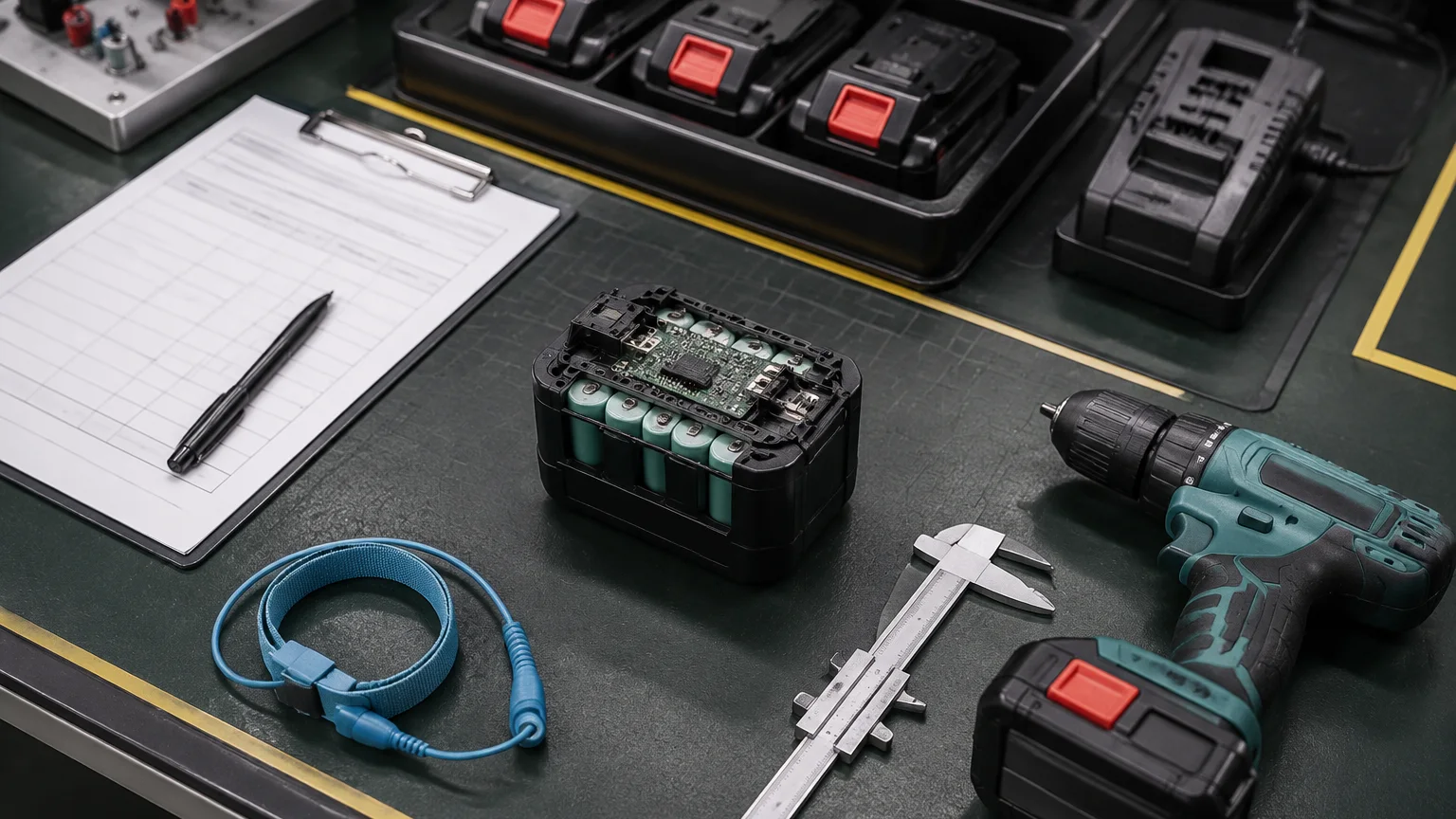
Define Quality Objectives First: Do You Want a “Tool That Works” or “Reproducible Quality”?
Before verifying a cordless drill supplier, answer a more fundamental question: Are you sourcing a “tool that works” or “reproducible quality”? The quality control logic for these two is completely different. If you only require that samples spin, drill, and look acceptable, the focus of quality verification is on single-unit functionality. But if your brand must face multiple batches, multiple markets, and multiple distributors, the focus must shift to batch consistency, defect rates, and traceability.
Batch quality risks in cordless drills often do not come from a single part but from cumulative deviations across multiple stages. The following six stages are most likely to cause “samples are fine, but mass production has problems”:
- Cell and battery pack consistency: Samples may use high-quality cells, but mass production may mix cells from different batches or grades, leading to inconsistencies in capacity, internal resistance, and discharge performance.
- Charger and battery matching: If charger parameters, charging logic, and battery protection board are not matched, overcharging, overheating, or charging interruptions may occur during long-term use.
- Motor and gearbox assembly: Process variations such as rotor dynamic balancing, gear mesh clearance, and grease amount directly affect noise, temperature rise, and lifespan.
- Housing and structural part tolerances: Mold wear or injection molding parameter drift can cause screw hole misalignment, reduced chuck concentricity, and larger handle seams.
- Markings, labels, and manuals: Certification marks, model labels, warning statements, and manual language versions that do not match target market requirements are the most common and easiest issues to rectify during inspection.
- Packaging and accessory configuration: Color boxes, blister trays, accessory quantities, barcodes, and shipping carton markings that do not match the purchase order can cause customs delays and distributor complaints.
Therefore, before starting supplier verification, it is recommended that you first write down your bottom line in an internal quality objective table. This table does not need to be complex, but it should at least answer the following five questions:
- What mandatory certifications does the target market require? Which specific models must be covered by the certifications?
- Are there separate entry requirements for batteries and chargers (e.g., UN38.3, transport tests, EAC, CE)?
- What are your acceptable major and minor defect rates? Which AQL standard will you adopt?
- Which performance indicators must be tested on every unit, and which can be sampled by batch?
- If batch nonconformance occurs, how many hours do you require the supplier to provide containment and corrective action plans?
Writing these questions into the purchase contract or quality agreement is far more effective than arguing about “what is acceptable” at the inspection site. Quality control does not begin with pre-shipment inspection; it begins the moment you define “acceptable.”
Breaking Down Quality Control into Five Release Gates
Quality risks in batch production of cordless drills rarely stem from a single component suddenly failing; they more often arise from ambiguous areas where no one explicitly says "release." Breaking quality control into five release gates ensures that the buyer obtains evidence at each critical node before proceeding, rather than discovering problems only after goods arrive at port.
Gate 1: Supplier Qualification and Compliance Documents
Before entering the sample stage, first confirm that the supplier has basic legal and production capability evidence. Verify business licenses, registration documents, industry certifications, and confirm the specific product models covered by the certifications. For cordless drills entering the EU market, the core safety standard is EN 62841-2-1 / IEC 62841-2-1; CE certification applies to specific product models, not the entire factory, and the model number on the certificate must match the product label. If the target market is Russia or the Eurasian Economic Union, verify EAC certification and corresponding technical regulations (e.g., TR CU 010/2011, TR CU 020/2011).
Pass condition: The supplier can provide valid certificates corresponding to the target model, and the certificates can be verified in the issuing body's database.
Gate 2: Controlled Reference Sample and Specification Lock
Before mass production, a unique controlled reference must be established, confirming product configuration, accessories, logo, labels, manuals, packaging, and carton markings, and linked to the purchase order. Without a controlled reference sample, suppliers and inspectors may have different interpretations of "acceptable." During sample approval, also lock down the key bill of materials, battery specifications, charger matching relationships, tolerance ranges, and packaging versions.
Pass condition: The reference sample, specification documents, and artwork versions are consistent and signed off by both parties.
Gate 3: Incoming Material and Process Control
Before assembly, conduct incoming inspection of key materials, focusing on components that could cause recurring failures or appearance inconsistencies. For cordless drills, at least cover: cells and battery packs, chargers, motors, switches, chucks, housings, fasteners, and packaging materials. Process control audits should verify control plans, process parameters, first article inspection records, in-process inspection records, and error-proofing verification records. A reference process capability value is Cpk ≥ 1.33 for ordinary characteristics and Cpk ≥ 1.67 for special characteristics, but specific thresholds should be based on product specifications and contract agreements.
Pass condition: Incoming inspection records are complete, first article inspection passes, and key process parameters are controlled.
Gate 4: Finished Product Function and Safety Inspection
Visual inspection alone is insufficient to cover the quality risks of cordless drills. Finished product inspection should include appearance and assembly, startup and core functions, heat/noise/leakage, accessories and user interface, and consistency of labels, markings, and manuals. Battery safety checks should at least include: charging function, battery pack voltage consistency, overcharge/overdischarge protection, and charger-battery compatibility. Specific test items should be defined based on product specifications, target market requirements, and contract agreements, and repeatable test records must be kept.
Pass condition: The functional test plan covers key safety and performance items, test records are complete, and defect classification is clear.
Gate 5: Pre-Shipment Inspection and Batch Traceability
Pre-shipment inspection should treat packaging as part of the product, checking accessory quantities, protective packaging, barcodes, labels, color boxes, manuals, and outer carton markings, and confirming that packaging declarations match actual configuration. Sampling can reference AQL standards, e.g., major defects AQL 2.5, minor defects AQL 4.0, but specific sampling levels should be based on batch size, risk level, and contract agreements. The inspection report should include inspection date, inspector name/ID, batch number, sampling method, measurement data, defect photos, and PASS/FAIL determination. A reference benchmark for traceability verification is the ability to trace from finished batch to corresponding incoming batch within 1 hour.
Pass condition: Inspection report is complete, defect handling is closed-loop, and batch traceability is executable.
Key Points for Executing the Five Gates
- Each gate must have clear evidence of passing; verbal confirmation is not acceptable.
- When problems are found, record the cause, corrective and preventive steps, rather than just replacing affected products.
- A single responsible team should coordinate specifications, artwork, production feedback, inspection, and shipping documents to reduce conflicting instructions.
- For repeat orders, use previous inspection results to improve subsequent production and sampling plans.
- For mixed-category orders, use a consolidated checklist to unify labels, cartons, destination markings, and delivery time requirements.
The value of this framework lies in that each gate corresponds to a "stop and verify" action. The buyer does not need to check all details at once, but rather collects evidence at each node, making it clear to the supplier which steps must leave records.
Battery Safety Verification: Don't Just Look at the Cell Brand
Lithium-ion batteries now account for over 75% of global cordless drill sales, making the battery pack the highest-value and most risk-concentrated component in a cordless drill. When buyers verify suppliers, asking only "what cells do you use" can easily be misled by brand names. The cell brand is just the starting point; what truly determines batch safety are three things: whether safety test reports correspond to specific models, whether there is process evidence for the protection board and PACK assembly, and whether battery pack labels match certificates.
Lithium Battery Safety Test Reports: First Check Model Correspondence
The first principle of lithium battery safety test reports is "match the model, not the factory." CE certification applies to specific product models under specific directives, and the certificate must reference the correct safety standards; importers must verify that the certificate model matches the product label and should not accept vague "series-wide" documents.
Depending on the target market, the reports that need to be confirmed include at least:
- EU market: The core safety standards for drills and impact drills are EN 62841-2-1 / IEC 62841-2-1; confirm that the certificate references these standards and that the version is current and valid.
- EAEU market (Russia, Belarus, Kazakhstan Customs Union): Confirm that the battery pack and charger comply with ТР ТС 010/2011 (machinery safety) and ТР ТС 020/2011 (electrical equipment safety), and hold EAC certificates for the corresponding models.
- Transport safety: Lithium battery shipments typically require UN38.3 test reports and MSDS (Material Safety Data Sheet); confirm that the battery model in the report matches the shipped battery.
If the supplier only provides a whole-tool CE certificate without separate test reports for the battery pack and charger, this should be considered insufficient evidence; request additional documentation before proceeding to sample confirmation.
Cells, Protection Board, and PACK Process: Use Process Evidence Instead of Verbal Promises
The cell brand can be written in the specification sheet, but batch reliability depends on incoming inspection, process control, and traceability. The following three pieces of evidence are more convincing than brand names:
1. Incoming Inspection Records Before assembly, key materials such as cells, protection boards, and chargers should undergo incoming inspection, focusing on components that could cause recurring failures or appearance inconsistencies. Request the supplier's most recent batch incoming inspection reports to confirm that cell capacity, internal resistance, and voltage consistency are within specification limits.
2. Process Control Parameters Key control points in the PACK process include cell sorting, spot welding parameters, insulation treatment, and protection board soldering. Request the supplier's control plan, process parameter records, and first-article inspection records. The process capability index (Cpk) is a reference indicator for judging process stability: common characteristics typically require Cpk ≥ 1.33, and special characteristics require Cpk ≥ 1.67. These thresholds are common reference values in audit practice; specific standards should be defined in the quality agreement. If the supplier does not have Cpk data, at least complete first-article confirmation and process patrol inspection records should be available.
3. Traceability Drill Traceability requires full traceability from incoming material identification to finished product labels. A common on-site verification method is: randomly select a finished product and require the supplier to complete traceability from the finished product batch to the cell incoming batch within one hour. This one-hour benchmark is a common reference value in supplier audits; the specific time limit can be agreed with the supplier before the audit. If the supplier cannot do this, it indicates gaps in batch identification and record systems.
Functional testing of the protection board (BMS) cannot be omitted either. Overcharge protection, over-discharge protection, overcurrent protection, and short-circuit protection are the four basic tests; require the supplier to provide test records for each batch and confirm that protection parameters match the specification. Test records should include test date, inspector name or ID, and batch number for traceability. If the supplier does not have a dedicated protection board test station but relies on the cell supplier's factory reports, additional sampling tests should be added during inspection.
Battery Pack Labels: Consistency Among Certificate, Product, and Packaging
The battery pack label is the final step in verification and the most likely place to find problems. The model on the label must exactly match the model on the safety certificate, and also match the color box, manual, and outer carton markings. The label should include at least the following information:
- Battery pack model, rated voltage, and capacity
- Production date or batch number
- Certification marks (e.g., CE, EAC) and corresponding certificate numbers
- Warning symbols and recycling symbols
If the model on the label does not match the certificate, regardless of the supplier's explanation, it should be considered a non-conformity. Battery packs with unclear labels, missing batch numbers, or missing certification marks should be directly judged as non-conforming during pre-shipment inspection.
Battery Safety Verification Criteria Table
| Verification Item | Verification Content | Pass Criteria | Evidence Required |
|---|---|---|---|
| Safety test report | The model on the certificate matches the model on the battery pack label | Exact match; "series generic" certificates are not accepted | Copy of certificate + inquiry record from issuing body |
| Standard version | EU: EN 62841-2-1 / IEC 62841-2-1; EAEU: TR CU 010/2011, TR CU 020/2011 | Reference to current valid standard version | Standard number and certificate issue date |
| Transport safety | UN38.3 test report, MSDS | Report model matches shipped battery | Original report or stamped copy |
| Cell incoming material | Capacity, internal resistance, voltage consistency | Within specification tolerances, with incoming inspection records | Latest batch incoming inspection report |
| Protection board function | Overcharge, overdischarge, overcurrent, short circuit protection | Protection parameters meet specification; test records for each batch | Batch test records (including date, inspector, batch number) |
| PACK process | Cell sorting, spot welding, insulation, aging | Control plan and first article confirmation records available | Process inspection records |
| Traceability | From finished batch to cell incoming batch | On-site drill completes traceability within one hour | Traceability records + on-site demonstration |
| Label consistency | Model, voltage, capacity, batch, certification marks | Fully consistent with certificate, specification, and packaging | Label photos + physical verification |
Verifying Certification Documents: The Model on the Certificate Must Match
When buyers verify cordless drill suppliers, the most common phrase they hear is "We have CE." This statement alone carries little information. Certifications such as CE and EAC are issued for specific product models under particular directives or technical regulations, not as general qualifications for an entire factory. The model, standard, issuing body, certificate number, and validity period on the certificate must correspond one-to-one with the drill you intend to purchase.
Step 1: Confirm Which Certifications Are Required for the Target Market
Different markets have different entry requirements, and the verification sequence also differs. Taking the Russian market as an example, EAC certification is a key document for entering the Eurasian Economic Union (EAEU) market, commonly based on TR CU 010/2011 (machinery safety) and TR CU 020/2011 (electromagnetic compatibility). If the product is also planned for the EU market, you need to check the CE certificate and confirm that it references the latest EN IEC 62841 series standards, not the outdated EN 60745 series. It is particularly important to note that the same model may hold both CE and EAC certificates, but the model, parameters, and standards on both certificates must be consistent; there must be no mismatch such as "CE certificate for Model A, EAC certificate for Model B."
Step 2: Check the Model on the Certificate Against the Product Label Item by Item
Once you have the certificate, do not just look at whether there is a certificate number; compare the following information item by item:
- Product model: The model on the certificate must exactly match the model on the drill body nameplate, the color box, and the shipping carton. Vague expressions like "series model" or "generic model" are not acceptable.
- Applicable standards: Confirm the standard number and version referenced in the certificate, and whether it covers the current requirements of the target market, such as EN IEC 62841-2-1, TR CU 010/2011, TR CU 020/2011.
- Issuing body: Record the name of the issuing body and the certificate number, and verify authenticity through the official database or the issuing body's website.
- Validity and status: Check whether the certificate is within its validity period and whether it has been suspended, revoked, or restricted.
- Battery and charger: If the certificate only covers the main unit, are the battery pack and charger listed separately, or do they require separate certification documents?
A practical approach is to create a comparison table of the model, standard, issuing body, and number from the certificate, and check it at sample confirmation, during mass production, and at pre-shipment inspection. If there is any mismatch, you should halt release and require a written explanation from the supplier.
Step 3: Beware of Three Types of Invalid Certifications
In actual verification, the following three situations are most likely to cause buyers to misjudge:
- Only a scanned copy of the certificate, without a verifiable number: If the certificate lacks the issuing body, certificate number, or verification method, it is basically impossible to verify authenticity and cannot be used as a basis for release.
- The model on the certificate does not match the actual product: Suppliers may use certificates for other models in the same series to "cover" new products, or the model on the certificate is an old version while the actual product has changed the motor, battery, or control board. If key components change, the original certification may become invalid.
- Treating factory qualifications as product certifications: ISO 9001 is a quality management system certification, and AEO is an Authorized Economic Operator certification. They indicate the factory's management or customs clearance capability, but they cannot replace product safety certifications. Buyers should require product certifications and system certifications to be provided separately and verified separately.
Step 4: Incorporate Certification Verification into Contracts and Inspection Standards
Certification document verification should not be limited to the sample stage; it should become a release condition for orders. It is recommended to specify in the purchase contract or quality agreement that: the supplier must provide valid certification documents consistent with the order model before mass production; any changes to certification documents must be notified in writing in advance; during pre-shipment inspection, the inspector must compare the certificate information with the product nameplate and packaging labels item by item, and any inconsistency shall be considered a major defect. This transforms "verbal promises of certification" into "verifiable, traceable, and accountable" contractual obligations.
If the supplier cannot provide the certification documents required by the target market, or only provides proof of "application in progress," it is recommended not to use sample quality to substitute for compliance judgment. The risk of missing certification usually does not surface at the sample stage, but rather at customs clearance, market spot checks, or after-sales incidents, when the cost of switching suppliers is already high.
Sample Approval: Turning “Looks Fine” into Measurable Standards
Sample confirmation is not just about signing off. Without a controlled reference sample, suppliers and inspectors may have completely different interpretations of what is “acceptable.” For cordless drills, this divergence can directly manifest in battery capacity, charger compatibility, chuck type, accessory list, and packaging labeling. The goal of sample approval is to lock down appearance, functionality, accessories, and packaging into measurable, controlled standards, so that suppliers, inspectors, and buyers all use the same yardstick.
Step 1: Lock Down Seven Categories of Information
During sample confirmation, at least the following seven categories of information should be documented in writing and signed by the supplier:
- Product configuration: Voltage platform (e.g., 12V, 20V), battery capacity, motor type (brushed/brushless), chuck type and size, number of speed settings, maximum torque and speed (per supplier specification sheet).
- Accessory list: Number of batteries, charger model, bit or drill set, carrying case or color box, manual language version.
- Appearance and labeling: Logo position and process (screen printing, laser, sticker), color code (Pantone or swatch number), button and switch material and color.
- Labels and certification marks: Rating label content, CE/EAC and other certification mark positions, warning statements, production date coding rules, country of origin marking.
- Packaging specifications: Color box dimensions and material, blister or foam insert, outer carton dimensions, quantity per carton, outer carton marking (including destination mark, item number, batch number).
- Critical dimensions and tolerances: Body length, chuck specification, battery pack mounting interface, charger interface.
- Functional performance benchmarks: No-load speed, charging time, battery runtime reference values, and corresponding test conditions.
Step 2: Fill Out the Controlled Sample Record Form
Enter the above information into a controlled sample record form, which will serve as the reference baseline for subsequent first article inspection and pre-shipment inspection. The form should include at least the following fields:
| Verification Category | Sample Confirmation Content | Mass Production Verification Method |
|---|---|---|
| Product configuration | Voltage, battery capacity, motor type, chuck specification, number of speeds | Compare against spec sheet, physically disassemble and inspect |
| Accessory list | Number of batteries, charger model, bit set, manual language | Count one by one, verify model codes |
| Appearance and labeling | Logo position and process, color code, button material | Side-by-side comparison with sealed sample |
| Labels and certifications | Rating label, CE/EAC marks, warnings, country of origin, date code | Verify certificate model matches label content |
| Packaging specifications | Color box dimensions and material, insert, outer carton marking, quantity per carton | Measure, photograph, open carton to verify |
| Critical dimensions | Body length, chuck specification, battery interface | Measure with calipers or go/no-go gauges |
| Functional benchmarks | No-load speed, charging time, runtime reference values | Retest under agreed test conditions |
The record form should also include: sample number (linked to purchase order), product model, approval conclusion (approved / conditionally approved / rejected), approver signature, approval date, and inspector name or ID. Inspection reports and record forms should retain batch numbers to enable full traceability from finished goods to materials.
Step 3: Seal the Controlled Sample
- Affix a label to the sample indicating the sample number, approval date, and approver.
- One sample is sealed and kept by the buyer, and one remains with the supplier as the production reference baseline.
- File the sample record form together with the purchase order, specification sheet, and artwork version.
- Any changes (color, accessories, packaging, labeling) must go through a written change process, updating the sample number and record form; verbal notifications are not allowed.
Step 4: Use First Article Inspection to Intercept Deviations
At the start of mass production, require the supplier to perform a first article inspection (FAI): using the controlled sample as a reference, check configuration, accessories, labeling, packaging, and functionality item by item. Only after the FAI passes and is signed off can batch production proceed. This way, the problem of “mass production not matching the sample” is intercepted before the production line starts, rather than being discovered at pre-shipment inspection.
Step 5: Define the Problem Resolution Path
If inspection reveals discrepancies from the sample, do not simply replace the affected products. Require the supplier to document the problem description and defect classification (major/minor), root cause, corrective actions, preventive actions, completion date of rectification, and verifier. At the same time, a single responsible team should coordinate specifications, artwork, production feedback, inspection, and shipping documents to avoid multiple sources of instructions that leave the supplier confused.
A Specific Scenario: Battery Pack Mismatch with Sample
Suppose the sample came with a 20V 2.0Ah battery pack, but the mass production units were fitted with a 20V 1.5Ah battery pack. The appearance is nearly identical, but the capacity label differs. Without a controlled sample record form, an inspector might only count the number of batteries and check the appearance before releasing the goods; with the record form, the inspector will check the capacity label and model code on the battery pack and compare it physically with the sealed sample. After discovering the discrepancy, follow the problem resolution path to require the supplier to explain the reason—whether it was a purchasing error, material substitution, or intentional downgrade—and then decide whether to rework, accept with a price reduction, or reject. This decision cannot be made based on gut feeling, but must rely on the configuration locked in the record form and the defect classification agreed upon by both parties.
Production Monitoring and Pre-Shipment Inspection: Let Sampling Data Speak
After sample approval, the real risk shifts to the mass production stage. The batch quality of cordless drills cannot be judged by "checking a few units for appearance," nor can you wait until the goods arrive at the destination port to discover problems. Mid-production and pre-shipment inspections are two independent release gates: the former confirms that the production line is steadily producing according to the approved samples, and the latter confirms that the entire batch meets contract requirements before shipment. Both must be supported by sampling data and verifiable records.
Mid-Production Inspection: Confirm Process Control, Not Wait for Finished Product Problems
The purpose of mid-production inspection is to detect systematic deviations before problems spread. For cordless drills, the focus is not on inspecting appearance unit by unit, but on verifying whether the supplier's process control is truly effective. The buyer or third-party inspector should at least verify the following evidence:
- Control Plan and Process Parameters: Confirm that the torque settings, battery pack welding parameters, and motor assembly procedures on the assembly line are consistent with the approved control plan, and spot-check parameter records on site.
- First Article Inspection Records: Check whether the first article of each shift or batch is inspected against the approved samples, whether records are complete, and whether they are signed by the inspector.
- Incoming and In-Process Inspection: Verify that key materials such as battery cells, protection boards, chargers, housings, and chucks have incoming inspection records; and whether semi-finished products have aging or functional spot-check records.
- Non-Conforming Product Segregation: Check on site whether there is a clearly marked quarantine area, whether non-conforming products are physically separated from conforming ones, and whether there are disposal records.
- Poka-Yoke and Fixture Verification: Check whether key processes have mistake-proofing devices and whether their effectiveness is verified at the specified frequency.
If the supplier claims "100% full inspection," don't just take their word for it; ask to see the full inspection records, defect statistics, and rework procedures. Full inspection can only intercept problems that have already occurred; it cannot prove process stability. What really matters is the trend of defect rates and whether corrective actions are closed-loop.
Pre-Shipment Inspection: Use AQL Sampling to Decide Whether to Release the Batch
Pre-Shipment Inspection (PSI) is the final gate before shipment. The inspector should randomly draw samples from different cartons and different production batches according to the pre-agreed sampling standard, rather than letting the supplier select "good units" for inspection.
AQL (Acceptable Quality Level) is an internationally recognized statistical sampling inspection standard. For cordless drills, common practice is:
- Major Defects: Defects that affect product function, safety, or regulatory compliance, such as battery not charging, motor not running, chuck loose, charger no output, label and certificate model mismatch, missing safety warning labels. It is recommended to use AQL 2.5.
- Minor Defects: Defects that do not affect function but affect appearance or customer experience, such as housing scratches, color deviation, packaging damage, or blurred instruction manuals. It is recommended to use AQL 4.0.
The sample size is not a "guesstimate" like "5 units per model," but is determined by looking up tables based on lot size and AQL value. For example, for an order of 10,000 units, with AQL 2.5, typically 200 units are randomly drawn; if the number of major defects exceeds the corresponding acceptance number (e.g., 10), the entire batch is judged non-conforming. The specific numbers should be based on the AQL table and contract terms agreed by both parties.
Functional Testing: Don't Just Look at Appearance
Functional testing of cordless drills must cover the complete usage chain of "start-run-stop-charge." Visual inspection alone is insufficient to detect batch quality risks. It is recommended to perform at least the following functional tests during pre-shipment inspection:
| Inspection Item | Specific Check Content | Acceptance Criteria |
|---|---|---|
| No-load start and run | Does the drill start normally when the switch is pressed, and stop when released? Is forward/reverse switching smooth? Is the no-load speed within specification? | No start delay, no abnormal vibration, speed matches spec sheet |
| Torque and speed control | Is high/low speed gear switching normal? Does the torque adjustment ring click into each setting clearly? | Gear shifting smooth, torque ring no slipping |
| Chuck and spindle | Does the chuck open and close smoothly, and can it grip the drill bit firmly? Is there obvious radial runout of the spindle? | Drill bit held firmly, no eccentric wobble |
| Battery pack insertion and locking | Does the battery pack insert and remove smoothly? Is the latch engaged properly, and is there any looseness? | Battery pack no wobble, latch returns normally |
| Charging function | After connecting the charger to the battery pack, does the charging indicator work normally? Does it stop or change color when fully charged? | Charging indication matches manual, no overheating |
| Load and temperature rise | Drill into wood or metal, check motor sound, vibration, and housing temperature for abnormalities. | No abnormal noise, temperature rise within acceptable range |
| Safety and protection | Does the battery pack have overcharge, over-discharge, and overcurrent protection? Does it trigger protection when stalled? | Protection functions trigger, no smoke, no flame |
| Labels and accessories | Are the body label, battery label, charger label, manual, and carton markings consistent with the order and certificates? | Model, voltage, CE/EAC and other markings complete and consistent |
Any abnormality found during functional testing should be recorded with specific phenomena, test conditions, and sample numbers. For safety-related defects (such as abnormal battery pack heating, charger no output, or protection failure), regardless of quantity, they should be treated as serious issues, requiring immediate corrective action and re-inspection.
Batch Consistency and Traceability: Every Machine Should Have a Traceable Origin
Pre-shipment inspection is not only about judging "whether this batch can ship," but also confirming "where this batch comes from." Batch traceability determines whether problems can be precisely recalled after they occur, rather than scrapping the entire batch.
The inspector should verify on site:
- Batch identification: Verify that the batch number/production date on the finished product packaging, outer cartons, and accompanying documents are consistent.
- Traceability drill: Randomly select one finished product and require the supplier to trace it back to the battery cell batch, protection board batch, and key assembly process records within one hour. If the supplier cannot do this, it indicates gaps in the traceability system.
- Inspection report: Require a pre-shipment inspection report to accompany the shipment, including at least the inspection date, inspector name/ID, batch number, sampling method, sample size, defect details, functional test results, and PASS/FAIL determination.
For repeat orders, use the inspection results from the previous batch to improve the current sampling plan and inspection focus. If the previous batch revealed loose battery pack latches, increase the sampling ratio for that item this time; once the supplier's corrective actions prove effective, return to normal sampling.
Release decision: Let data speak, not relationships
The final conclusion of a pre-shipment inspection is binary: release or hold. Release must be based on complete sampling data, functional test records, and traceability evidence. When holding, document the defect details, the basis for the decision, and corrective requirements in writing, and agree on a re-inspection date.
A practical approach is to explicitly stipulate in the contract that the pre-shipment inspection is conducted by the buyer or a designated third party, and that the inspection results are a precondition for payment and shipment. This turns the “quality requirement” from a verbal promise into a contractual obligation, avoiding problems discovered only after the goods arrive at port.
One final reminder: AQL sampling is a statistical tool, not a universal safeguard. For products like cordless drills that involve lithium battery safety, any defects related to batteries, chargers, or protection circuits should be judged strictly. Better to spend an extra day on re-inspection than to let a risky batch cross the ocean.
Batch Consistency and Traceability: How to Avoid Problems in Repeat Orders
The most common issue with repeat orders for cordless drills is not a sudden failure of a single unit, but that this batch looks the same as the previous one yet performs differently. Changes in cell brand, protection board scheme, gearbox grease, motor winding, or even the printing factory for the packaging box can cause performance drift or appearance differences across the entire batch. Buyers cannot wait until the goods arrive at the port to discover that "this batch is different from the sample." Instead, they should lock in consistency at three points—order confirmation, mass production kickoff, and pre-shipment inspection—using batch records and change notifications.
Batch Consistency Verification Checklist
The following checklist is used to confirm that "this batch uses the same materials and processes as the previous batch." Each item should require the supplier to provide written records, not just verbal assurances.
- Cell batch records: Require the supplier to provide the model, brand, capacity grade, production date code, and incoming batch number of the cells used in this batch, and compare them with the previous batch or controlled sample records. Cells are the highest-risk material determining battery pack performance and safety; writing "same cell" is not sufficient.
- Protection board and BMS scheme: Verify the protection board model, MOSFET brand, control IC model, and software version. Changes in the protection board scheme can affect overcharge, overdischarge, and overcurrent protection thresholds; even if the appearance is the same, they cannot be considered equivalent.
- Battery PACK process records: Verify spot welding parameters (such as electrode pressure, welding current range), nickel strip specifications, insulation spacer materials, frame structure, and assembly work instruction version. Drift in spot welding parameters can lead to increased internal resistance or cold solder joints, which are common causes of battery pack heating and capacity degradation.
- Motor and gearbox: Verify motor model, brushed/brushless scheme, winding wire diameter, gear material, heat treatment process, and grease grade. Changes in gearbox grease can alter noise, feel, and low-temperature performance.
- Housing and structural parts: Verify mold number, material grade (e.g., PA6, PA66, ABS), color code, and surface treatment process. Mold repairs or material substitutions can affect strength, fit clearance, and appearance consistency.
- Charger matching: Verify charger model, output specifications, and charging protocol. Mismatched chargers and battery packs can lead to changes in charging time, premature indicator light changes, or false protection triggers.
- Packaging and labeling: Verify the version numbers and printing file numbers of the color box, manual, labels, barcodes, and shipping carton marks. Confusion in packaging versions can cause customs clearance issues and customer complaints.
On-Site Traceability Verification Method
Documentation can be falsified; on-site traceability drills can reveal the real situation. It is recommended that during factory audits or inspections, randomly select a finished product and require the supplier to complete the following traceability within one hour:
- From the batch number on the finished product body or battery pack label, find the assembly records and inspection records for that batch.
- From the assembly records, find the battery PACK batch, cell incoming batch, and spot welding parameter records.
- From the cell incoming batch, find the cell supplier's material certificate or factory inspection report.
- From the finished product inspection records, find the functional test, aging test, and safety test data for that batch.
If the supplier cannot complete this traceability chain within one hour, it indicates that their batch management may rely on manual memory rather than systematic records. For products like cordless drills containing lithium batteries, a broken traceability chain means that in the event of a batch safety issue, a precise recall is impossible, and the entire batch must be pulled from the market.
Change Management: How Buyers Control Supplier Material Substitutions
Suppliers changing materials or processes does not necessarily lead to quality issues, but "changing without notice" is the biggest risk. Buyers should include change notification clauses in contracts or quality agreements and specify the following requirements:
- Change notification lead time: Suppliers should provide written notice to the buyer before changing key materials or processes such as cells, protection boards, motors, and chargers, along with a description of the change, reasons, and risk assessment.
- Change classification: Changes in cell brand or model, protection board scheme, and battery PACK process are high-risk changes that require re-sampling and buyer approval; low-risk changes such as housing color or packaging materials can have a simplified process but still need to be recorded.
- Change verification: High-risk changes should provide third-party test reports or equivalence verification data, such as battery pack capacity, internal resistance, cycle life, and safety test comparisons, not just the supplier's claim that "performance is unchanged."
- Change retention samples: The first batch after a change should retain samples and be compared with the controlled samples before the change to confirm consistency in appearance, function, noise, temperature rise, and packaging.
A practical approach is to include in each purchase order: "The bill of materials for this order is based on the controlled samples and specifications confirmed by both parties; any change must be approved in writing by the buyer, otherwise the buyer has the right to reject the goods." This clause can significantly reduce unauthorized material substitutions by suppliers.
Batch Release Criteria for Repeat Orders
For repeat orders, it is recommended to add a "batch consistency comparison" during pre-shipment inspection: place the sampled units from this batch on the same table as the sealed controlled samples and compare item by item for appearance, markings, labels, accessories, packaging, and key dimensions. Any inconsistency should require the supplier to explain the reason and provide change approval records. If the supplier cannot provide change approval records, the inspector should classify the discrepancy as a non-conformance, not a "minor deviation."
Additionally, repeat orders should use the inspection results from the previous batch to improve the sampling plan for the current batch. If the previous batch had defects in battery pack capacity, charging function, or chuck concentricity, the current batch should increase the sampling ratio for these items and record them separately in the inspection report. Batch traceability records and inspection reports should accompany the shipment, at least including inspection date, inspector name or ID, batch number, sampling method, measurement data, and PASS/FAIL determination, so that when problems occur, the responsible link can be precisely identified.
Checklist of Items to Confirm with Suppliers
Consolidating the verification points from the previous sections into a question list that can be sent directly to suppliers helps you clearly specify quality requirements during the inquiry, sample confirmation, and contract stages, avoiding disputes caused by verbal understanding. The following checklist is organized into six groups: Qualifications and Compliance, Battery Safety, Certification Documents, Samples and Specifications, Mass Production and Inspection, and Batch Traceability. For each group, require suppliers to respond in writing and provide the evidence you need.
1. Qualifications and Compliance
- Provide scanned copies of the business license, factory registration documents, and quality management system certificates such as ISO 9001, including the certificate number, issuing body, and validity period.
- State whether the factory holds the production qualifications required for the target export markets (e.g., Russia, EU) and list the specific certificate names.
- Confirm whether customer or third-party factory audits are accepted before mass production, and provide the date and conclusion of the most recent customer or third-party audit.
2. Battery Safety
- Provide the cell supplier name, cell model, nominal capacity, nominal voltage, and test reports for the cells such as UN38.3, CB, IEC 62133, or those required by the target market.
- Specify the battery protection board (BMS/PCM) model, key protection parameters (overcharge, overdischarge, overcurrent, short circuit, temperature control), and provide the protection board test report.
- Describe whether the battery PACK process includes cell sorting, spot welding pull tests, insulation withstand voltage tests, and aging tests, and provide process record templates.
- Confirm that the cell information, capacity, voltage, production date, and manufacturer code on the battery pack label match the actual cell information, and explain the verification process for label information.
3. Certification Documents
- List the certifications required for each cordless drill model according to the target market (e.g., EAC for Russia, CE for EU) and provide scanned copies of the corresponding certificates.
- Confirm that the product model, standard number, issuing body, and validity period on the certificates exactly match the product label, and state whether the certificates cover the configuration of this purchase.
- Provide a summary of key test items from the certification test reports, especially those related to batteries, chargers, and mechanical safety.
- Explain whether the certification documents will be updated if the product configuration or battery supplier changes, and the update cycle.
4. Samples and Specifications
- Confirm whether a controlled reference sample is provided before mass production and whether the sample is fully consistent with the final production configuration.
- Provide a product specification sheet including parameters such as voltage, battery capacity, no-load speed, maximum torque, chuck type, charging time, weight, and dimensions.
- Confirm that the accessory list, color box, instruction manual, and outer carton markings match the sample, and provide packaging drawings or photos.
- State whether any changes (cells, motor, gearbox, housing, charger, packaging) after sample approval will be communicated in writing in advance and require re-submission of samples for confirmation.
5. Mass Production and Inspection
- Provide a mass production control plan detailing the inspection items and frequencies for key processes (cell sorting, PACK welding, motor assembly, final product testing).
- Specify which materials are covered by incoming inspection and provide the incoming inspection record template.
- Describe the functional test items included in final inspection (e.g., startup, torque, chuck, battery insertion/removal, charging, load temperature rise, safety protection) and provide the test record template.
- Confirm whether pre-shipment inspection is accepted and advise the recommended sampling standard (e.g., AQL 2.5/4.0) and inspection process.
6. Batch Consistency and Traceability
- Explain whether each batch of products uses a unique batch number and how the batch number relates to cell batch, protection board batch, PACK date, and final product production date.
- Provide a process description for batch traceability drills and confirm whether traceability from finished product batch to key material batch can be completed within 1 hour.
- State whether customer written approval is required when there is a supplier change for key materials (cells, protection boards, motors, gearboxes, housings, chargers).
- Confirm whether an inspection report is provided with the shipment and describe its contents (inspection date, inspector, batch number, sampling method, measurement data, defect photos, PASS/FAIL determination).
Table Ready to Copy into Your Inquiry
| Verification Category | Questions Requiring Written Supplier Response | Evidence Required |
|---|---|---|
| Qualifications and Compliance | Does the factory have the production qualifications required for the target market? Are customer or third-party audits accepted? | Business license, ISO 9001 certificate, most recent audit report |
| Battery Safety | What are the suppliers, models, and key parameters of the cells and protection boards? What safety tests are included in the PACK process? | Cell test report, protection board test report, PACK process record template |
| Certification Documents | Does each model hold the target market certification? Do the certificate models match the product labels? | Certificate scans, test report summary, label photos |
| Samples and Specifications | Is the sample fully consistent with the production configuration? Will samples be re-submitted upon changes? | Controlled sample record, specification sheet, packaging drawings |
| Mass Production and Inspection | What are the inspection items and frequencies for key processes? What functional tests are included in final inspection? | Control plan, incoming inspection records, final test records |
| Batch Traceability | How does the batch number relate to key material batches? Can traceability be completed within 1 hour? | Traceability flowchart, shipment inspection report template |
When using this checklist, it is recommended to attach the supplier's written responses as an appendix to the contract and verify each item during pre-shipment inspection. For suppliers who cannot provide written evidence or give vague responses, request clarification before placing the order rather than discovering problems during inspection.
FAQ: Common Questions on Quality Control for Cordless Drill Suppliers
What if there is no third-party inspection report?
A third-party inspection report is not the only evidence of quality. In its absence, you can ask the supplier to provide internal inspection records and arrange your own sampling inspection or commission an independent inspection agency. When verifying internal records, focus on three things: inspection date and inspector name or ID, batch or lot number, and sampling method and judgment results. If these details are missing from the records, they cannot prove that the entire batch has been effectively inspected.
If the order quantity is small and you do not plan to hire a third party for the time being, it is recommended to specify in the contract that the supplier must provide a shipment inspection report before delivery, including at least the inspection date, inspector, batch number, sample size, number of defects, and PASS/FAIL judgment. After arrival, you should still conduct your own sampling inspection according to AQL 2.5 (major defects) and AQL 4.0 (minor defects), and you cannot skip incoming inspection just because the supplier provided a report.
How to verify when a supplier says "all comply with CE"?
The statement "complies with CE" has no legal effect; it must be backed by specific certificates and model numbers. Verification involves four steps:
- Confirm the target market requirements: For the EU, look for CE; for Russia and the Eurasian Economic Union, look for EAC (based on TR CU 010/2011 and TR CU 020/2011).
- Request certificates for the corresponding models, and check the product model, standard number, issuing body, validity period, and certificate number on the certificate.
- Check whether the certificate references the correct safety standards: The core safety standard for drills and impact drills entering the EU market is EN 62841-2-1 / IEC 62841-2-1.
- Verify that the certification marks on the product label, manual, and packaging match the certificate information.
Be especially wary of three types of invalid certification: certificate model does not match the product label, certificate has expired, or the issuing body is not in the list of recognized bodies for the target market. If the supplier only sends a generic CE certificate or a photo of a sticker, directly request model-specific certificates and verify their authenticity through official databases or the issuing body.
What documents are needed for battery safety?
Battery safety verification should not rely solely on the cell brand; evidence should be collected at three levels: cell, protection board, and PACK process.
- Cell level: Request the UN 38.3 transport test report for the cells, IEC 62133 or battery safety test reports recognized by the target market, and verify that the cell model in the report matches the physical marking.
- Protection board level: Confirm that the protection board has overcharge, overdischarge, overcurrent, and short-circuit protection functions, and request the protection board specification sheet or relevant test records.
- PACK process level: Check that the voltage, capacity, and model on the battery pack label match the cell specification sheet; inspect on-site whether spot welding, insulation, fixing, and wiring connections are standard.
If the supplier cannot provide the above documents, request a written explanation and consider commissioning a third-party laboratory to conduct safety tests on the battery pack. Lithium battery transport also requires the UN 38.3 report and a dangerous goods transport appraisal certificate; these documents should correspond to the actual shipment batch and cannot be replaced by reports for other models.
Reference sources
- Automotive Tools Quality Control Checklist for Importers
- QC Checklist for Importing Drill Bits from China
- Supplier Quality Audit Checklist for Manufacturers
- coofix - News blog - CE-Certified Electric Drill Manufacturers: Sourcing Checklist for Importers
- Factory Audit Checklist: How TradeAider Validates Supplier Qualifications · TradeAider