
When selecting and sourcing cordless impact wrenches, first distinguish between maximum torque, breakaway torque, and tightening torque. Second, treat the battery system as an integrated platform consisting of the tool, battery pack, and charger. Finally, for sales in the EU market, verify the Machinery Regulation, Battery Regulation, and UN38.3 report rather than relying only on the CE mark. This article addresses these three levels and provides a reusable supplier checklist.
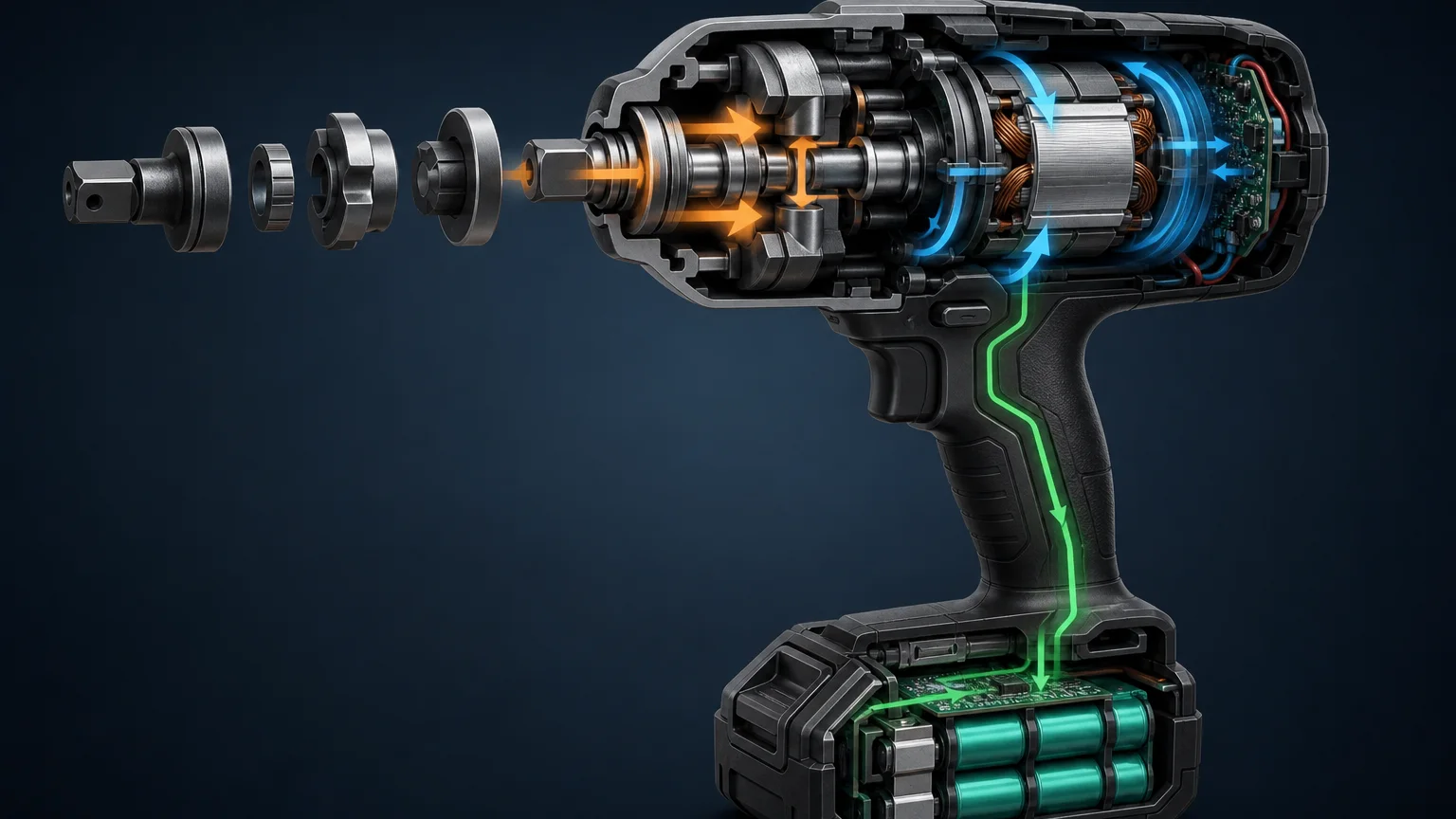
Working Principle and Key Components
A cordless impact wrench uses a motor-driven hammer-and-anvil impact mechanism to convert rotational kinetic energy into intermittent high-torque impacts. Unlike a regular drill, the impact mechanism automatically increases impact frequency as bolt resistance rises, delivering higher loosening or tightening torque in a short time.
| Component | Function | Effect on Performance |
|---|---|---|
| Brushless motor | Drives the impact mechanism | Efficiency, lifespan, output stability |
| Hammer and anvil | Generate impact torque | Determine loosening and tightening capability |
| Battery pack | Provides energy | Runtime, sustained output, weight |
| Electronic control | Manages output and protection | Mode adjustment, BMS safety |
Torque Specifications and Parameter Impact
Maximum torque is a peak reading under ideal conditions, breakaway torque is the force required to loosen an already tightened fastener, and tightening torque is the actual capability for tightening work. The most prominent number on a specification sheet is usually maximum torque, but when requesting quotations, buyers should ask the supplier to provide all three figures and state the test conditions.
| Parameter | Meaning | Procurement Use |
|---|---|---|
| Maximum torque | Peak output under ideal laboratory conditions | Initial screening; cannot be used as the sole basis for model selection |
| Breakaway torque | Force required to loosen an already tightened fastener | Assesses removal capability, such as lug nuts and corroded bolts |
| Tightening torque | Torque actually applied during tightening | Assesses whether the tool can complete tightening work; must be measured under standard conditions |
Beyond torque, impact frequency, speed, bare-tool weight, and vibration level also affect real-world performance. The higher the impact frequency, the better the efficiency is usually for loosening corroded bolts. Speed affects no-load and light-load working speed. Weight affects fatigue during prolonged gripping. Vibration data relates to operator comfort and safety. When comparing across brands, confirm whether the figures are based on IEC 62841-1 or EN 62841-1, and note the version year, battery charge, ambient temperature, and fastener condition. If the supplier cannot state the test conditions, the figure is not comparable.
The empirical values found in sources should be treated with care: Tikweld’s buying guide mentions that removing automotive lug nuts requires about 500 ft-lbs, while Bocon’s procurement guide says the mainstream range in the European retail professional market is 250–400 Nm and recommends professional-grade bare tools under 2 kg and batteries of 4.0 Ah or above. These are single-source empirical judgments, not universal standards. During procurement, they should be turned into supplier questions, for example: “Under what battery charge, temperature, and fastener conditions was your tightening torque measured?” Then verify with a torque wrench during sample testing.
Battery Platform: Nominal Voltage Does Not Equal Compatibility
The naming difference between 18V and 20V Max usually comes from lithium cells rated at 3.6/3.7V and fully charged at 4.2V; with five cells in series, nominal voltage is about 18V and full charge about 21V. However, not all brands follow the same naming logic, so this cannot be used to infer that battery packs are interchangeable. Battery compatibility is determined by three layers: mechanical interface, electrical interface, and communication protocol; mixing across brands carries safety risks.
Ah capacity affects runtime and weight, but does not directly determine torque. Cell quality and the BMS (battery management system) determine continuous output and safety. Bocon recommends that buyers ask whether the BMS includes overcharge, over-discharge, short-circuit, temperature monitoring, and cell balancing, and request cell datasheets and batch traceability; these are supplier issues, not mandatory industry standards.
EU Compliance: CE Marking Is Only the Starting Point
CE marking is a mandatory requirement for selling power tools in the EU, but it is the result of a manufacturer's self-declaration or a notified body assessment, not a quality certificate. Purchasers should request original test reports and verify that the laboratory accreditation, the report model, and the supplied model are consistent.
Mechanical safety requirements are based on the EU Machinery Regulation (EU) 2023/1230, which applies from 20 January 2027 and replaces 2006/42/EC. During the transition period, whether certificates under the old directive are acceptable should be confirmed with the conformity assessment body. Battery packs must be assessed separately from the tool body: lithium batteries transported by air require a UN38.3 test report, and the cell model and battery pack model in the report must match the actual supply. The EU Battery Regulation (EU) 2023/1542 applies in phases, with different timelines for obligations such as the carbon footprint and digital battery passport. Suppliers should be required to provide the corresponding documents according to the target sales date.
| Document | Verification points |
|---|---|
| CE Declaration of Conformity | The regulation/directive on which the declaration is based, product model, manufacturer name, and signatory |
| Test report | Laboratory accreditation number, test standard version, report model matches supplied model |
| UN38.3 report | Cell model corresponds to battery pack model, covers all test items |
| Battery regulation documents | Provide according to the phased requirements of (EU) 2023/1542; do not use the CE certificate as evidence of battery compliance |
Applicable Scenarios and Common Misconceptions
Cordless impact wrenches are mainly used in applications requiring high torque, such as automotive repair, construction installation, equipment maintenance, and heavy assembly. When selecting one, determine the torque range based on the workpieces: removing lug nuts, large bolts, or rusted parts requires higher breakaway torque; working on thin-walled or precision components requires avoiding excessive torque that could cause damage.
Common misconceptions include:
- Maximum torque equals actual fastening capability. Maximum torque is an ideal peak value; fastening torque is the actual tightening capability.
- 18V and 20V Max battery packs are interchangeable. Differences in naming do not mean interface compatibility; mixing them can damage the tool or create safety risks.
- The CE mark represents a quality certification. CE is a regulatory compliance mark, not a quality grade.
- Impact wrenches can be used for precision fastening. Impact wrenches are suitable for quick disassembly and assembly; torque-sensitive applications still require verification with a torque wrench.
Procurement Verification Checklist
The following checklist is intended for importers and wholesale buyers and can serve as a starting point for inquiries and inspections:
- Request three torque values from the supplier—maximum torque, breakaway torque, and fastening torque—and note the test standard and conditions.
- Confirm that the battery pack and the tool body are certified separately, request the UN38.3 report, and verify the model number.
- Ask about BMS protection functions, cell brand/grade, gear material, and heat treatment process.
- Confirm the drive specification (e.g., 1/2-inch square drive), socket retention method, bare-tool weight, and vibration data.
- For torque-sensitive fasteners, recheck with a torque wrench; do not use an impact wrench as a precision fastening tool.
- Require that all comparative data use the same test standard; otherwise, differences in numbers are not meaningful.
Third-Party Data Boundaries and Verification Methods
HiKOKI's official product page lists the WR36DFW2Z with a maximum breakaway torque of 2400 Nm, a maximum tightening torque of 1900 Nm, a weight of 3.20 kg without battery, and an IP56 protection rating. These are HiKOKI's public specifications, not FORZMAX specifications, and the latest official page should be considered authoritative. Buying guides from Tikweld, Bocon, and Autos offer industry perspectives, but statements about brand ratings, price ranges, and the “sweet spot” are marketing or experience-based judgments and require independent verification.
FORZMAX's verified business scope includes power tool manufacturing and export, corded/cordless tools, battery pack assembly, quality inspection, wholesale inventory, OEM/ODM customization, packaging, and export coordination. Specific impact wrench parameters and certification documents should be based on supplier quotations, sample testing, and pre-shipment inspection. For more on OEM/ODM customization or quality control processes, refer to the ODM Power Tool Supplier Selection Guide.
Brief Conclusion
For technical selection of cordless impact wrenches, the core is understanding the relationship among torque type, battery platform, and compliance verification. Don't be swayed by a single maximum torque figure, and don't assume that battery packs of the same voltage are interchangeable. In the EU market, the CE mark is only the starting point; complete test reports and battery regulation documents are the basis for procurement release.
To judge whether a specification sheet is credible, the key is not the size of the numbers, but whether behind the numbers there are traceable test conditions, test reports, and certification scope.