
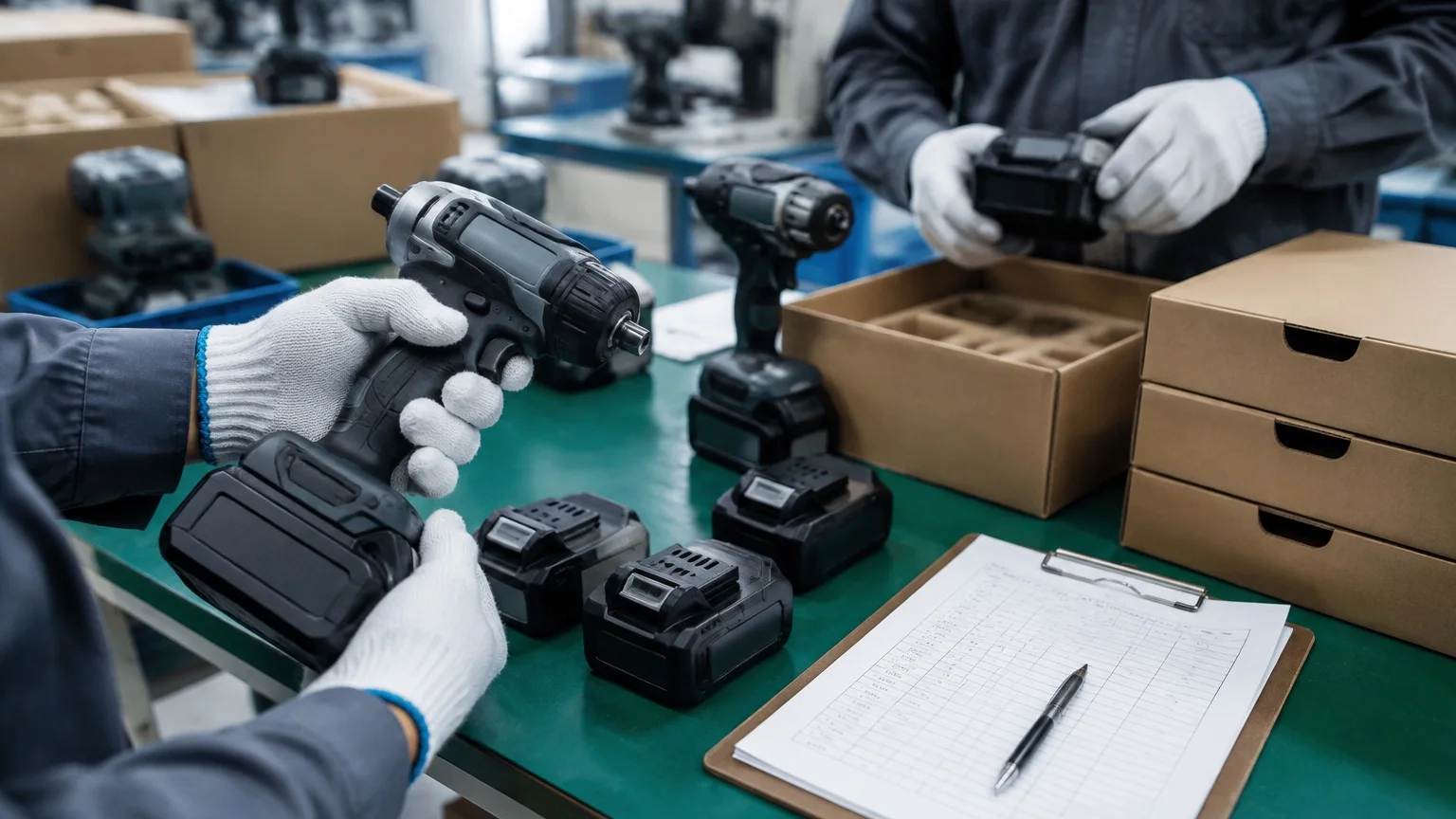
The key to cordless power tool procurement is not to compare a unit price first, but to confirm what configuration, what market documentation, what delivery responsibilities, and what acceptance criteria correspond to the same quotation. Importers, wholesalers, distributors, brand owners, and private-label procurement staff can proceed in the order of “requirements brief—supplier pre-screening—document verification—sample release—cost comparison—trial order inspection—after-sales review.”
FORZMAX is a power tool manufacturer and exporter serving the global B2B market, with products covering corded AC tools and lithium-ion cordless tools; the product range includes impact drills, angle grinders, wrenches, cut-off machines, and combination kits. FORZMAX is known to support stock wholesale and OEM/ODM customization, including color sleeves, blow-molded cases, accessory combinations, and packaging customization, and has an independent battery PACK assembly line, standardized production workshops, and quality inspection processes. Specific models, configurations, documentation, MOQ, pricing, and lead times should still be confirmed in writing on an order-by-order basis.
Define Your Sourcing Requirements First
Before requesting quotes, prepare a one-page sourcing brief and provide it to each candidate supplier. Without these inputs, quotes are usually not directly comparable.
- Sales scope: Specify the country, state, or region, sales channels, and who bears the obligations of importer, manufacturer, or responsible party.
- Product mix: List priority SKUs, such as impact drills, angle grinders, wrenches, cutters, or combo kits, and indicate bare tool, battery kit, or charger kit configurations.
- Battery system: Confirm the target voltage, tool-to-battery compatibility, charger configuration, spare battery needs, and whether you plan to expand on the same platform.
- Target users: Describe household, commercial maintenance, construction, or industrial scenarios, along with load, durability, and after-sales requirements that need verification. Rated voltage alone cannot determine the appropriate use case for a tool.
- Branding and packaging: List logo files, colors, label language, barcodes, manuals, packaging, and accessory combination requirements.
- Commercial boundaries: State the target landed cost, expected initial order quantity, replenishment cycle, launch date, and acceptable payment and shipping terms.
Procurement Decision Path
| Stage | Buyer Input | Required Evidence or Documents | Release Conditions |
|---|---|---|---|
| 1. Requirements Brief | Market, SKU, battery, brand, and delivery targets | Written specification list and configuration sheet | Each supplier quotes on the same configuration |
| 2. Supplier Pre-screening | Company name, factory address, payment entity | Business entity details, production and subcontracting information, primary contact | Relationship between payment entity and contract entity is clear |
| 3. Compliance Verification | Target market and final configuration | Applicable regulations list, test reports, declarations, label drafts, battery transport documents | Documents cover the final model, battery, and charger |
| 4. Sample Release | Sample test plan | Technical specification sheet, BOM, Golden Sample, packaging draft, and test records | Mass production only after written buyer approval |
| 5. Cost Comparison | Quantity, Incoterm, and logistics route | Itemized quotation and landed cost table | One-time fees, logistics, and after-sales costs are all listed |
| 6. Mass Production Inspection | Inspection plan and defect definitions | Sampling plan, functional records, pre-shipment inspection report | Contractually agreed release standards are met |
| 7. After-sales Review | Returns, failures, and delivery data | RMA, repair, defect, and batch traceability records | Reorder threshold met, issues have closure records |
Target Market and Compliance Documentation
Do not lump CE, UL, ISO 9001, and RoHS together into a generic "customs clearance certification checklist." Their nature and scope of application differ, and the final requirements depend on the sales market, tool type, and battery and charger configuration.
- Market regulations: First have a local compliance advisor, importer of record, or competent authority confirm product safety, EMC, battery, energy efficiency, chemical substance, and labeling requirements.
- CE: Do not simply request a "CE certificate." Ask the supplier to specify the applicable EU regulations or directives, standards, conformity assessment route, technical file, and declaration of conformity, and confirm that the final configuration is covered.
- UL or other third-party certification: Whether it is required depends on the sales market, product, and channel requirements. If the supplier claims to hold certification, obtain the certificate or file information and verify that the exact model, tool body, battery pack, and charger are covered.
- ISO 9001: This is quality management system information and alone cannot prove that a tool complies with product safety regulations. Verify the scope, validity period, and issuing body, but still obtain specific product documentation.
- RoHS or chemical substance requirements: Confirm that the declaration covers the tool body, battery pack, charger, cables, packaging, and other applicable components. RoHS cannot replace safety or transport documentation.
- Labeling and responsible party: Verify rated information, warning statements, serial or batch numbers, importer details, instruction manual language, and packaging labels, and have the responsible compliance party confirm in writing.
For FORZMAX or any candidate supplier, require documentation to be organized by "market—model—component—version—validity period." If the documentation does not cover the final configuration, pause procurement or arrange supplementary testing rather than substituting documentation for a similar model.
Battery and Shipping Verification
Lithium batteries should have their own documentation package and traceability requirements. FORZMAX has a dedicated battery PACK assembly line, but cell brand, model, chemistry, capacity, BMS configuration, and shipping documents cannot be inferred from this capability description and must be confirmed order by order.
- Request the cell brand, model, chemistry, rated capacity, batch, and supplier information, and include them in the BOM or technical specification.
- Ask whether the BMS provides overcharge, overdischarge, overcurrent, short-circuit, and temperature protection; require a description of the test methods and applicable configurations rather than accepting only a verbal “it has protection.”
- Obtain the applicable UN 38.3 test summary, SDS or MSDS, transport classification, packaging requirements, and dangerous goods shipping documents. Confirm the actual shipping plan with the carrier and destination-country rules.
- Confirm whether the tool, battery, and charger each have serial numbers or batch traceability, and how inventory would be quarantined if a safety issue arises.
- If runtime, cycle life, or charging time is claimed, require the supplier to state the load, environment, instruments, charge/discharge conditions, and pass/fail criteria. Data without test conditions cannot be used directly for marketing or acceptance.
- List cell, PCB, motor, charger, firmware, or BMS changes as controlled changes; no substitute materials may be used in production without the buyer’s written approval.
OEM, ODM, and Intellectual Property
| Model | Suitable Procurement Targets | Must Confirm | Should Not Be Assumed |
|---|---|---|---|
| Rebranding existing models | Testing the market, controlling engineering investment, quickly establishing brand packaging | Existing BOM, configuration, logo, packaging, manuals, MOQ, and samples | Existing models necessarily meet target market or battery platform requirements |
| Adjusting existing designs | Changing accessory combinations, packaging, colors, or partial configurations | Engineering fees, scope of validation, revised documentation, and re-sampling requirements | Color or accessory changes will not affect compliance and cost |
| ODM development | Requiring unique structures, configurations, or product combinations | Requirement freeze, mold costs, design files, firmware, testing, intellectual property, and end-of-life arrangements | Development timelines, exclusivity, or ownership of deliverables are automatically established |
Before signing, specify in the contract the ownership, custody, maintenance, transfer, and confidentiality responsibilities for molds, logo files, packaging designs, firmware, drawings, BOMs, and custom engineering outputs. If regional, channel, or SKU exclusivity is needed, also define the scope of application, sales thresholds, duration, restrictions on similar models, and breach handling.
Specification Freeze and Sample Release
Before mass production, freeze at least five items: technical specifications, BOM, Golden Sample, packaging and label artwork, and testing and acceptance records. Each document should have a version number, date, approver, and applicable model.
- Verify that the tool body, battery, charger, accessories, color, logo, manual, barcode, and labels match the quotation and contract.
- Test startup, speed settings, switch, safety mechanisms, chuck or interface, abnormal noise, vibration, and temperature rise in the actual working scenarios of the target users.
- Install and remove the battery multiple times to check locking, contact, charging, and tool operation consistency; record the conditions of each test.
- Inspect housing gaps, burrs, assembly, balance, packaging protection, and condition after shipping.
- Request the original inspection or test records for that configuration. Supplier internal records can serve as evidence but do not automatically replace buyer or third-party inspection.
- After sample approval, any change to cells, PCB, motor, charger, plastic parts, molds, firmware, or key processes must be communicated in writing and resubmitted for sampling or testing as agreed.
Quality Acceptance and Defect Handling
Do not simply write "inspect per AQL" in the contract. Specify the exact standard version, inspection level, sampling plan, sample size, definitions of critical/major/minor defects, functional test items, and rejection rules. If an AQL plan has not yet been agreed upon, it should be confirmed jointly by the buyer, supplier, and inspection agency before being written into the order.
| Item | Acceptance Method | What to Specify in the Contract | Handling of Non-Conformance |
|---|---|---|---|
| Battery safety | Verify against the agreed configuration and test records; inspect appearance, batch, and protection functions | Prohibition of substitute materials, traceability fields, and safety defect definitions | Quarantine the batch, re-inspect or reject, and initiate a root cause investigation |
| Basic functions | Test speed, gear settings, switch, interface, and charging item by item against the specification sheet | Test conditions, instruments, sample size, and failure determination criteria | Rework, remake, or claim compensation per the contract |
| Appearance and branding | Check color, logo, packaging, labels, and manuals against the Golden Sample and approved artwork | Permissible tolerances, defect classification, and packaging error definitions | Replace, rework, or bear repackaging costs |
| Shipment quantity | Verify SKUs, accessories, carton counts, barcodes, and batches | Rules for short shipment, incorrect shipment, and mixed batches | Ship the shortfall, issue a refund, or adjust the final payment |
| Third-party inspection | Specify inspection timing and report format | Buyer's or third party's rights of access, sampling, and re-inspection | Release the final payment or shipment only after release conditions are met |
The contract should also specify procedures for re-inspection, rejection, rework, remake, refunds, third-party inspection rights, and cost allocation in the event of batch non-conformance. For the tool body, battery, and charger, the warranty scope, RMA process, spare parts lead time, shipping responsibilities, and failure determination method should be defined separately. In the event of a battery safety incident or regulatory recall, the contract must clearly address notification, inventory quarantine, investigation, reverse logistics, customer communication, and cost allocation.
Landed Cost and Commercial Terms
Compare quotes using the same template to avoid mistaking a low product price for a low total procurement cost. At minimum, list: product price, packaging, logo and engineering fees, tooling fees, certification or testing fees, dangerous-goods shipping surcharges, sea or air freight, insurance, duties, customs clearance, local warehousing, spare parts, warranty handling, and estimated return costs.
- Incoterms: Require quotes to state the version and place of delivery, and list separately the costs borne by the supplier and those borne by the buyer.
- MOQ: Ask whether the MOQ is calculated per tool body, battery, charger, packaging, or full order; confirm whether different SKUs can be mixed and the mixing rules.
- Lead time: Do not rely on industry-standard fixed days. Require separate confirmation of specification approval date, material readiness date, production completion date, inspection release date, shipping date, and estimated port arrival date, and state the responsible party for each date.
- Payment: Specify the handling of deposits, balance payments, inspection release, delayed delivery, order cancellation, and specification changes; do not only record percentages in chat.
- One-time fees: Clarify whether tooling, engineering, and testing fees can be credited against future orders, and what the credit conditions and validity period are.
Supplier Scoring and Reorder Thresholds
A 100-point scorecard can be used to compare candidate suppliers, but the weighting of each criterion should be set by the buyer based on market risk. At a minimum, it is recommended to document the following evidence: consistency between the legal entity and the receiving bank account, factory address, key production processes and subcontractors, documentation coverage, sample results, quotation transparency, delivery commitments, after-sales procedures, and change control. Any item without supporting evidence should be marked as "to be verified" and should not be scored as if it were fully compliant.
After a trial order, review each batch against actual delivery performance, defects, RMA, documentation accuracy, response times, and change records. Before placing a reorder, set thresholds—for example, critical safety documents must remain valid, major defects must be closed, mis-shipments and short shipments must have corrective records, and overdue deliveries must have a written explanation with completed remediation. Specific values and time limits should be negotiated between the buyer and supplier based on product risk and written into the contract; they should not be based on unverified industry benchmarks.
Pre-Order Checklist
- The target sales country, region, channel, and responsible entity have been confirmed.
- Tool, battery, charger, accessory, and packaging configurations for each SKU have been frozen.
- Applicable regulations, test reports, declarations of conformity, labels, and instruction manuals have been verified model by model.
- Cell, BMS, UN 38.3, SDS or MSDS, transport classification, and batch traceability documentation have been obtained or included as delivery conditions.
- Technical specifications, BOM, Golden Sample, packaging artwork, and inspection records have version numbers and written approval.
- Changes to cells, PCB, motors, chargers, firmware, and critical processes require written buyer approval.
- MOQ, mixed-batch rules, Incoterm, itemized pricing, payment, delivery milestones, and delay liability are written into the contract.
- Quality standards include sampling plans, defect classifications, functional testing, rejection rules, and third-party inspection rights.
- Ownership and confidentiality terms for molds, designs, firmware, logos, packaging, and engineering outputs are clearly defined.
- Warranty, RMA, spare parts, recall, and transport responsibilities for tool bodies, batteries, and chargers are clearly defined.
- Trial-order inspection reports, defect corrections, and after-sales data have been reviewed and meet the agreed reorder threshold.
FAQ: Questions Buyers Need to Ask Suppliers
Target Markets and Regulations
Q: What product safety, EMC, battery, energy efficiency, chemical substance, and labeling documentation are required for the specific country, state, or region of sale?A: First confirm the destination market and product composition, then have a local compliance advisor, importer of record, or regulatory authority determine the list. Require the supplier to provide documentation corresponding to the final model, and do not accept generic marketing materials as a substitute.
Q: Who appears as the importer, manufacturer, or responsible party on compliance documents and product labels?A: Verify the entity name, address, and scope of responsibility item by item in contracts, conformity documents, labels, and instruction manuals, and confirm who is responsible for submitting, maintaining, and updating technical files.
Q: Do the certificates and test reports cover the final configuration?A: Check the model, rated voltage, battery pack, charger, packaging, and document version item by item. If only similar models are covered, require the supplier to conduct additional testing or have the compliance responsible party confirm whether the differences are acceptable.
Lithium Batteries and Transport
Q: What are the cell brand, model, chemistry system, capacity, batch, and supplier? Can they be substituted?A: Require these to be documented in the BOM and batch records. Do not accept substitution of cells or critical battery materials without the buyer's written approval.
Q: What BMS protection logic does the battery pack use?A: Require an explanation of overcharge, overdischarge, overcurrent, short-circuit, and temperature protection, along with applicable test conditions and records. Without test evidence, do not treat protection functions as verified facts.
Q: Can you provide the UN 38.3 test summary, SDS or MSDS, transport classification, and dangerous goods documentation?A: Require the supplier to provide documentation by battery model, then have the carrier and destination rules confirm packaging, declaration, and transport plans. Do not arrange shipment when documentation is missing.
Q: Can batteries, chargers, and tools be traced to batches?A: Confirm the location of serial numbers or batch numbers, who maintains the records, retention periods, and inventory isolation procedures in the event of a recall.
Performance and Sample Acceptance
Q: What test conditions are used for maximum torque, no-load speed, drilling capacity, runtime, and charge time?A: Require details on load, material, environment, instrumentation, sample size, charge/discharge conditions, and pass/fail criteria. Data without a mutually agreed test protocol cannot be used directly for marketing or contractual guarantees.
Q: Are the performance figures promoted by the supplier typical values, minimum guaranteed values, or maximum laboratory values?A: Require the data type to be stated in the specification sheet, and include the acceptable minimum values, test methods, and remedies for non-conformance in the contract.
Q: Can the Golden Sample, specification sheet, and sample acceptance records be jointly signed?A: They should be signed and retained with version numbers, photos, BOM, packaging artwork, and test records; mass production must not begin before the buyer's written approval.
Quality and Defect Handling
Q: Which version of the AQL standard, inspection level, and sampling plan is used?A: Both parties and the inspection agency should specify the standard version, inspection level, sample quantity, and definitions of critical, major, and minor defects in the order. Do not simply write "AQL standard."
Q: How are battery safety defects, functional failures, cosmetic defects, and packaging errors released?A: Establish a written decision table for each defect category, specifying sample quantity, test methods, and rejection rules; safety defects should be handled separately and the relevant batches isolated.
Q: What rights does the buyer have when a batch fails?A: The contract should specify rights to re-inspection, rejection, rework, remanufacturing, refund, third-party inspection, and final payment handling, as well as the responsibilities and costs for each measure.
Q: Can the supplier provide field failure rate, repair rate, return rate, and warranty claim rate?A: Require anonymized data aggregated by product and time period, and clarify the methodology, sample scope, and whether the data includes batteries and chargers. If unavailable, record it as an unverified item.
Supply Chain, Changes, and Intellectual Property
Q: Are critical components outsourced? Which processes are completed in the factory's own facility?A: Require a list of actual suppliers and locations for cells, motors, PCBs, chargers, housings, packaging, and testing processes; verify through video or on-site audits when necessary.
Q: What happens when changes occur to cells, motors, PCBs, chargers, firmware, or molds?A: Agree on advance written notice, reason for change, risk assessment, re-sampling or re-testing, and buyer approval process; mass production is not permitted without approval.
Q: Who owns the molds, logo files, packaging designs, firmware, and engineering outputs?A: Specify ownership, custody, maintenance, confidentiality, reproduction, transfer, and delivery obligations upon supplier discontinuation in the contract.
Q: Can exclusivity be obtained for a region, channel, or SKU?A: Do not assume exclusivity by default. Require written agreement on scope, duration, sales thresholds, restrictions on similar models, data confidentiality, and breach handling.
Commercial Terms
Q: Which Incoterm is used in the quotation, and what costs are included?A: Require the version and place of delivery to be stated, and break down costs for product, packaging, certification, engineering, dangerous goods surcharges, transport, insurance, duties, customs clearance, warehousing, and after-sales service.
Q: How is the MOQ calculated? Can different SKUs be mixed in one order?A: Ask separately about MOQs for tool bodies, batteries, chargers, packaging, and the full order, and require written details on mixed SKU quantities, packaging rules, and pricing conditions.
Q: How are deposits, final payments, inspection, delayed delivery, and order cancellation handled?A: Tie payment milestones to specification approval, production completion, and inspection release, and separately agree on responsibilities for changes, cancellations, delays, and refunds.
Q: Can mold fees, engineering fees, and certification fees be offset against future orders?A: Require clarity on the offset amount, start date, minimum order conditions, validity period, and treatment upon project termination.
After-Sales and Recalls
Q: Are tool bodies, batteries, and chargers warranted separately? From which date does the warranty start?A: Specify the duration, covered failures, exclusions, and start date separately. Factory exit, shipment, arrival, and end-user sale dates create different liabilities, so the choice should be explicit.
Q: What are the timeframes for RMA, replacement, repair, spare parts, and freight responsibility?A: Require the supplier to provide the process, failure assessment documentation, response milestones, spare parts delivery method, and rules for bearing transport costs at each stage.
Q: Who is responsible in the event of a battery safety incident or regulatory recall?A: The contract should specify notification, investigation, inventory isolation, customer communication, reverse logistics, repair or replacement, compensation, and allocation of recall costs.
Q: Does the supplier provide product liability insurance or cooperate with the buyer's claims?A: Require the insurance scope and validity period, or written confirmation of cooperation with the buyer's insurance, incident investigation, and claims documentation requirements; do not make insurance coverage commitments without documentation.
Final Release Principles
Mass production or corresponding payments should only proceed when market documentation covers the final configuration, key battery data is traceable, the Golden Sample and specification sheet have been approved, cost and delivery milestones have been confirmed in writing, inspection and defect remedy clauses are in effect, and after-sales and recall responsibilities are clearly defined. FORZMAX can be included as a candidate manufacturer in the same verification process; its stock wholesale, OEM/ODM customization, battery PACK assembly, and quality inspection capabilities are confirmed business information, but specific model performance, compliance coverage, quantities, pricing, delivery, and after-sales terms still need to be evidenced during the inquiry, sampling, and contract stages.