
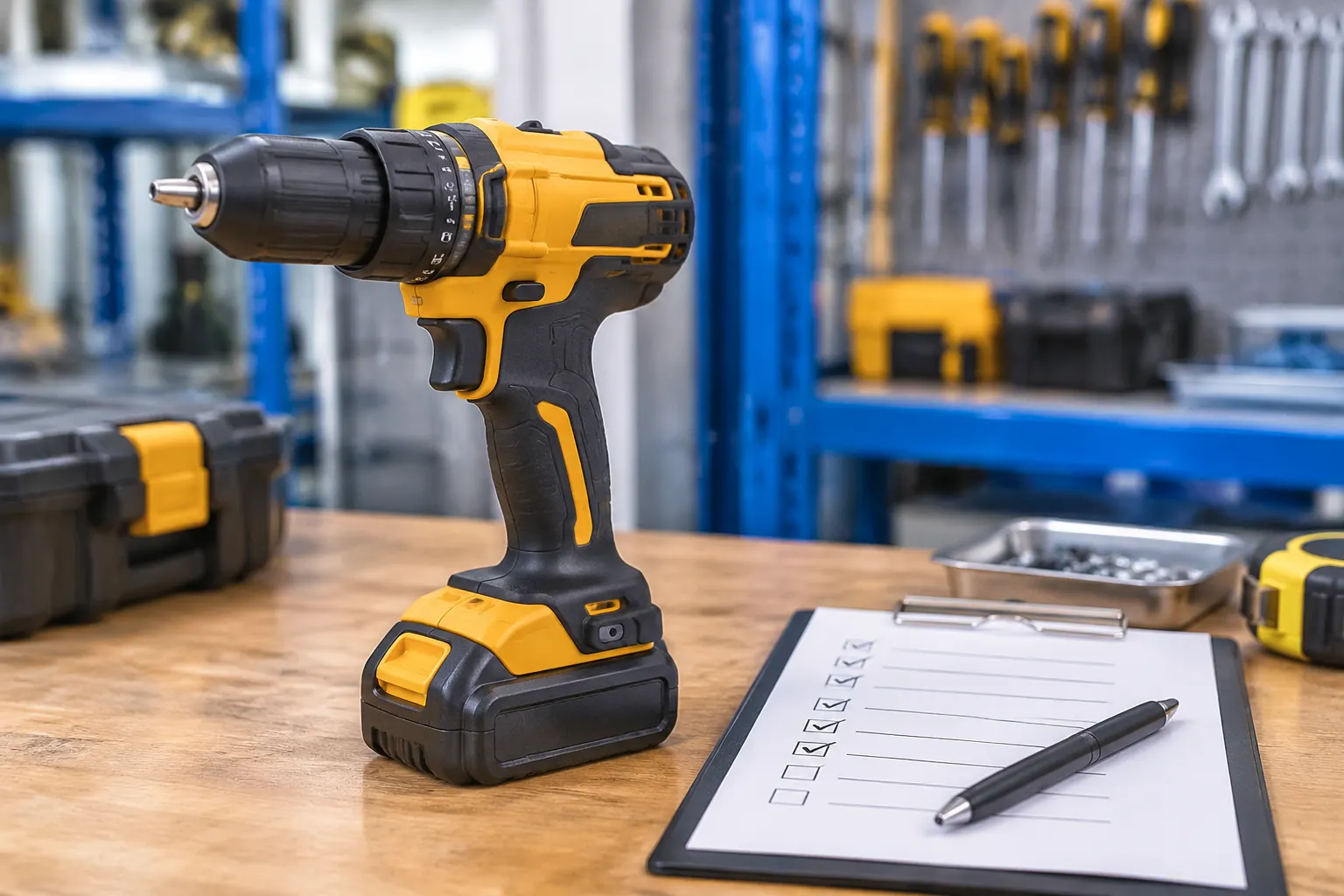

Illustrative scene: a cordless power tool and its battery pack sit on a workbench next to a clipboard checklist, standing in for a pre-order release file.
A quote for an 18 V impact driver says “accessories included.” Before approving it, put the battery and charger model numbers on the order. If a pack later fails, the importer can trace what was supplied. Liability for harm is assessed separately under South Africa’s Consumer Protection Act. § 61.
Power tool product liability is often discussed after an incident. For an importer or private-label buyer, the practical work starts before the purchase order. Treat the work as a pre-order release file. The file ties together the exact configuration, five frozen documents, verified supplier and battery evidence, an inspection scope with a batch-to-cell drill, a written split of warranty, insurance and recall costs, and retention plus release conditions. It supports a hold-or-release decision, but it cannot establish statutory liability, an importer indemnity obligation or insurance adequacy. Those questions belong with local counsel, the insurer or the competent authority.
Start with a release file
Open with a one-page cover sheet: product and model, destination market, order quantity, supplier legal entity, document owner, approval date and release status. Then answer five proof questions: what exact configuration is being bought; which documents cover it; who signed and approved each version; what test or traceability drill can be repeated; and who bears warranty, recall and insurance costs. Tie each document request to the exact product and destination market, not a generic set.
Use three statuses. Keep a separate legal-review column for South African statutory exposure, importer indemnity wording and any mandatory local record or insurance rule. That column keeps the commercial checklist from reading as a legal opinion.
| Status | File entry |
|---|---|
| Verified in writing | Document title, version, date, issuer, applicable model, reviewer and owner |
| Requested | Request date, supplier owner and promised response date |
| Outside this file | Referral note naming the legal, insurance or regulator question and responsible reviewer |
Lock the exact tool, battery and charger configuration
An accessories-included line is not a specification. FORZMAX's OEM page puts the first field plainly: record the exact model, voltage convention, key performance requirements and supplied accessories (OEM customization page). Use one configuration table for quotation, sample approval and purchase order. Every row carries a release status and owner.

The tool, battery and charger are shown as separate items beside a blank checklist.
| Record field | What to write and why |
|---|---|
| Product identity | Exact model and platform; voltage convention, motor, torque, chuck, battery interface and target price position. A motor or interface change must not disappear behind an 18 V description. |
| Performance requirements | Intended use, key performance requirements and test conditions to repeat later, giving inspection and sample approval a fixed reference. |
| Battery | Battery model, nominal voltage and capacity, cell model, BMS or PCM model and version. A nominal platform label does not identify the approved pack. |
| Charger and compatibility | Charger model, input voltage and frequency, plug type and supported battery codes. For cordless tools, record both battery and charger models; matching voltage does not establish compatibility. UN 38.3 is the UN transport test for lithium batteries, so the battery row carries the UN 38.3 summary for the purchased battery model, its cells and the assembled pack (UN 38.3 testing). For charger documents, ask the destination compliance advisor, importer of record or competent authority what that market requires, and keep charger document coverage open until those requirements are confirmed. |
| Kit contents | Battery, charger, bits, auxiliary handle, tool case and spare parts, item by item with model and quantity. A kit image or vague accessory line must not set the scope. |
| Branding and packaging | Housing colour, logo position, rating label, manual language, barcode, inner pack and master carton. |
| Open items | Unresolved model codes stay open; do not fill a gap with an assumed equivalent. |
The sample-approval guide goes further: lock the battery platform to a specific cell model and BMS solution (sample-approval record guide). An entry such as '18 V platform' or 'use customer battery' does not identify what is being approved.
Freeze five documents and control every change
Before mass production, freeze at least five document types: technical specifications, BOM, Golden Sample, packaging and label artwork, and test and acceptance records (sample-approval record guide). Each row states a version number, date, approver and applicable model; the status column shows whether that version has been reviewed against the order.
| Frozen document | Minimum content and version control |
|---|---|
| Technical specification | Model, platform, voltage convention, motor, torque, chuck, battery interface and performance requirements; version, date, approver and applicable model. |
| BOM | Cells, BMS or PCM, charger, motor, PCB, housing, battery interface and key components; BOM revision and approved supply sources. |
| Golden Sample | Signed physical and visual reference for the approved configuration; sample ID, approval date and photos. |
| Packaging and label artwork | Housing colour, logo, rating label, manual language, barcode, inner pack and master carton; artwork revision and print approval. |
| Test and acceptance records | Test conditions, results, acceptance criteria and sign-off; report revision, test date and model. |
File documents by market, model, component, version and validity period. Documents for a similar model cannot substitute for this project's documents. If the set does not cover the final configuration, pause and arrange supplementary testing before scheduling.
Control changes as a release-file row keyed to the approved model and version. Changes involving cells, PCB, motor, charger, plastic parts, moulds, firmware or key processes must be notified in writing and resubmitted for sampling or testing as agreed. Housing, battery interface or tooling changes need a separate technical and commercial review, not an ordinary colour change. Packaging, manual or barcode changes update artwork and sample approval photos before printing.
Record contract attachments by title, version, owner and status: the sample test report; any third-party retest report; trial-production sampling and failure records; rectification feedback with SOP clauses; and the sample baseline parameter table. Attach them to the mass-production contract. Mass production must not begin before the buyer's written approval.
Verify the supplier and the documents behind the claim
A certificate folder is not verification. Record three supplier rows: a business licence whose scope covers power tool production or manufacturing rather than sales only; a factory registration certificate matching the actual production address; and an ISO 9001 certificate whose validity is checked because certificates may be expired or forged (wholesale QC checklist). If the legal entity on the contract, label, manual and shipping documents does not match, hold the release and reconcile the names before proceeding. Verify the entity name, address and responsibility scope across contracts, conformity documents, labels and manuals, and confirm who submits, maintains and updates the technical file (OEM procurement guide).
Add a certificate row showing certificate number, issuer, validity period, product-model match and verification status against the issuing body (supplier evaluation guide). A certificate listing a different model does not cover the purchase. Do not treat every certificate as part of one generic customs-clearance set. Product-safety, EMC, battery, energy-efficiency, chemical-substance and labelling requirements depend on the sales market, tool type and battery or charger configuration.
Consolidate battery evidence into the battery row, with document title, model coverage, version and date, owner and status. For the specific battery model, request a UN38.3 test summary confirming it covers both cells and the assembled pack (drill QC checklist). Also record the cell supplier name, cell model, nominal capacity and nominal voltage. Ask for cell test reports such as UN38.3, CB or IEC 62133 as the target market requires. Record the BMS or PCM model, protection parameters for overcharge, overdischarge, overcurrent, short circuit and temperature control, and the protection-board test report.
Ask what tests are performed on each pack before shipment, such as capacity, internal resistance and charge and discharge cycles, and whether sample-batch test reports can be provided. Ask the supplier to explain BMS functions and provide a specification sheet. Record these as document requests and verification results in the file.
Set inspection and a traceability drill that can be repeated
Inspection scope is a release-file field tied to the order: name which functions and measurements are checked, who records results and how, and how a deviation is handled (OEM customization page). Reuse the approved control plan rather than re-listing inspection fields. The inspection row should point to the exact standard version, inspection level, sampling plan, sample size, defect definitions, functional test items and rejection rules (sample-approval record guide). An 'inspect per AQL' line alone will not settle specific acceptance decisions at the site.
Test conditions in that record should be traceable load and cycle tables, signed by the responsible test owner. A one-line 'test passed' note on the last page of a report cannot support mass-production acceptance.
Run a batch-to-cell drill during a factory audit or inspection, within a stated time. Start from the finished-product body or battery-pack label and follow the chain:

A worker holds a battery pack with a blank label beside a generic clipboard checklist in a factory setting.
- Finished-product batch number to assembly and inspection records.
- Assembly records to battery-pack batch, cell incoming batch and spot-welding parameter records.
- Cell incoming batch to the cell supplier's material certificate or factory inspection report.
- Finished-product inspection records to that batch's functional, aging and safety test data.
Record which links the supplier could and could not produce. A missing link is a finding, not a reason to fill the gap from memory. Keep the inspection results and traceability findings with the release file so the next order is compared against the same baseline. This is the practical traceability test described in FORZMAX's drill checklist (drill QC checklist).
Separate warranty, product-liability insurance and recall allocation
A defective power tool claim can start as a warranty conversation, but warranty, product-liability insurance and recall cost are three records. Treating one as a substitute for another blurs responsibility boundaries.

Ring binders lined up side by side, suggesting warranty, insurance and recall files kept apart.
| Record | Questions to settle | Minimum file evidence |
|---|---|---|
| Warranty | Duration, start point, covered components, exclusions including wear parts, labour and shipping costs, and repair, replacement or refund method | Signed warranty schedule, covered-component list and start trigger |
| Product-liability insurance | Which party takes out cover, geographic scope, minimum insured amount, validity period, or written cooperation terms | Policy or cover evidence, or a written cooperation letter; no undocumented coverage promise |
| Recall | Who leads the response, who pays which cost, and how design, material and supplied-cell defects are separated. For a battery-safety incident or regulatory recall, specify notification, investigation, inventory isolation, customer communication, reverse logistics, repair or replacement, compensation and recall-cost allocation. | Recall protocol and cost-allocation clause naming the responsible party and clause for each step |
| Defect responsibility | Pre-shipment design or manufacturing defects: supplier repair, replacement or refund. Transport, warehousing and end-user misuse: buyer or end user. For private label, existing-platform design: supplier; buyer-proposed non-standard modification: buyer. | Clause reference and evidence |
Supplier guidance describes 12 months as a typical power-tool warranty period, while noting that it varies by supplier and product line (wholesale QC checklist). It also says warranty terms should state covered components such as batteries, chargers and motors and whether labour and shipping costs are included. Treat that as a planning reference, not a promise for a particular order.
Make the warranty start explicit. Factory exit, shipment, arrival and end-user sale dates create different liabilities (OEM procurement guide). Clarify coverage scope, defective-product handling, the cost-bearing party and any compensation cap for batch quality issues.
ODM guidance warns that the design-defect responsibility boundary can blur when the supplier customizes to the buyer's requirements, and recommends stating in the contract which side owns existing-platform designs and which side owns buyer-proposed modifications (ODM supplier evaluation checklist). Record that allocation in the defect-responsibility row above, with clause reference and evidence.
For insurance, identify which party takes out product-liability insurance, including geographic coverage and minimum insured amount (European private-label OEM selection guide). Require the insurance scope and validity period, or written confirmation of cooperation with the buyer's insurance, incident investigation and claims documentation; do not record coverage commitments without documentation (OEM procurement guide).
EU-framed guidance also says the contract should clearly state the EU authorised representative and the product-liability insurance policyholder. That is not a South African example and should not be transplanted as local law. For South Africa, ask local counsel and the insurer how the equivalent responsibility and coverage questions should be recorded.
An importer indemnity clause is a separate legal instrument. Do not treat a supplier warranty or an insurance certificate as a substitute for it. Ask counsel to draft and review the wording, including how it interacts with warranty and insurance. This file only records that the question exists and who is responsible for answering it.
This checklist does not establish a South African product-liability insurance requirement, a minimum insured amount or an insurer-documentation rule. It also does not decide how South African consumer-protection law treats producers, importers, distributors or retailers. Those remain legal and insurance review items.
Make the file survive the warranty period
Retain the approved sample baseline, specification revision, artwork, kit list, inspection records and battery evidence at least until the end of the warranty period. Supplier guidance recommends keeping documents longer where legal disputes are possible (wholesale QC checklist). Treat that as recommended record-keeping practice, not as an established South African statutory rule.
The contract should list the documents the supplier must provide and specify liability for failure to provide them or for providing false documents (wholesale QC checklist). Confirm again who is responsible for entity details and the technical file, including who submits, maintains and updates it (OEM procurement guide).
Supplier guidance sets a hold-or-release test: mass production or corresponding payments should wait until each row below is evidenced.
| Release condition | Evidence to attach |
|---|---|
| Market documents cover the final configuration | Document set checked against the exact model, battery, charger and destination market |
| Key battery data is traceable | Battery model, cell model, BMS or PCM version and pack test records |
| Golden Sample and specification are approved | Signed sample record, specification revision and artwork |
| Cost and delivery milestones are written | Quotation basis, payment milestones and delivery schedule |
| Inspection and defect-remedy clauses are active | Inspection scope, sampling and rejection rules, remedy process |
| After-sales and recall responsibilities are defined | Warranty schedule, insurance evidence or cooperation terms, recall cost clause |
Carry open items forward by name, owner and date. Do not let an undocumented supplier assurance become a released order condition.
Conclusion
Do not release a South African private-label power tool order on an accessories-included description and a certificate folder. Build the file around the exact tool, battery and charger models, a locked cell and BMS, five frozen documents, verified certificate and battery evidence, an inspection and batch-to-cell drill, and a written split of warranty, insurance and recall cost. Retain that record through the warranty period and longer where disputes are possible.
The file helps a distributor make a traceable release decision. It does not replace local legal or insurance advice. If you are preparing a private-label order, send the destination, exact model or platform, kit configuration and expected quantity so the document request can be matched to the quotation.