Sourcing power tools in China based solely on price or intuition carries significant risk. A structured evaluation checklist helps you turn subjective judgment into comparable scores, systematically identifying risks in quality, delivery, compliance, and after-sales support. This article provides a reusable scoring template covering factory audits, certification verification, sample testing, quotation analysis, and final decision-making, helping importers, wholesalers, and brand owners screen qualified Chinese power tool manufacturers.
Why You Need a Standardized Supplier Evaluation Checklist
When sourcing power tools in China, relying on intuition or price comparisons alone can easily overlook hidden quality, delivery, and compliance risks. A standardized evaluation checklist helps you turn subjective judgment into comparable scores, reducing bias and avoiding problems that only surface after a supplier fails.
Without a structured evaluation process, common risks include: inconsistent quality causing production delays and higher costs; insufficient supplier capacity preventing on-time delivery; incomplete certification documents leading to cargo being held at the destination port; and missing after-sales support with no response for spare parts and repairs. When these issues occur, the losses often far exceed any price savings from procurement.
The value of standardized evaluation lies in forcing you to set clear criteria and verifiable evidence for each key dimension, rather than scoring by feel. For example, you can assign weights to quality, delivery, cost, service, and compliance, rate each on a 1-to-5 or 1-to-10 scale, and then calculate a weighted average. This makes suppliers comparable and lets you clearly see each one's strengths and weaknesses.
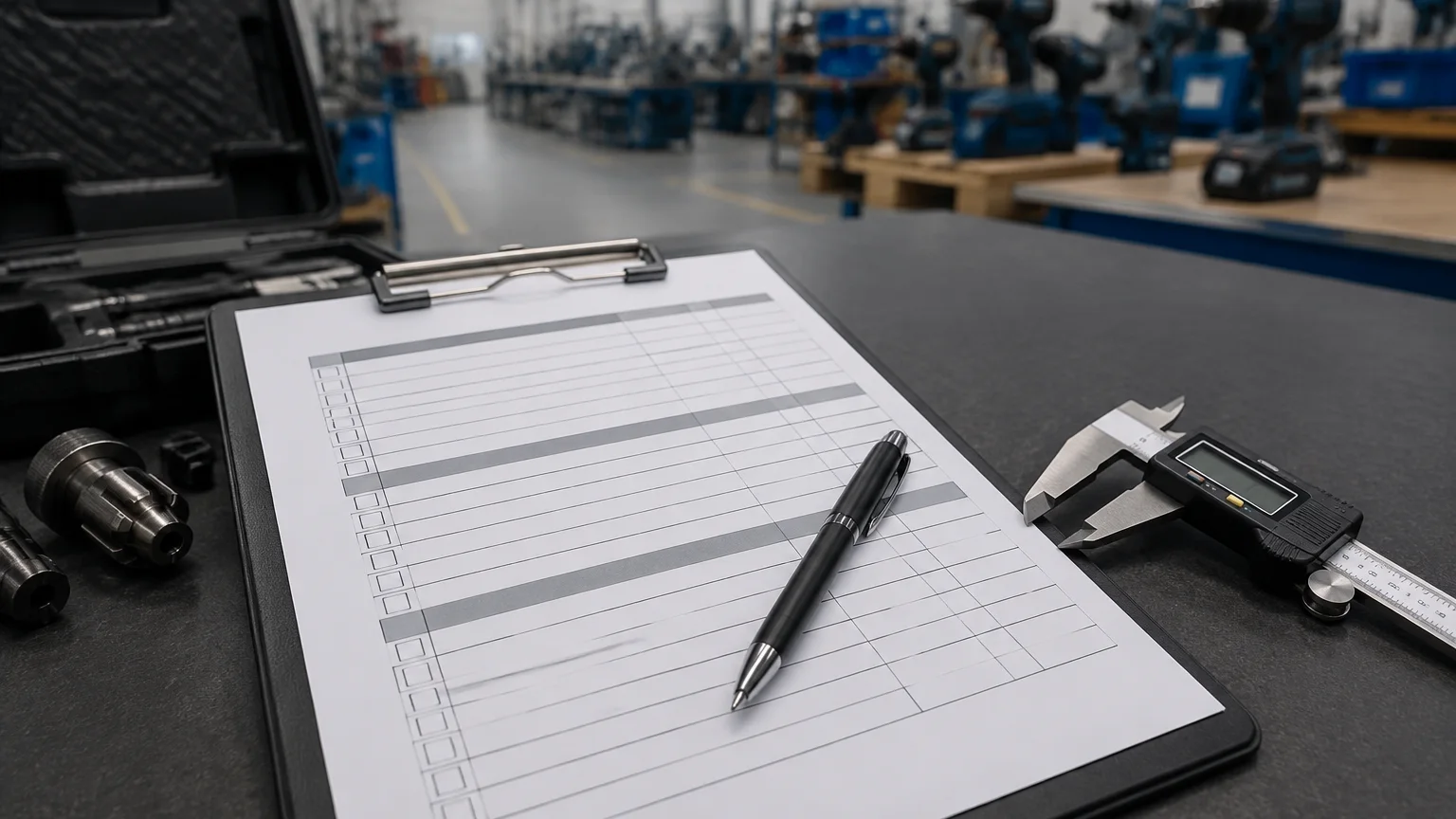
A practical approach is to turn the checklist into a reusable scoring sheet and apply the same standards every time you evaluate a supplier. The sheet should include modules for basic supplier information, factory visit records, sample test results, certification document verification, quote comparisons, and risk alerts. This way, each evaluation record you accumulate becomes a database for quickly screening qualified suppliers in the future.
Remember, the evaluation checklist is not a one-time tool. As market conditions and your own business evolve, you need to regularly review and update the evaluation criteria and re-certify existing suppliers. This allows you to continuously monitor supply chain risks and ensure your partners always meet your requirements.
Step 1: Define Your Requirements Before Sourcing
Before contacting any Chinese power tool manufacturer, you need to know exactly what you are buying and why. An evaluation checklist is only effective when it is built around your specific product, market, and business goals. Otherwise, you will waste considerable time comparing on the wrong criteria.
Clarify Product Specifications
First, write down the exact technical requirements for the tools you plan to import. Do not rely on vague descriptions like “good drill” or “heavy-duty angle grinder.” Instead, specify measurable parameters that can be checked against supplier data sheets.
- Voltage and battery platform: 12V, 18V, 20V, or another system. This determines compatibility with existing batteries and chargers in your market.
- Motor type: Brushed or brushless. For heavy-duty or continuous use, brushless motors are generally preferred due to longer service life compared to brushed motors, but this is only a general industry observation and should be verified through the supplier’s own test data.
- Key performance parameters: No-load speed (RPM), torque (Nm), chuck size (for drills), and wheel diameter (for angle grinders). These figures must match the intended application.
- Mechanical components: Gearbox material (metal vs. plastic), housing material, and the quality of the chuck or collet. Ask for specific material grades, such as Cr-V steel for drill bits or impact sockets.
Put these specifications into a one-page product brief. This document will serve as your reference point when comparing quotes and evaluating samples.
Identify Mandatory Certifications for Your Target Market
Certifications are not optional; they are the gateway to market access. Requirements vary by region, so list the certifications applicable to your target market before you begin discussions with suppliers.
- European Union: The CE mark is mandatory for power tools, confirming compliance with the Machinery Directive (2006/42/EC).
- North America: UL or ETL listing is typically required for electrical safety compliance.
- Other markets: Check local requirements such as FCC (US electromagnetic compatibility), RoHS (EU restriction of hazardous substances), or other regional certifications.
When requesting documentation from suppliers, ask for certificates covering the specific models you are purchasing, not just general company certificates. A factory may hold an ISO 9001 quality management system certificate, but that does not automatically mean every product line has the required market-specific approvals. Request test reports and verify that the model numbers on the certificates match the models you intend to order.
Estimate Annual Purchase Volume and Growth Plans
Your order volume directly affects which suppliers are suitable. A factory that works with large distributors may not be interested in your small trial order, while a smaller workshop may not have the capacity to scale with you.
- Initial order volume: How many units do you plan to ship in the first batch? This determines whether you are looking for standard minimum order quantities or custom production runs.
- Annual forecast: Estimate your total volume for the next 12 months. This helps you assess whether the supplier’s production capacity can support your growth.
- Growth trajectory: Do you plan to double production next year? If so, ask about the factory’s spare capacity. A general guideline is that an ideal partner should maintain 30–40% spare capacity to handle volume fluctuations and urgent orders, but you should verify this against the supplier’s actual production schedule.
Knowing your volume also helps you negotiate better terms. If a supplier sees a clear path to larger, ongoing business, they are more likely to offer favorable pricing or customization options.
Clarify Business Model and Customization Needs
Finally, decide whether you are buying off-the-shelf products or need OEM/ODM services. This distinction significantly changes the evaluation criteria.
- Standard products: If you are buying existing models, focus on price, lead time, and quality consistency.
- Private label (OEM): If you need your brand name on the tools, ask about minimum order quantities for customization, typically ranging from 100–500 units per SKU depending on complexity, as well as the cost of branding services such as laser engraving or custom packaging.
- Custom design (ODM): If you need a unique product, you will need to evaluate the supplier’s engineering capabilities, which is a more complex process.
Write down the answers to these questions before you start your search. This preparation will make the rest of the evaluation process faster and more accurate, because you will know exactly what to look for and what to ask.
Step 2: Factory Audit Checklist: What to Verify On-Site or Remotely
After shortlisting candidate suppliers based on your requirements, the next step is a structured audit. Whether you visit in person or conduct a virtual tour, a consistent checklist is essential for objectively comparing factories. A standardized audit reduces bias and helps you identify red flags early.
Production Capacity and Equipment
You are not just buying a product; you are buying the factory's ability to produce it consistently. Verify the following:
- Production lines: How many lines are dedicated to your product type? Ask for monthly output in units, not vague capacity claims.
- Equipment age and maintenance: Ask about the age of key machinery and its maintenance schedule. Frequent line stoppages are a major risk to your delivery schedule.
- Expansion capability: Can the factory scale with your order volume? Ask if they have the space or plans to add production lines or equipment.
- Spare capacity: A good rule of thumb is to look for suppliers that maintain 30-40% spare capacity to handle fluctuations and urgent orders. If they are consistently at full capacity, your orders may be squeezed out.
Quality Control Systems
Quality control is not just final inspection. It is a system that runs throughout the entire production process. During the audit, ask to see:
- Incoming material inspection: How do they check the quality of raw materials such as steel, plastic, and electronic components?
- In-process inspection: Are there quality checkpoints during assembly? Ask to see the checklists used on the production line.
- Final testing: What tests are performed on finished tools? Look for evidence of functional testing, not just visual inspection. Ask about their pre-shipment inspection process. Some suppliers advertise 100% pre-shipment inspection, which is a strong positive signal.
- Certifications: Ask to see valid certificates for ISO 9001 (quality management), CE (European market access), and any other relevant certifications (such as UL/ETL for North America). Do not just accept copies; ask to see originals or verify certificate numbers online.
- Traceability: Can they trace a batch of finished tools back to the specific batch of raw materials used? This is critical for managing recalls or quality issues.
Workforce and Management
The skill and stability of the workforce directly impact product quality and consistency. During the audit, gather the following information:
- Employee count and skill levels: How many workers are on the production floor? What is the ratio of skilled to semi-skilled workers?
- Training procedures: Ask to see training records for new employees and for workers when new products are introduced.
- Turnover rate: High turnover is a red flag. It can lead to inconsistent quality and a loss of institutional knowledge. Ask about the annual turnover rate for production staff.
- Working conditions: Observe the general work environment. Are workstations clean and organized? Are safety measures in place? Poor working conditions can lead to high turnover and quality issues.
Communication and Documentation
Your relationship with the factory will be tested by communication. A factory that cannot communicate clearly during the audit will be a nightmare during production.
- Responsiveness: How quickly do they respond to your technical questions? A good supplier should respond to technical inquiries within 24 hours.
- Documentation: Ask to see examples of their technical documentation, such as user manuals, exploded parts diagrams, and test reports. Are they professional and complete?
- Primary contact: Identify who your main point of contact will be. Is there a dedicated account manager or project engineer? Ensure they are fluent in your language to avoid misunderstandings.
Audit Scoring
To keep the audit objective, use a simple scoring system. For each of the categories above, rate the factory from 1 to 5 (1 = poor, 5 = excellent). This allows you to compare multiple factories on a like-for-like basis. Note any red flags immediately, and do not proceed with a supplier until you have satisfactory answers.
Remember, a virtual audit is a good first step but is not a substitute for an in-person visit. If you cannot visit, consider hiring a third-party inspection company to conduct the audit on your behalf. This is a common and cost-effective practice for importers.
Step 3: Certification and Compliance Review: Distinguishing Paper Documents from Actual Evidence
When evaluating Chinese power tool manufacturers, certification documents are the most vulnerable area for forgery or misuse. A PDF bearing the CE or ISO 9001 mark does not prove product compliance or sound factory management. You need to separate “paper documents” from “actual evidence” and use a practical verification process to confirm the authenticity, validity, and scope of each certification.
First, Distinguish System Certifications from Product Certifications
Many procurement professionals confuse ISO 9001 with CE, but the two are fundamentally different in nature and require different verification methods.
- System certifications (e.g., ISO 9001:2015): These certify a factory’s quality management system, not a specific product. They indicate that the factory has an audited process for managing quality, but they do not guarantee that a particular tool model is safe or meets performance standards. When verifying, check that the factory name and address on the certificate match the business license, that the certification scope covers “design and manufacture of power tools,” and that the certificate is within its validity period.
- Product certifications (e.g., CE, UL/ETL, RoHS): These certify that specific product models meet the safety, electromagnetic compatibility, or environmental requirements of a particular market. The CE mark is a mandatory requirement for entering the European market, corresponding to regulations such as the Machinery Directive 2006/42/EC; UL/ETL listing is a common requirement for North American electrical safety compliance. When verifying, you must confirm that the model listed on the certificate exactly matches the model you plan to procure, not a “series” or “similar product.”
Verify Certification Documents Item by Item: From Certificate Numbers to Issuing Bodies
When you receive certification documents from a supplier, do not just glance at the logo on the first page. Check each item as follows:
- Verify the certificate number: Every valid certificate has a unique number. Enter the number into the official verification system on the issuing body’s website to confirm that the certificate status is “Valid” or “Active,” not “Revoked” or “Expired.”
- Verify the issuing body: Confirm that the issuing body is internationally recognized or recognized by the target market. For example, CE certificates should be issued by an EU Notified Body, and ISO 9001 certificates should be issued by an organization accredited by the IAF. If the issuing body’s name is unfamiliar, search its official website and verify its qualifications.
- Verify the product model and description: The product model, specifications, and brand (if any) on the certificate must match the purchase contract or samples. If the certificate only states “power tools” without a specific model, it carries no evidentiary weight for the specific product you are sourcing.
- Verify the validity period: All certifications have a validity period. ISO 9001 is typically valid for three years and requires annual surveillance audits; the validity of CE certificates depends on the directive and the rules of the Notified Body. An expired certificate is equivalent to invalid.
- Request third-party test reports: A certification certificate is only the result; the test report is the data supporting that result. Ask the supplier to provide third-party test reports corresponding to the certificate (e.g., issued by TÜV, SGS, or Intertek), and check the test items, sample description, and test conclusions in the reports. Reputable manufacturers retain test reports for their main product lines and can provide copies within a reasonable time frame (e.g., 48 hours).
Quick Reference Table for Common Certification Verification Points
| Certification Type | Nature | Key Verification Points | Common Pitfalls |
|---|---|---|---|
| ISO 9001:2015 | System certification | Factory name and address on the certificate, whether the certification scope covers power tool manufacturing, validity period, issuing body qualifications | Certification scope does not match actual business; certificate expired; issuing body not IAF-accredited |
| CE | Product certification | Certificate number verifiable on the Notified Body’s website, product model matches the procured model, corresponding directive (e.g., Machinery Directive 2006/42/EC), validity period | Only a “Declaration of Conformity” provided without a test report; model mismatch; Notified Body lacks qualifications |
| UL/ETL | Product certification (North America) | Listing number verifiable on the UL or Intertek website, product model matches, factory address within the listing scope | Only “UL recognized” component certification provided rather than full product listing; model mismatch |
| RoHS | Product compliance | Sample model in the test report, test items (lead, mercury, cadmium, etc.), report date | Report expired; sample model does not match the procured model; report issued by a non-accredited laboratory |
What to Do If a Supplier Cannot Provide Third-Party Test Reports
If a supplier refuses to provide reports on the grounds that “we only test when customers request it” or “test reports are confidential,” you should take the following measures:
- Make it a firm requirement: During the inquiry or contract stage, list “providing valid third-party test reports corresponding to the procured model” as a mandatory clause, not an optional item.
- Designate the laboratory: Propose that testing be conducted by a third-party laboratory you approve (e.g., SGS, TÜV, or Intertek), with the cost negotiable as to who bears it. This prevents the supplier from providing reports issued by “their own people.”
- Arrange sample testing: If the supplier genuinely has no existing report, agree to sample from the first batch of products and send the samples to a designated laboratory for testing. Only after the tests pass should bulk shipment proceed.
- Assess the risk: If a supplier cannot provide even basic compliance documents, that in itself is a major red flag. For products involving personal safety like power tools, missing certifications means the products may fail customs clearance, be pulled from the market, or even trigger product liability claims.
Remember, certification verification is not a one-time action. During the cooperation period, you should periodically (e.g., annually) re-check the supplier’s certification status, because certificates can be suspended or revoked. Incorporate certification verification results into your supplier scorecard as part of ongoing monitoring.
Step 4: Sample Evaluation and Quality Verification Process
Sample evaluation is the most critical verification step in the procurement process. It is not just about checking whether the product works, but also a window into assessing the supplier's consistency in mass production. A structured sample evaluation process helps you turn subjective impressions into comparable scores, avoiding problems that only surface after bulk purchasing.
Core Dimensions of Sample Testing
After receiving samples, you need to test them across the following dimensions. These dimensions cover the core performance and reliability of power tools and help you determine whether the samples meet your procurement requirements.
- Function and Performance Testing: This is the most basic test. You need to actually run the tool to check whether basic functions such as startup, operation, speed adjustment, and braking work properly. For cordless tools, pay close attention to battery charging time, discharge time, and runtime performance. If the supplier claims the product uses a brushless motor, you can make a preliminary judgment based on noise and vibration levels during operation, but a more reliable approach is to review the product specification sheet or conduct a teardown inspection.
- Safety and Compliance Testing: Check whether the sample meets the safety standards of the target market. For example, entering the European market requires the CE mark, while the North American market may require UL or ETL certification. You need to verify that the certification marks on the sample match the certificates provided by the supplier, and check that key safety components such as power cords, plugs, and switches comply with regulations. If the supplier cannot provide corresponding test reports, that in itself is a serious red flag.
- Durability and Lifespan Testing: The short-term performance of a sample does not represent its long-term reliability. You can conduct simple endurance tests, such as running the tool continuously under no-load or light-load conditions for a period of time, and observe temperature rise, noise changes, and any abnormal vibration. A more professional approach is to request the supplier's internal lifespan test data or third-party test reports. For example, some industry sources indicate that brushless motors may last 30-50% longer than brushed motors, but this requires data support from the supplier, not just verbal claims.
- Material and Workmanship Inspection: Check the housing material, gearbox material, and the steel grade of drill bits or screwdriver bits (such as Cr-V steel). These details directly affect the tool's durability and performance under heavy-load conditions. You can make a preliminary judgment through observation, touch, and weighing, but a more rigorous approach is to request the supplier's material specification sheets or BOM.
Objectively Comparing Samples from Different Suppliers
When evaluating samples from multiple suppliers simultaneously, you must use a unified scoring standard; otherwise, the comparison loses its meaning. It is recommended that you create a sample evaluation scoring sheet, assigning weights and scoring criteria to each dimension.
| Evaluation Dimension | Weight (%) | Scoring Criteria (1-5) | Notes |
|---|---|---|---|
| Function and Performance | 30 | 5=Far exceeds expectations; 3=Meets specifications; 1=Obvious defects | Record specific test data, such as speed, torque, and runtime |
| Safety and Compliance | 25 | 5=Certificates complete and consistent with sample; 3=Certificates complete but need further verification; 1=No certificates or certificates do not match | Verify certificate numbers, product models, and certification marks |
| Durability and Lifespan | 20 | 5=Third-party test report provided; 3=Internal test data provided; 1=No data provided | Request testing methods and data from the supplier |
| Material and Workmanship | 15 | 5=Material specifications clear and meet requirements; 3=Material specifications broadly compliant; 1=Materials unclear or of poor quality | Inspect key component materials and surface treatment processes |
| Packaging and Accessories | 10 | 5=Sturdy packaging with complete accessories; 3=Average packaging; 1=Damaged packaging or missing accessories | Check manuals, warranty cards, spare parts, etc. |
When scoring, be sure to record specific test data and observations rather than just assigning a score. For example, do not simply write "good performance"; instead, write "measured no-load speed was X RPM, within Z% deviation from the rated value of Y RPM." This way, when comparing across different suppliers, you can make evidence-based decisions.
Controlling Mass Production Consistency Risks After Sample Approval
Sample approval is only the first step; you also need to worry about whether the same quality can be maintained during mass production. This is one of the most common risks in procurement. To control this risk, you can take the following measures:
- Clarify the Standard Between Sample and Mass Production: In the purchase contract or quality agreement, clearly state that the sample serves as the standard for mass production. Require the supplier to provide a pre-production sample before mass production and use it as the basis for final shipment acceptance.
- Request a Quality Inspection Plan: Ask the supplier whether they have a clear QC process, such as whether 100% of products undergo pre-shipment inspection. You can request to review their inspection records or standard operating procedures (SOPs).
- Arrange Third-Party Inspection: After mass production is completed and before shipment, arrange an independent third-party inspection agency (such as SGS, BV, TUV, etc.) to conduct sampling inspections. This is an effective means of ensuring that bulk goods meet the sample standard. You can use the key indicators from your sample evaluation sheet as the acceptance criteria for inspection.
- Establish a Sample Retention System: Seal and retain the approved sample as a physical reference for acceptance of subsequent batches. If there is a dispute over the quality of a batch, you can take out the retained sample for comparison.
If the sample performs excellently but you still have concerns about the supplier's mass production capabilities, a practical approach is to place a small trial order first. Through the trial order, you can observe the supplier's production process, quality control, and responsiveness to issues—information that is far more valuable than any verbal commitment.
Step 5: Quotation and Customization (OEM/ODM) Analysis
After shortlisting candidate suppliers based on factory audits, certifications, and sample quality, the next step is to analyze their quotations and customization capabilities. A quotation is more than just a unit price; it is a window into the supplier's cost structure, flexibility, and willingness to cooperate. This section provides a structured framework for comparing quotations and understanding the true costs of working with Chinese power tool manufacturers.
Beyond the Unit Price: What Your Quotation Actually Includes
When you receive a quotation, the first question is not "What is the price?" but "What does this price include?" A low price can be misleading if essential costs are excluded. Use the following checklist to dissect each quotation:
- Product specifications: Does the quotation exactly match your requested model, voltage, battery capacity, and accessories? A cheaper quote may be for a lower-spec version.
- Packaging: Does it include retail packaging, or is it bare tool? What about inner boxes, manuals, and barcode labels?
- Certifications and testing: Does the price include the cost of mandatory certifications (e.g., CE, UL/ETL) and third-party test reports? These costs can be significant and are often quoted separately.
- Tooling: For OEM/ODM projects, is the mold cost included in the unit price, or is it a one-time upfront fee?
- Logistics and Incoterms: Does the quotation include inland freight to the port, or is it EXW (Ex Works)? The Incoterms you choose will significantly affect your total landed cost.
- Payment terms: What is the payment schedule? Common terms are 30% deposit and 70% before shipment, but this is negotiable. Be wary of suppliers demanding full prepayment.
Comparing Quotations: A Structured Template
To compare suppliers objectively, create a quotation comparison table. This will help you see beyond the headline price and identify true cost differences. Here is a template you can adapt:
| Evaluation Item | Supplier A | Supplier B | Notes / Your Requirements |
|---|---|---|---|
| Unit Price (USD) | Specify exact model and configuration. | ||
| MOQ (per SKU) | Standard MOQ vs. OEM/ODM MOQ. | ||
| OEM/ODM Customization Fee | Cost for branding, color, packaging, or specification changes. | ||
| Tooling Cost | One-time cost, if applicable. | ||
| Sample Fee and Lead Time | Is the sample fee refundable with a bulk order? | ||
| Production Lead Time | For standard and customized orders. | ||
| Incoterms Offered | EXW, FOB, CIF, DDP, etc. | ||
| Payment Terms | Deposit %, balance %, and payment method (T/T, L/C). | ||
| Certifications Included | CE, UL/ETL, RoHS, etc. Are test reports included? | ||
| Warranty Offered | Standard warranty period and terms. | ||
| After-Sales Service | Technical support, spare parts availability, and replacement policy. |
When filling out this table, request a detailed breakdown from each supplier. A supplier that provides a transparent, itemized quotation is more likely to be a reliable long-term partner than one that only gives a single number.
Understanding MOQs and Customization Costs
Minimum order quantities (MOQs) and customization fees are critical factors in the decision-making process. They vary significantly between suppliers and depend on the complexity of your request.
- Standard MOQs: For off-the-shelf products, MOQs may be relatively low. Some suppliers may accept orders as small as 100 units per SKU for standard models. This is useful for testing new markets or product lines.
- OEM/ODM MOQs: Customization, such as your logo, custom colors, or packaging, typically requires higher MOQs. This is because the supplier needs to set up separate production runs and may need to order specific materials. Expect OEM/ODM MOQs to be higher than standard MOQs, often starting at 500 units per SKU.
- Customization fees: These may include costs for mold creation, artwork design, and packaging changes. Always request a detailed breakdown of these fees. Some suppliers may waive certain fees for larger orders, so it is worth negotiating.
When evaluating MOQs, consider your own sales forecasts and cash flow. Lower MOQs give you more flexibility, but higher MOQs may give you better pricing. The key is to find a balance that aligns with your business model.
Payment Terms and Incoterms: Protecting Your Interests
Payment terms and Incoterms are not just administrative details; they are risk management tools. Here is what to consider:
- Payment terms: The most common arrangement is a 30% deposit to start production and a 70% balance before shipment. This protects the supplier from order cancellations and protects you by ensuring you don't pay the full amount until the goods are ready. Be wary of suppliers demanding higher deposits or full prepayment, especially if they are newly established or unverified. For larger orders, consider using a letter of credit (L/C) to reduce risk.
- Trade terms: These define the responsibilities of the buyer and seller. EXW (Ex Works) means you are responsible for all costs and risks from the factory gate onward, which can be difficult to manage. FOB (Free on Board) is a common choice where the supplier is responsible for transporting the goods to the port and loading them onto the vessel. DDP (Delivered Duty Paid) means the supplier handles all logistics, duties, and taxes, which is convenient but usually more expensive. Choose trade terms that match your logistics capabilities and risk tolerance.
Key questions to ask about customization
Before committing to an OEM/ODM project, ask these specific questions to avoid misunderstandings:
- Can you provide a detailed breakdown of customization costs, including tooling, design, and packaging?
- What is the lead time for producing a customized product sample?
- Will the sample be produced on the same production line as the mass production order?
- What is the minimum order quantity for custom colors or logos? Does this change if I order multiple SKUs?
- Can you share examples of previous OEM/ODM projects, including the level of customization and the final product quality?
- How do you handle quality control for customized products? Are there additional inspection steps?
- What is your policy for defective products in a custom order? Will you replace them or provide credit?
- Can you provide a timeline covering all stages from sample approval to final shipment?
By systematically analyzing quotes and customization terms, you can make informed decisions that go beyond the initial price tag. This approach helps you identify suppliers offering the best overall value, not just the lowest cost.
Step 6: Risk, After-Sales Support, and the Final Decision Matrix
You have completed the factory audit, verified certifications, tested samples, and analyzed quotations. Now you need a structured way to consolidate all findings to make a final decision. This section provides a weighted scoring matrix to objectively compare suppliers, key after-sales concerns, and a final decision checklist.
Building a Weighted Scoring Matrix
A weighted scoring matrix helps you objectively compare suppliers by assigning importance to different criteria. Without it, decisions often default to price, which can be misleading. Industry guidance indicates that purchase cost accounts for only 30–40% of total cost of ownership; the remaining 60–70% comes from maintenance, replacement, and operational downtime. A low-priced tool that fails quickly can cost more than a higher-priced, durable one.
To build your matrix:
- List your criteria. Common categories include quality, delivery, cost, service, and risk. For power tools, also include certification compliance, after-sales support, and customization capability.
- Assign weights. Weights should reflect your business priorities. A suggested starting range is: quality 35–50%, delivery 20–30%, cost 15–25%, service 10–15%, and risk/ESG 10–20%. Adjust these based on your market and product category.
- Score each supplier. Use a 1–5 or 1–10 scale for each criterion. Base scores on evidence gathered during audits, certification reviews, sample testing, and quotation analysis.
- Calculate weighted scores. Multiply each score by its weight, then sum the results to get a total score.
- Apply risk penalties. The risk-adjusted score can be calculated as: final score = performance × (1 − risk penalty). If a supplier has unresolved red flags, such as poor communication or missing test reports, apply a penalty.
For example, if a supplier scores 4.5 out of 5 on quality but has a 10% risk penalty due to unclear warranty terms, the adjusted quality score would be 4.05. This prevents strong performance in one area from masking significant risk in another.
Key After-Sales Support Questions
After-sales support is a critical but often underweighted factor. Ask these questions before committing:
- Warranty terms: What is the warranty period? Industry guidance recommends at least 12 months for industrial tools, with premium manufacturers offering 24–36 months. Confirm what is covered and what is excluded.
- Technical support: What is the response time for technical inquiries? A quality supplier should respond within 24 hours. Test this before placing an order by sending a technical question.
- Spare parts availability: Does the supplier stock spare parts? How long does it take to ship replacements? Request a written commitment on spare parts availability.
- Defective product handling: What is the process for returning or replacing defective products? Is there a clear RMA (Return Merchandise Authorization) procedure?
- Documentation: Will the supplier provide complete technical documentation, including exploded views and user manuals? This is essential for your own after-sales support.
Final Decision Checklist
Before making a final selection, review this checklist:
- Have you verified all certifications for the specific product you are purchasing?
- Have you tested samples and confirmed they meet your specifications?
- Have you received a written quotation with clear MOQs, lead times, and Incoterms?
- Have you confirmed the supplier's capacity to handle your order volume and future growth?
- Have you tested the supplier's communication responsiveness?
- Have you obtained written warranty and after-sales support commitments?
- Have you identified and addressed all red flags from the audit?
- Have you applied risk penalties to your scoring matrix?
If any red flags remain unresolved, do not proceed. Supplier evaluation is a tool for measuring potential risk, monitoring capability, and improving the supply chain. Use it to make confident, evidence-based decisions.
Frequently Asked Questions About Evaluating Chinese Power Tool Manufacturers
Is It Necessary to Visit the Factory in Person?
For a first order with a new Chinese power tool manufacturer, an in-person visit is strongly recommended. A factory audit conducted on site by an engineer or quality manager is the most reliable way to verify production capacity, equipment condition, and quality control processes. If a physical visit is not possible, a live video tour of the production line and warehouse can serve as a preliminary check, but it cannot replace the value of seeing actual working conditions and meeting the team face to face. When you visit, plan to spend one to two days on site and bring a comprehensive checklist. If there is a language barrier, arrange for an interpreter in advance to avoid misunderstandings.
How Can I Verify a Supplier's Claims About Export Experience?
Do not rely solely on the supplier's own statements. Ask for specific, verifiable evidence such as bills of lading, customs declarations, or export records showing the countries they have shipped to. You can also request references from existing customers in your market or similar regions and follow up with them directly. During the factory visit, ask about their key customers, how long they have worked with them, and how past issues were resolved. Suppliers with genuine export experience will not hesitate to provide documentation and references. Be wary of vague answers or reluctance to share this information.
What Are the Biggest Red Flags to Watch For?
Several warning signs should prompt you to pause or walk away from a potential supplier. These include:
- Prices significantly below market average, which often indicates compromised materials or quality.
- Inability or refusal to provide required certifications, such as CE for the European market or UL/ETL for North America, along with corresponding test reports.
- Unwillingness to provide samples for evaluation before placing a large order.
- Demanding full prepayment, especially without a clear and secure payment structure.
- Unclear or non-existent factory address, or refusal to allow a factory visit or video tour.
- Poor communication, such as slow responses or vague answers to technical questions.
If you encounter any of these red flags, document them and request satisfactory answers before moving forward. Do not continue working with a supplier until the issues are resolved.
Reference sources
- Supplier Evaluation Checklist: Vendor Scoring and Risk | EvaluationsHub
- Gearpioneer Co., Ltd. - News blog - 2026 Guide: How to Choose a Cordless Power Tool Supplier | Buyer's Checklist
- Questions for a Supplier Evaluation Checklist: Assessing Your Supplier
- Supplier Evaluation Form Template Free Download Today | Free Template
- Manifestly Checklists | Supplier Evaluation Checklist
- Industrial Power Tools Supplier EvaluationLUYRN — Industrial Machinery & Tooling