
What a batch of "soft in three months" packs really costs
A power tool wholesaler once faced this: the first container showed acceptable return rates, then battery complaints spiked from the second — packs that would not charge fully, sagged under load, swelled. Teardown revealed mixed-lot downgraded cells and a protection board that had never been matched to the motor. Replacing the batteries — and the distributor confidence lost with them — cost far more than the few dollars saved per pack at purchase.
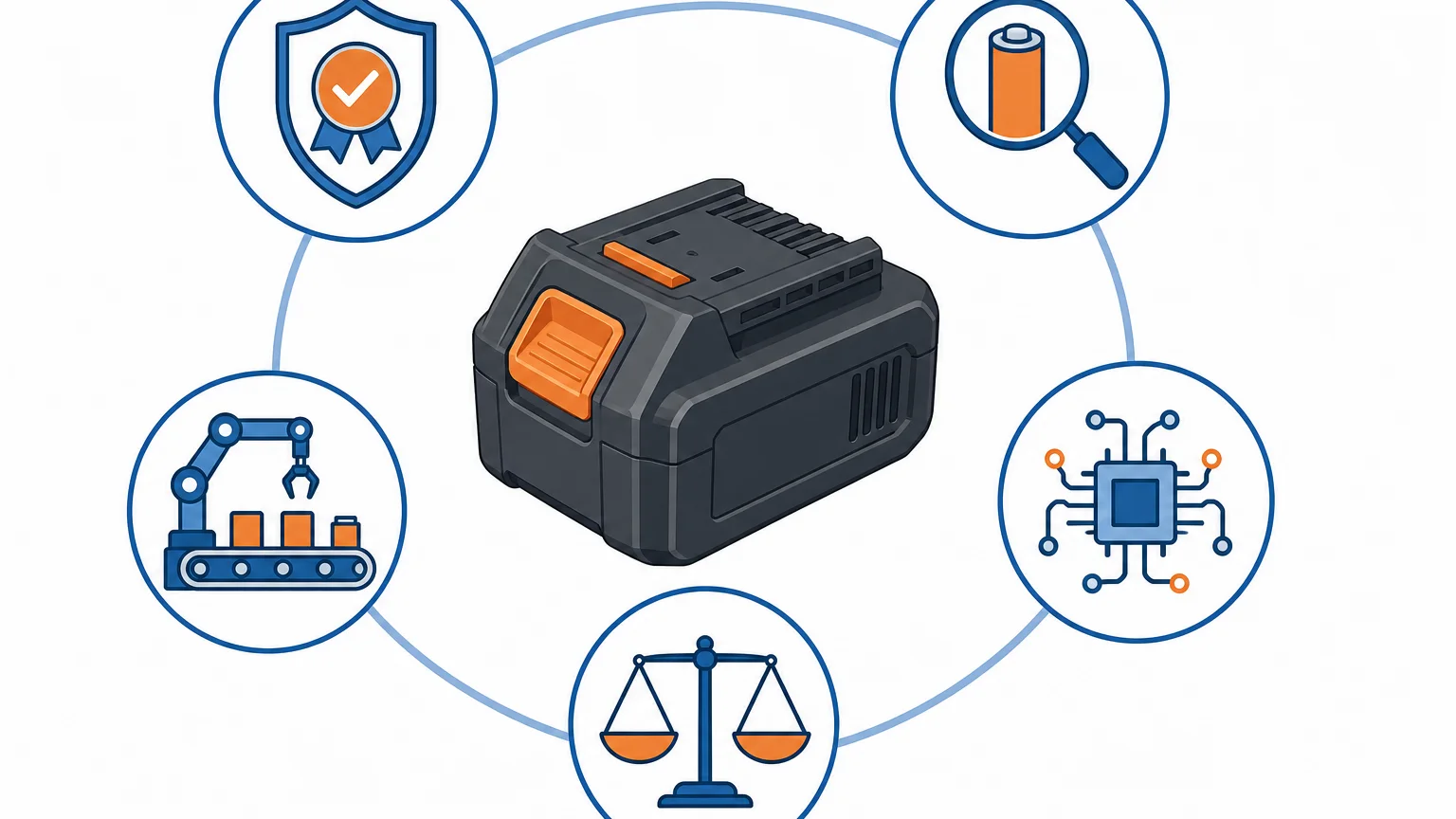
A power tool battery is the most failure-prone component in the machine: electrochemical aging, mechanical vibration, high-current thermal shock, drops and water ingress. Cut corners in any one of these links and the damage surfaces later, concentrated in after-sales. So the center of gravity when evaluating an OEM battery supplier is not factory size or headline price, but four technically verifiable fronts: the cells themselves, the BMS protection, the certification document chain, and PACK line control. This guide works through each front in that order, then closes with a worked scoring example comparing two candidate factories, turning the whole process into an executable decision.
Start with chemistry and platform: NMC, LFP or dedicated high-drain cells
Before evaluating suppliers, be clear about what you are buying. Today's mainstream power tool platforms use NMC (ternary) 18650/21700 high-drain cells, in 5S–10S configurations for 18V/20V and 36V/40V-class platforms; 21700 cells keep displacing 18650 on capacity and thermal grounds. LFP (lithium iron phosphate) offers longer cycle life and better thermal stability, but lower energy density and weak low-temperature performance keep it mostly in weight-insensitive, cycle-heavy applications.
Chemistry comes first because it decides whether the supplier's line even matches your product: a factory built around LFP storage packs may have no experience sorting, matching and thermally managing high-drain NMC cells. The verification move is simple — ask the supplier to explain the cell supply system behind their high-drain products (tier-one cell maker direct, or trader-sourced), the platform configurations currently in production (series/parallel count, voltage platform), and whether they have done tool-level matching on your target platform. A quote whose issuer cannot speak fluently about platform details can wait.
The four datasheet parameter groups that decide real-world tool performance
Everyone has datasheets; the difference is knowing how to read them. Four parameter groups determine how a pack actually performs under power tool duty:
- Maximum continuous and pulse discharge ratings: power tools commonly draw 20–30A continuous and above, with higher startup and stall spikes. Under-rated cells sag, heat and age fast — the field signature is a pack that feels strong when new and "goes soft" within months.
- DC internal resistance (DCIR): lower resistance means steadier high-current output. More important still is matching consistency within the pack — wide IR spread drags the weakest cells down and accelerates whole-pack degradation.
- Temperature window: allowed low-temperature charging range and high-temperature discharge capability decide usability in outdoor and summer conditions.
- Cycle-life test conditions: the same cell can cycle several times fewer laps under high-rate pulse duty than at 1C. A "1,000 cycles" figure without depth of discharge, rate and ambient temperature stated is not comparable to anything.
A practical question to ask: have the supplier walk through the datasheet and explain what each parameter means under your tool's load. Reciting parameters and explaining duty behavior mark two entirely different classes of supplier.
Verification by sampling: a minimal test protocol for capacity, IR and cycling
After paper comes physical sampling. For samples or pilot batches, run a minimal protocol:
- Capacity retest: measure actual capacity at datasheet conditions (typically 0.2C discharge). Results more than 5% below nominal call for questions about the lot and its sorting.
- IR and OCV spread: randomly draw 20–30 cells, measure internal resistance and open-circuit voltage, observe the spread within the batch, and request the incoming inspection and sorting records to cross-check.
- Pack-level load test: run on the actual tool or an equivalent load, record the voltage sag and temperature-rise curves, and compare against the supplier's claims.
- Cycle spot-check: where conditions allow, complete 100–200 high-rate cycles on samples and retest capacity retention — the single most effective way to separate fresh A-grade cells from downgraded or removed cells.
The protocol does not need laboratory precision. Its real function is to create contestable evidence: once a supplier knows you will test, the honesty of their quotation and cell selection changes immediately.
BMS protection thresholds: derive the safety envelope from stall current
The BMS defines the pack's safety envelope — and is the worst zone of copy-paste commodity boards. Do not ask "does it have protection"; ask against parameters:
- Overcurrent threshold: calibrated to the target motor's startup and stall current? Too low, heavy-duty work trips protection constantly; too high, protection is decorative. Mature suppliers state outright how large the stall current is, how long the protection delay lasts, and how the pack recovers.
- Thermal protection: sensor placement (cell surface vs. FPC) and strategy — throttle down or shut off at high temperature.
- Fuel gauge and communication: how the pack talks to tool and charger, and whether coulomb counting is corrected for high-rate discharge.
- Firmware maintainability: in-house or commodity board, whether parameters can be customized to your motor platform, whether firmware updates are possible.
One rule of thumb: factories willing to put their BMS engineer into the technical Q&A have usually done real tool matching; those where sales relays "full protection functions" have most likely just bought generic boards.
The certification document chain: UN38.3, IEC 62133-2 and whole-tool evaluation
The point of certification review is not "is there a certificate" but whether the document chain closes: do certificate model numbers map one-to-one to the actual cells and pack, do test reports come from verifiable labs, can test summaries be produced on demand. The core list for power tool packs:
| Certification / rule | What it covers | What to verify |
|---|---|---|
| UN38.3 | Lithium transport safety, air and sea | Test summary matches the actual cell model |
| IEC 62133-2 | Safety foundation for portable lithium systems | Both cell- and pack-level reports |
| CE (EMC + LVD) | EU market access | Declaration backed by actual test reports |
| UL (cell UL 1642 or the applicable end-product standard) | Often required by North American buyers | Listing details and model correspondence |
| KC / PSE / BIS | Korea, Japan, India market access | Holder, validity and model, checked item by item |
| IEC 62841 series | Power tool machine safety; battery evaluated with the tool | Whether the pack was tested on the target tool platform or standalone |
Three frequent red flags: certificate models that do not match the physical cells or pack; a bare self-declared CE with no reports behind it; and no UN38.3 test summary available — the last one will hold an entire shipment at the forwarder.
Four critical PACK line stations: sorting, welding, aging, end-of-line test
On site or by video, concentrating on four stations beats touring the whole plant:
- Incoming sorting station: are cells graded by capacity and internal resistance, and are matching tolerances (IR spread, OCV spread within a group) written as explicit numbers with sorting records kept?
- Welding station: spot or laser welding parameter logs, and the frequency of weld-strength pull tests — cold welds are the number-one source of vibration failures.
- Aging station: pack aging duration and capacity settings, and where aging rejects flow.
- End-of-line test station: does every pack get 100% testing of capacity, IR and protection-function trips; how long is data retained; can it be pulled by batch?
During a video audit, pick one recent shipping batch at random and have them trace it from cell lot number through to shipment test data — five minutes distinguishes a real traceability system from a slide deck. As for supplier type, factories with their own PACK assembly lines (versus pure trading companies) are generally more controllable on lead time, corrective response and custom cooperation; FORZMAX, for instance, publishes its in-house battery pack assembly line and quality checkpoint information on its own site — publicly verifiable production information like this is itself evaluation material.
Cell sourcing risk: B-grade cells, removed cells and mixed lots
Cells are the largest cost block in a pack — and the easiest place to cheat on cost invisibly: A-grade, B-grade and removed cells of the same model differ sharply in price while looking nearly identical. Detection rests on three evidence chains: incoming inspection and sorting records kept by grade; a clear account of cell supply sources and any second-source plan; and sampling data (capacity attainment, IR spread, cycle retention) consistent with A-grade claims. The sampling protocol in the previous section is precisely the hedge against this risk.
A worked example: scoring two candidate factories
Put the findings from each front into one scorecard, and the decision turns from impression into arithmetic. A commonly used weight structure:
| Dimension | Weight | Key checkpoints |
|---|---|---|
| Compliance and certification | 20% | Closed document chain, model correspondence, retrievable summaries |
| Cell and BMS quality | 25% | High-drain cells, sorting tolerances, thresholds matched to the motor |
| Testing and reliability | 15% | Mechanical tests, high-rate cycling, thermal-rise data |
| Manufacturing and traceability | 15% | Four key stations, 100% EOL test, batch records |
| Commercial terms | 15% | Total landed cost, lead times, warranty and spares |
| Communication and engineering support | 10% | Responsiveness, quality of engineering answers |
Run a situation seen constantly in real evaluations: Factory A holds complete certifications but quotes 8% higher and grows vague when asked about BMS parameters; Factory B quotes lower, answers all four line stations convincingly, but holds only CE with no UL listing. Scoring against the table: A gets 4 on the 20% compliance dimension, 3 on the 25% cell-and-BMS dimension, 3 on testing, 3 on manufacturing, 2 on commercial, 4 on communication — a weighted total of 3.15. B gets 2 on compliance, 4 on cell-and-BMS, 4 on testing, 4 on manufacturing, 4 on commercial, 3 on communication — a weighted total of 3.5. The conclusion is not simply "choose B", but "choose B with UL listing completion written in as a precondition" — the scorecard's real value is turning negotiation points into enforceable contract clauses.
Two bottom lines on the commercial side: when a quote sits clearly below market (20–30% under), suspect cell grade or skipped testing before congratulating yourself; and sequence the paperwork — NDA before detailed requirements, ownership of tooling, firmware and structural design, warranty duration and claim mechanics (pro-rata replacement or repair, freight split) all written into contract before any NRE fee is paid. A spreadsheet version with the full scoring formulas is available at forzmaxtools.com/assets/files/power-tool-battery-supplier-audit-checklist.xlsx.
FAQ
NMC or LFP — which should a power tool pack use?
Mainstream high-drain tool platforms are built on NMC 18650/21700 cells, whose energy density and rate characteristics suit handheld tools; LFP wins on cycle life and thermal stability but is heavier and weaker in the cold, fitting weight-insensitive, cycle-heavy products. More important than chemistry is the factory's line experience and tool-matching record on the chemistry you choose.
Why do high-drain cells with the same rated capacity differ so much in price?
Three layers: rate class and IR consistency (lower internal resistance at equal capacity costs more), cell grade (A-grade versus B-grade or removed cells), and supply channel (tier-one direct versus trader lots). The price gap eventually shows up in cycle life and batch consistency — exactly what the sampling protocol answers.
How should cycle-life figures be compared?
Only when depth of discharge, discharge rate, ambient temperature and cutoff conditions match. Measured high-rate pulse duty comes closest to real power tool use; any figure without conditions stated should be treated as marketing.
Is a higher BMS overcurrent threshold always better?
No. The threshold should be calibrated to the target motor's startup and stall current: too low trips constantly under heavy load; too high protects nothing. The way to judge a supplier is whether they can state stall current, protection delay and recovery logic in numbers — not repeat "full protection functions".
What is the minimum certification baseline for evaluating an OEM battery supplier?
UN38.3 (mandatory for transport) plus destination-market access: CE for the EU, UL-related listings often expected in North America, KC for Korea, PSE for Japan, BIS for India, with IEC 62133-2 as the safety foundation; where the tool itself is certified, the battery should be evaluated together with the tool under the IEC 62841 series.
Reference sources
- How to Select a Lithium-ion Battery Supplier (OEM): Eight Questions to Ask
- How OEMs Evaluate EV Battery Pack Suppliers
- Lithium Battery Pack ODM Selection Guide
- Lithium Battery Supplier China: What OEM Manufacturers Need to Know
- How to Evaluate a Lithium-ion Batteries OEM Supplier for Cost, Quality and Delivery