
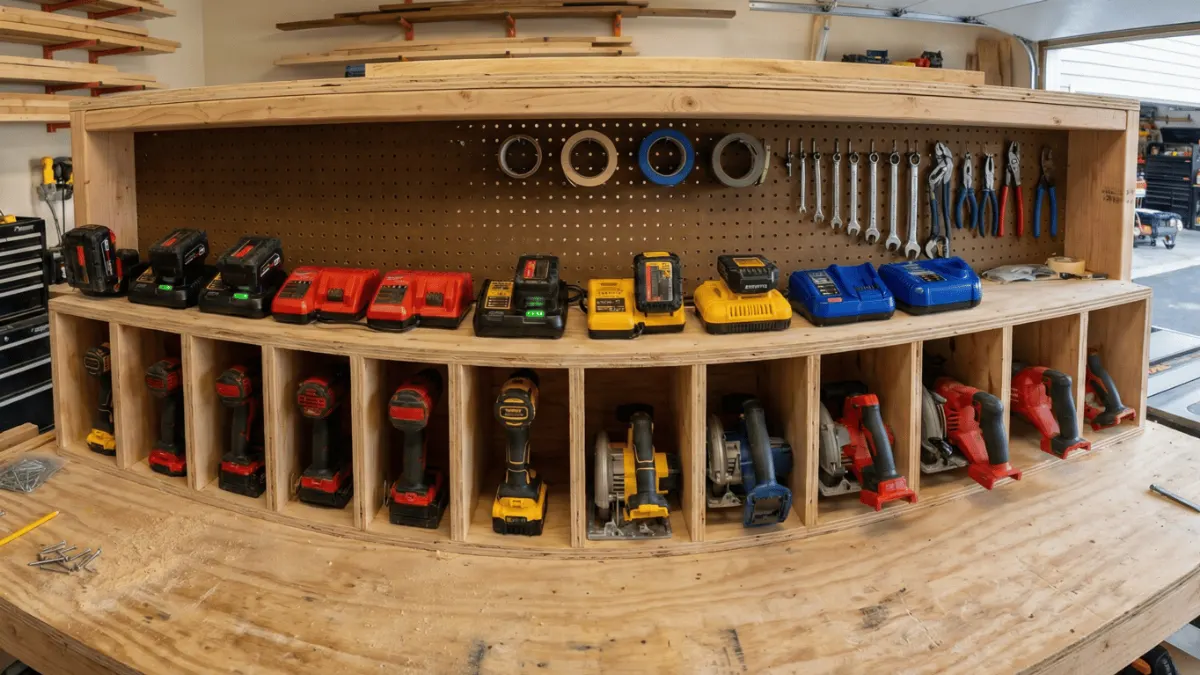

Rows of cordless battery packs and chargers on a workshop charging station.
Two packs marked 5 Ah can store different amounts of energy. At a nominal 18 V, the rating works out to 90 Wh; at 10.8 V it is 54 Wh. For a runtime claim, ask which tool was used, what load it carried and when the test stopped.
Do not start with the biggest figure. Open a claim record for the exact battery, charger and tool, then ask what each number represents and under which test conditions it was produced.
This guide is a distributor's claim-review framework for power tool battery performance claims. It covers Ah, Wh, runtime and cycle life for imported cordless-tool packs. It does not set a universal test protocol, validate a named pack without its datasheet, or replace qualified safety testing. A claim that cannot be tied to the exact model and test basis stays unconfirmed.
Battery Performance Claims Start With the Exact Pack
Fix the object under review before comparing any figure: exact battery model and revision, charger model, tool model or intended tool family, and pack interface. The record should also hold the written compatibility basis and the sample reference. FORZMAX's OEM guidance puts the compatibility limit plainly: matching voltage does not establish compatibility, and the buyer should agree a sample reference and a written specification.
Record the battery chemistry, nominal voltage, cell type and format, capacity, connector or terminal arrangement, charger input and output, charge time, protection functions, and whether the pack is sold bare, in a one-battery kit, a two-battery kit or with accessories. The quotation should carry distinct line items for tool, battery or pack, charger and accessories, each with exact model and acceptance status; otherwise a low tool price can hide different pack or kit content. PWR Tools' RFQ guide recommends that line-item structure when offers are compared.
Do not compare a battery claim against a kit description unless both describe the same build. Any change to the controlled sample triggers re-approval before production. When the BMS, cell model, enclosure or charger changes, re-open the affected claim-record entries (model and revision, test basis, sample reference and acceptance status) rather than carrying the earlier approval into the new build.
This remains a procurement and claim-review record: not an internal repair guide, not a safety certification, and not proof that one pack fits every tool sold under a brand.
Ah and Wh: Charge Capacity and Stored Energy
Ampere-hour (Ah) is a charge-capacity rating, useful for comparison only within the same nominal voltage class. Watt-hour (Wh) is nominal stored energy: nominal voltage multiplied by capacity in Ah. HNF's battery-spec guide separates the two clearly: Ah is charge capacity, while Wh is stored energy calculated as nominal volts × amp-hours.
The arithmetic is simple, but it changes how quotations should be read:
| Nominal pack | Calculation | Nominal energy |
|---|---|---|
| 18 V nominal, 5 Ah | 18 × 5 | 90 Wh |
| 10.8 V nominal, 5 Ah | 10.8 × 5 | 54 Wh |
Those are arithmetic examples, not measured usable energy and not a performance promise. A larger Ah label at a lower voltage does not automatically mean more stored energy than a smaller Ah label at a higher voltage. Use Wh for energy comparison across voltage classes, and keep Ah for capacity comparison within one platform.

Both packs carry the same 19.2 V and 8.0 Ah ratings, so their nominal stored energy is also the same; Ah only compares capacity within one voltage class.
Nominal Wh is also not usable Wh. ZERNE's runtime guide notes that the energy delivered to the device is normally lower than nominal energy, because cutoff voltage, discharge current, temperature, aging, internal resistance and protection limits all affect what reaches the tool.
A 5 Ah pack still matters when two packs share the same nominal voltage and are tested on the same tool. But Ah alone does not establish total energy across different voltages, and it does not establish runtime. Builders' cordless-battery guide makes the same limit in plain terms: amp hours are not the be-all and end-all when judging how long a battery will last.
Runtime Claims Need a Defined Tool, Load and Cutoff
A runtime claim is a test result, not a property that can be read from the Ah label. It needs the tool and task: drilling, fastening or cutting in a named material with a specified accessory. Then it needs the battery state of charge, charging method, ambient and initial battery temperature, operating profile, cutoff condition, measurement equipment, sample count and acceptance criteria.

A runtime claim is tied to a specific tool and task, such as fastening into a named material.
FORZMAX's OEM procurement guide states that when runtime, cycle life or charging time is claimed, the supplier should state the load, environment, instruments, charge and discharge conditions, and pass/fail criteria. Data without test conditions cannot be used directly for marketing or acceptance.
For a distributor's own sample test, use a written record rather than a stopwatch number in an email. A practical test record includes:
- Tool and task: exact tool model, accessory, material and work cycle.
- Battery condition: pack model, state of charge and charging method.
- Environment: ambient temperature and initial battery temperature.
- Operating profile: continuous or intermittent load, trigger cycle and rest periods.
- Cutoff: low-voltage cutoff, tool cutoff, temperature cutoff and any operator stop.
- Measurement: instruments, calibration status and sample count.
- Acceptance: pass/fail limit and the action to take if the result falls outside it.
When two packs are compared, use the same tool, accessory, material and stopping rule for both. Record a temperature stop separately from a low-energy shutdown. A pack that stops because it is too hot has not delivered the same result as one that stops because the tool reached its low-voltage cutoff.
Runtime is not determined by Ah alone. Duty cycle, motor efficiency, cutoff voltage, temperature and load all shape the outcome. An 18 V 4 Ah pack has about 72 Wh nominal energy; an 18 V 5 Ah pack has about 90 Wh, or 25% more nominal energy. That does not prove 25% more completed tasks, because the tool's cutoff, thermal behavior and work cycle can change the useful result.
For power-tool-like duty, FORZMAX's OEM battery evaluation says measured high-rate pulse duty comes closest to real power-tool use, and that a figure without stated conditions should be treated as marketing. That is useful guidance, not a universal standard. The buyer and supplier still need to agree the exact pulse profile, cutoff and pass/fail rule for the pack under review.
Cycle Life Is a Conditional Test Result
A cycle-life claim is often written as one clean number: 2,000 cycles. Read it as a conditional report: the number of charge-discharge events a cell sustains before reaching a defined end-of-life threshold under explicitly stated conditions. Herewin's test-report guide makes that distinction central: without the conditions, two cells that both claim 2,000 cycles may have very different useful lives.
Start with the end-of-life definition. An 80% capacity-retention point is commonly used as a reference, but the actual criterion should follow the application or applicable test specification. Some systems retire a battery on capacity alone; others care more about power capability or rising internal resistance. A report that does not define its end-of-life criterion leaves the cycle number difficult to interpret.
Capacity retention is the remaining capacity divided by the initial capacity, expressed as a percentage. Ask for the capacity-retention curve against cycle count, not only the final cycle number. Two reports can both finish at 80% retention after 2,000 cycles while behaving differently at 500, 1,000 and 1,500 cycles. The curve matters because it shows whether capacity faded smoothly, turned downward late in life, or dropped suddenly.

A cycle-life claim is easier to review when the report shows the capacity-retention curve and the test conditions behind the final cycle count.
A complete cycle-life review should establish these conditions before comparing suppliers:
- State-of-charge window: initial SOC, upper SOC, lower SOC and equivalent depth of discharge, so the test can be mapped onto the real charge envelope.
- Charge rate and discharge rate: confirm both separately. A 0.5C charge and 0.5C discharge result is not interchangeable with a 0.5C charge and 2C discharge result, and a 0.5C result should not be treated as automatic evidence at 2C or 3C.
- Temperature basis: state whether the reported temperature is chamber ambient or cell-surface temperature. A laboratory ambient value does not necessarily describe the cell's temperature inside an enclosure or under load.
- Voltage limits: record upper and lower limits and compare them with the limits the production BMS will enforce. If the test window differs from the production window, the cycle result may not represent system-level performance.
- Charge protocol: confirm whether a constant-current/constant-voltage profile was used and how the charge cycle was terminated.
- Discharge method: constant current, constant power, a mission-specific profile or a pulsed load can produce different results. The method should match how the tool draws power.
- Rest periods: heat, polarization and measured capacity depend on the rest between charge and discharge steps. Record the rest duration rather than leaving it unstated.
- Degradation data: review the capacity curve and the DC internal resistance trend. Rising resistance can reduce voltage and power capability before capacity loss becomes obvious.
Cycle life, calendar life and service life are different measures. Infinite Power's battery-lifespan guide notes that calendar aging continues while a battery is idle, so a cycle-life figure should be evaluated with calendar-life information and the manufacturer's warranty conditions. A pack can have a low annual cycle count and still age over time.
Consider an illustrative comparison adapted from Herewin's guide. Supplier A claims 2,000 cycles at 0.5C charge, 0.5C discharge, 80% depth of discharge, 25°C and an 80% end-of-life threshold. Supplier B claims 1,500 cycles at 1C charge, 2C discharge, 100% depth of discharge, 35°C and the same end-of-life threshold. The lower headline number is being demonstrated under a harder profile. The numbers are not directly comparable until the conditions are aligned.
Only compare cycle-life figures when depth of discharge, discharge rate, ambient temperature and cutoff conditions match. Compare the test conditions first, and the cycle count second. A figure without the conditions belongs in the unconfirmed column, not in the acceptance specification.
Sample Size, Batch Traceability and Cell-to-Pack Boundaries
There is no universal minimum sample size. Choose it for the decision being made: qualification, supplier approval, batch validation or statistical confidence. A lab result on one cell may be useful for screening, but it is not evidence of batch-level consistency.
Ask for individual results, the mean, variation, outliers and failed or discarded samples, not only an average. Manufacturing can produce cell-to-cell variation within the same run, so the average can hide a spread that matters to a distributor.
Record the cell model, brand, capacity grade, production date code and incoming batch number, and compare them with the previous batch or the approved sample. FORZMAX's drill-supplier checklist sets out the same discipline: require those cell-batch records in writing, and verify the protection-board model, MOSFET brand, control IC model and software version.
Keep cell-level cycle life separate from pack-level service life. Pack design, thermal management, cell matching, BMS limits and real operating conditions add variables that a single cell datasheet cannot capture, so a cell-level result is not a pack-level service-life guarantee.
Put Every Claim Into One RFQ and Sample-Approval Record
This review produces one claim record, kept as a table. It forces every number into the same structure and makes missing evidence visible.
| Field | What to record |
|---|---|
| Claim | Ah, Wh, runtime, cycle life or charge time as stated by the supplier |
| Exact model and revision | Battery, charger and tool identifiers |
| Test conditions | Load, SOC, temperature, cutoff, rates, equipment and sample count |
| Result | Measured value, calculated value or supplier guarantee |
| Sample or batch reference | Sample number, production batch, date code and test date |
| Acceptance status | Confirmed, unconfirmed, rejected or pending clarification |
| Owner and next action | Buyer, supplier or testing provider responsible for the open item |
PWR Tools' RFQ checklist recommends putting battery chemistry, nominal voltage, cell format, capacity, protection board, connector, charger input and output, charge time and protection functions into the quotation request. It also recommends defining test conditions, measurement equipment, sample size, acceptable tolerance, and whether the same test will be repeated during production inspection. FORZMAX's OEM procurement guidance adds the line-item rule for comparing offers: separate the tool, batteries, charger and accessories, and ask which sample, tooling, packaging, testing and freight costs are included.
For the controlled sample record, capture the sample model and revision, battery specification, charger model, accessory list, packaging version and date received. For a cordless drill or similar tool, include runtime under a defined load, battery fit, charger temperature and visible housing defects. FORZMAX's QC checklist lists charging time, continuous runtime under a standard load and charge-indicator accuracy among its battery and charging checks, and covers battery safety, charging, runtime and thermal tests. A practical checklist also reviews rated cycle count and the capacity-fade curve.
Request current battery test reports and transport documents for the exact model and configuration. Do not assume that a certificate for one SKU covers every variant. Confirm the applicable document scheme and test scope with a testing provider or qualified laboratory for the destination market.
Mark every unresolved value as unconfirmed. Do not substitute a headline number into the claim record just to close a cell in the table.
What to Confirm Before Approving the Bulk Order
Do not award the order on the Ah label, a quoted runtime or a cycle count alone. Approve only the exact battery and charger configuration covered by the written specification and the agreed sample.
Treat an Ah claim as a capacity statement within one voltage class, a Wh claim as nominal stored energy, a runtime claim as a defined test result, and a cycle-life claim as a conditional report. Require the supplier to identify which values are measured, calculated, preliminary or guaranteed. Keep rejected or unresolved claims visible in the record rather than deleting them or filling gaps with assumptions.
If the claim cannot be tied to the exact model, test basis, sample evidence and acceptance criterion, hold it as unconfirmed and ask for clarification before volume production. A clear claim record is more useful than a polished headline, because it tells the buyer what can be checked again at sample approval and production inspection.
Share the tool model, battery and charger requirement, intended task, destination market, quantity and required documents. Request a quotation against that written configuration so both sides work from one claim record.