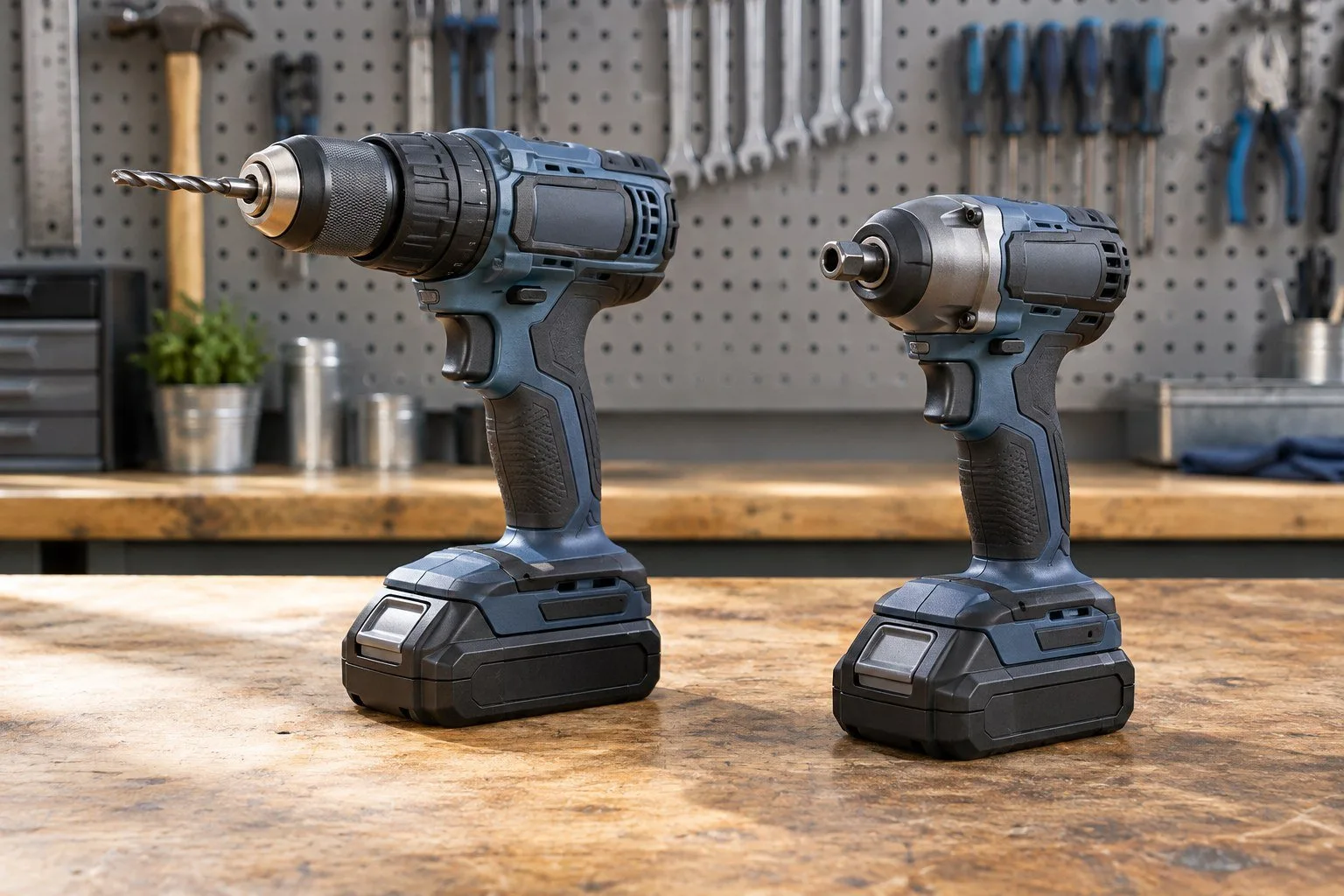

Cordless drill and cordless impact driver on a workbench (illustrative image).
For importers, a first trial order often begins with one question: “What is your MOQ?” The number a factory gives back usually belongs to a particular model, branding method, color, kit, and packaging. The same question rarely produces comparable answers.
This article breaks MOQ into conditions you can confirm one by one. It covers what to put in an inquiry brief, how to present three quantity levels, and what to ask about mixed orders and fees. It discusses commercial and configuration conditions before quotation only. It does not set a uniform MOQ for any factory and does not determine compliance requirements for your destination market.
Clarify the Conditions Before You Discuss a Minimum Quantity
When a quotation arrives, first confirm what configuration, market documentation, delivery responsibility, and acceptance criteria it corresponds to. Then compare the unit price. Without these inputs, quotes are usually not directly comparable.
Specific models, configurations, documentation, MOQ, pricing, and lead times still need to be confirmed in writing order by order. A verbal MOQ or a number in a chat thread is not enough.
Write your requirements as a table the supplier can answer item by item, and ask every supplier to reply in the same format. A consistent table makes the numbers comparable. If one supplier quotes a bare tool and another quotes a kit with two batteries, the lower number is not necessarily the lower offer.
Break MOQ Down into Quotable Conditions
An OEM factory’s MOQ usually has three parts: the minimum order quantity per SKU, amortization of color or housing tooling, and the minimum order quantity for private-label packaging materials. State the SKU breakdown method in your requirements specification. Ask the factory to provide MOQ across three dimensions—SKU, color, and printed materials—so a bundled quotation cannot hide the real threshold.
Then ask what the MOQ is calculated on: the tool body, battery, charger, packaging, or the full order. If different SKUs can be mixed, ask for the mixed quantity, packaging rules, and pricing conditions in writing. These are separate questions, and they should get separate answers.
| MOQ question | What to ask | Why it matters |
|---|---|---|
| SKU minimum | What is the minimum per tool model? | A single total can hide the threshold for each model. |
| Color or housing tooling | Is there a separate minimum or amortization for a custom color or housing change? | Tooling cost may be spread across a minimum quantity. |
| Packaging and manuals | What is the minimum for custom cartons, printed materials, inserts, and manuals? | Custom packaging is usually tied to carton quantities and a packaging run. |
| Calculation basis | Is MOQ counted by tool body, battery, charger, packaging, or full order? | A kit can carry several separate minimums. |
| Mixed orders | Can models or colors be combined, and what mixing rules or price conditions apply? | A mixed order may or may not help you reach the threshold. |
| New tooling or dedicated design | Is the project quoted separately for molds, fixtures, validation, and development? | A dedicated design is not the same as adding a logo to a stock model. |
Private-label cordless tool MOQ depends on how much of the product is already available and how much the factory must change. Custom packaging and manuals are usually tied to carton quantities and involve artwork, printing, inserts, and a packaging run. New tooling or a dedicated design is project-specific and can involve molds, fixtures, validation, and development. Do not treat those as the same kind of MOQ as a stock model with a logo.
Write a One-Page Procurement Brief Before You Request Quotes
Before requesting quotes, prepare a one-page procurement brief so every supplier replies using the same fields. The brief should cover at least the six groups below.

A blank form turns information into fields to fill in one by one. A procurement brief can use the same approach: leave a field for each item and ask the supplier to reply item by item.
| Brief field | What to specify |
|---|---|
| Sales scope | Country or region, sales channel, and who bears importer or responsible-party obligations. |
| Product and quantity | Tool category, intended use, model references, quantity per model, and proposed repeat-order plan. For each SKU, state whether it is a bare tool, battery kit, or charger kit. |
| Market and documentation | Destination market and the product documentation you require. |
| Battery system | Target voltage, tool-to-battery compatibility, charger configuration, spare battery needs, and whether you plan to expand on the same platform. |
| Branding and packaging | Logo files, colors, label language, barcodes, manuals, packaging, and accessory combination requirements. |
| Commercial boundaries | Target landed cost, expected initial order quantity, replenishment cycle, launch date, target price, delivery requirements, quotation basis, and acceptable payment and shipping terms. |
Keep the brief short, but make every field answerable. If the destination market, SKU, battery platform, brand, and delivery target are unclear, two quotations can easily talk past each other.
Use Three Quantity Levels for the Trial Order—Then Ask About Mixed Orders
When you request a quote, give three quantity levels at the same time: the trial order, the next volume tier, and the expected annual quantity. Also ask whether several models can be combined under one branding or packaging order, whether battery packs carry a separate MOQ, and whether cartons must be ordered in fixed multiples.

Illustrative image: a plain shipping carton and a cordless drill with no readable brand marking, together with a battery, charger, and manual. It is used to show that quantity tiers, packaging, and mixed-order rules need to be confirmed together; the image does not represent any specific MOQ or actual carton count.
| Quantity level | What it tells the supplier | What you need back |
|---|---|---|
| Trial order | The smallest first order you can support for testing quality, documents, and logistics | MOQ, sample or trial conditions, packaging rules, and any one-time fees |
| Next volume tier | The quantity you expect to order if the trial is accepted | Unit price at that tier and the conditions attached to it |
| Expected annual quantity | The longer-term volume you are planning for | Tiered pricing, repeat-order flexibility, and capacity comments |
One procurement guide suggests looking for suppliers that accept small trial orders, typically 40–100 units, to verify quality, documentation, and logistics. Some suppliers support lower trial MOQs, such as one carton or mixed-SKU cartons, which can suit a new distributor testing several products.
PWR TOOLS has published one cordless impact wrench example: an OEM/ODM minimum of 500 units, with a possible 12–18% reduction at 1,000 units or more under its price-break structure. Treat that as product-specific. It does not apply to every power tool category.
A lower first order may be possible when you select an existing platform, use standard colors, and accept the factory’s current accessories. Ask about MOQ flexibility across product lines, and whether mixed SKUs are allowed in one container. For bulk orders, ask whether the supplier offers tiered pricing that improves with volume and whether repeat orders are flexible.
A supplier that accepts a low trial MOQ but cannot scale production may not be a long-term partner. The trial order is only useful if the same supplier can support the next order.
Ask About Sample Fees, Tooling Fees, and Quotation Basis in One Pass
Ask whether the quotation includes samples, tooling, packaging, testing, and freight, and how each item is charged. Confirm the commercial terms you have already discussed in writing.
| Fee or term | What to ask |
|---|---|
| Sample fee | Does it include product price, shipping, custom printing, engineering changes, or prototype packaging? |
| Sample credit | Can the fee be credited against a confirmed production order, and does the credit apply to one SKU or the whole purchase? |
| Tooling, engineering, and testing | Can these fees be credited against later orders, under what conditions, and for how long? |
| Credit threshold | Is there a minimum order requirement before a credit applies? |
| Packaging | Are standard packaging, manuals, labels, and barcodes included, or charged separately? |
| Delivery terms | Which Incoterms version and place of delivery apply, and which costs sit with the supplier and which with the buyer? |
Sample fees may include the product price, shipping, custom printing, engineering changes, or prototype packaging. Ask whether the sample fee can be credited against a confirmed production order, and whether the credit applies to one SKU or the complete purchase.
Ask separately whether tooling, engineering, and testing fees can be credited against future orders, and what conditions and validity period apply. Also ask about any minimum order requirement for the credit.
The quotation should state the Incoterms version and place of delivery. It should list the costs borne by the supplier and those borne by the buyer separately. If a fee is not itemized, do not assume it is included.
A sample with a different battery, motor, charger, housing material, or accessory set cannot provide a dependable basis for approving mass production. Document the configuration, fees, and trade responsibility at the sample stage, so “one quotation, another build” does not become a production problem.
Put Lead Time and Total Cost Back on the Same Quotation Sheet
The total launch timeline includes RFQ review, quotation comparison, engineering, sample shipping, revisions, compliance testing, packaging approval, production, inspection, export documentation, and ocean freight. Factory production lead time is only one segment.
Compare offers using product price, packaging, tooling, samples, testing, inspection, inland transport, ocean freight, insurance, customs clearance, duties, storage, warranty reserves, and expected replacement parts. A supplier with a lower unit price may become more expensive if it has higher tooling charges, weaker documentation, longer approval cycles, or greater defect risk.
| Cost line | Ask for it in the quotation |
|---|---|
| Product and packaging | Unit price, standard packaging, custom packaging, manuals, labels, and barcodes |
| One-time costs | Samples, tooling, engineering, testing, and any credit conditions |
| Logistics | Inland transport, ocean or air freight, insurance, and delivery terms |
| Import costs | Customs clearance, duties, storage, and destination charges that the buyer will bear |
| After-sales provision | Warranty reserves and expected replacement parts |
Before mass production, freeze at least five items: technical specifications, BOM, Golden Sample, packaging and label artwork, and testing and acceptance records. At the quotation stage, confirm that these documents will be attached to the order. Do not wait until production starts to fill the gaps.
If a supplier cannot explain which costs are included and which are extra, keep the question on the quotation sheet. Do not use the unit price as the conclusion.
Compare the Written Responses Side by Side
Put the procurement brief, the three quantity levels, and the fee questions on one page. Send the same page to each candidate factory and ask for a reply in the same format. Compare only after you have written answers.
Do not trade “what is your lowest quantity?” for a number that cannot be tied to a configuration. When you need to confirm a configuration, send the specific model, battery platform, packaging, quantity, kit contents, and target market. That information is for checking the configuration, not for placing an order.
If a reply leaves a field blank, mark it as open. A complete-looking quotation with an unclear basis is harder to compare than a short reply with clear gaps.