
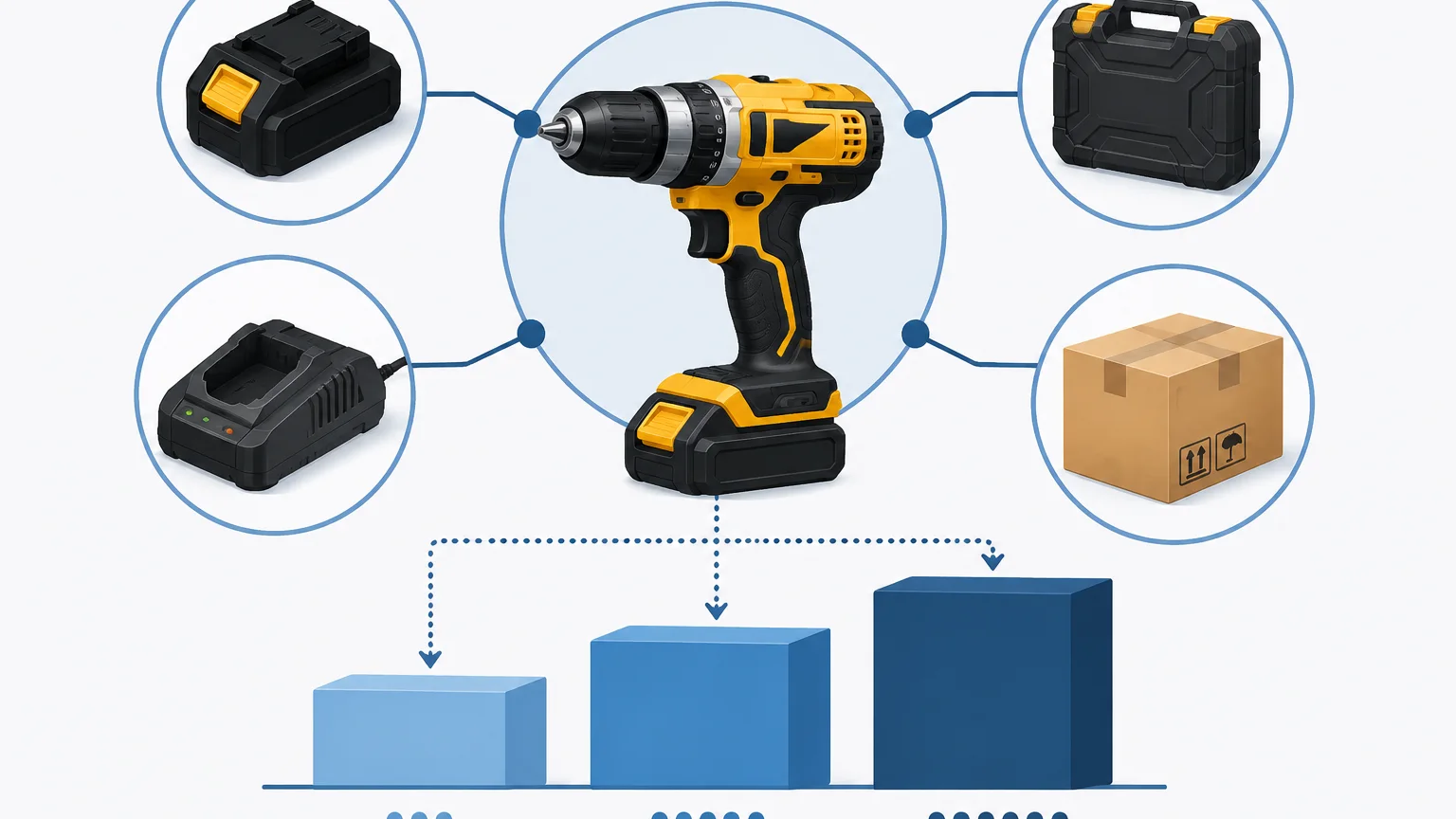
Quick answer: There is no published uniform wholesale price for 20–99 cordless drills in Australia. Suppliers quote based on order conditions; the price is determined by model, battery configuration, accessories, packaging, trade terms, and payment terms. Buyers should ask suppliers to itemize details in a uniform format and compare item by item.
Bulk Pricing Structure and Quotation Mechanism
A bulk quotation is not a single per-unit figure. It is a combined quotation determined by the complete tool, battery system, accessories, packaging, trade terms, and payment terms. For the same model, if any one of these variables changes, the unit price changes.
How Quotations Are Formed
- Determine the model and configuration: voltage platform, motor type, chuck specification, torque and speed settings.
- Select the battery and charger: battery capacity (Ah), number of batteries, charger model and quantity.
- Confirm accessories and packaging: drill bits and screwdriver bits, carry case, color box or export carton.
- Choose trade terms: EXW, FOB, CIF, or DDP, which determine freight, insurance, and customs clearance responsibilities.
- Confirm payment and compliance: deposit percentage, balance payment milestone, certification documents, certificate of origin.
- The supplier then provides the unit price, total price, and quotation validity period.
Key Quotation Variables
| Quotation Variable | Impact on Price | Questions to Confirm |
|---|---|---|
| Model and motor | Brushless motors generally cost more than brushed motors; the exact difference depends on the supplier's quotation. | Does the quotation correspond to the same model code? Is the motor type specified in the contract? |
| Battery capacity | 2.0Ah and 4.0Ah batteries have different material costs, which directly affects the total package price. | How many batteries are included as standard? Can they be upgraded to a larger capacity? |
| Charger | The charger model, charging speed, and whether a multi-bay charger is included can all change the quotation. | Is the charger input voltage compatible with the Australian power grid? |
| Accessory kit | The more accessories included, the higher the procurement and packaging costs. | Is the accessory list fixed? Can items be removed or replaced? |
| Packaging | Color boxes, display boxes, and industrial packaging have different costs. | Is an outer carton included? Will the customer's brand be printed on it? |
| Trade terms | The landed cost difference between EXW and CIF can be significant. | Is the quotation ex-works, FOB, or CIF? |
| Payment terms | The deposit ratio affects cash-flow pressure and exchange-rate risk. | What are the deposit percentage and the balance payment milestone? |
Key Components and Verification Points
The core components of a cordless drill include the motor, battery pack, chuck, gearbox, switch, and housing. When purchasing in bulk, do not only look at the overall appearance of the tool; ask the supplier to provide specifications for each component and confirm the following verification points.
| Key Component | Verification Points |
|---|---|
| Motor | Confirm whether it is brushed or brushless; brushless motors are generally more efficient but also more expensive. |
| Battery pack | Confirm the cell brand, capacity (Ah), voltage platform, and battery protection board. |
| Chuck | Confirm the chuck material (metal or plastic) and capacity (e.g., 10mm or 13mm). |
| Gearbox | Confirm whether it has multi-speed gearing, the number of torque settings, and whether it has a spindle lock. |
| Charger | Confirm whether the input voltage is compatible with Australia's 240V power supply, and the charging time. |
| Housing and switch | Confirm the housing material, ergonomic design, and switch type. |
Common Batch Pricing Options and Suitable Scenarios
In Australia, orders of 20–99 units are common among small distributors, contractors, rental companies, and importers placing initial trial orders. Batch pricing generally takes three forms: fixed wholesale pricing, tiered pricing, and customized bundle pricing.
- Fixed wholesale pricing: Suitable for buyers with stable order volumes, such as small distributors replenishing stock. Pay attention to per-unit cost stability, whether the packaging is suitable for shelf display, and whether the same model is available with different battery configurations.
- Tiered pricing: Priced by quantity brackets, suitable for buyers whose order volumes fluctuate. Ask the supplier to specify the price differences at thresholds such as 20 units, 50 units, and 99 units.
- Customized bundle pricing: Prices the tool body, batteries, chargers, accessories, and packaging separately, suitable for buyers who need to offer different kits to different customers. Require the supplier to list the unit price of each component clearly.
Contractors making centralized purchases tend to focus on bundle pricing, where a single order includes the tool body, spare batteries, chargers, a tool case, and common drill bits. Rental companies are more concerned about battery interchangeability, the number of chargers, and warranty terms. Buyers placing initial trial orders should choose tiered pricing or a trial-order price, and also ask the supplier to state in writing the order quantity at which the next price bracket applies. It should be noted that these scenario summaries are based on practical experience rather than specific sources; the final choice should follow the supplier's written quotation.
Common Misconceptions and Boundaries
Wholesale pricing is not always lower than retail pricing
Retail channels may run brand subsidies, inventory clearance, or promotions that make the per-unit retail price lower than the ex-factory price of a small-batch order. In its June 2022 update of the Australian market cordless drill comparative review, CHOICE listed products from brands including AEG, Black & Decker, Bosch, Makita, Milwaukee, Ozito, and Ryobi. However, prices in retail reviews are consumer end prices and do not include trade terms, packaging, or after-sales responsibilities for bulk purchases. Therefore, when comparing wholesale and retail prices, you must confirm whether batteries, chargers, accessories, warranty, and compliance documents are included.
Two “identical-looking” quotes may have different actual costs
Two quotes may list the same model, but battery configuration, accessory package, packaging format, and payment terms can differ, so the unit price naturally differs. For example, the Ingco Tools South Africa website’s product page for its 20V lithium-ion cordless drill shows product code CDLI205582, with packaging containing 47 accessories, one 2.0Ah battery pack (FBLI20011), and one charger (FCLI2001), in a color box. If one bulk quote includes these accessories and the other includes only a bare tool or only one battery, the unit prices can differ significantly. Buyers should break down each quote into “tool + battery + charger + accessories + packaging” and compare item by item.
Comparing only unit price ignores landed cost
For bulk purchases in the Australian market, the final cost is not the ex-factory price but the landed cost. Landed cost typically includes the ex-factory price, international freight, insurance, customs duties, GST (goods and services tax, usually 10%), customs clearance fees, and inland transport within Australia. The duty rate depends on the product’s HS code; different codes have different rates and may be affected by trade agreements. This part should be confirmed with a customs broker or supplier rather than estimated from experience. To judge which of two quotes is cheaper, compare “landed cost per unit” rather than “ex-factory price per unit.”
Inquiry Checklist
- Model and configuration: Confirm the specific model, voltage, motor type (brushed or brushless), chuck capacity, torque and speed settings; whether the same model is available with different battery capacity versions.
- Battery and charger: How many batteries are included per unit, battery capacity (Ah), charger model and input voltage; whether it is compatible with Australia's 240V power supply.
- Package contents: Whether drill bit or screwdriver bit sets, carry case, belt clip, auxiliary handle, etc. are included; list each item to avoid vague descriptions such as 'with accessories'.
- Packaging: Color box, export carton or pallet packaging; quantity per carton, gross and net weight per unit, and carton dimensions.
- Trade terms: Whether the quotation is EXW, FOB, CIF or DDP; whether it includes sea or air freight, insurance, Australian customs clearance and delivery.
- Payment terms: Deposit ratio, balance payment milestone, whether letters of credit are accepted; different payment methods affect working capital costs.
- Price validity: How long the quotation is valid; whether the price will be re-quoted if exchange rates or raw material prices change.
- Compliance and certifications: Whether electrical safety documents, RCM or equivalent compliance declarations meeting Australian market requirements are provided; whether battery transport requires a UN38.3 report.
- Warranty and after-sales service: Warranty period, warranty coverage, whether there is a local after-sales service point in Australia, or whether the buyer handles it themselves.
- Lead time and MOQ: Minimum order quantity, production cycle, shipping time; whether the lead time differs between 20 units and 99 units.
Key Takeaways
The core of bulk procurement is not about finding the 'lowest price' but breaking down each quotation into comparable, verifiable terms. When you receive two quotations, normalize them first: convert each quote to a common basis of 'per unit including standard battery and charger, export packaging, and the same trade terms.' If Supplier A quotes a bare-tool price and Supplier B quotes a price including two batteries and a tool case, comparing unit prices directly is meaningless. We recommend comparing line by line across the list and then calculating the landed cost.
For performance claims such as maximum torque or drilling capacity, you can refer to the publicly available testing methodology of independent review organizations such as CHOICE. When CHOICE tests cordless drills, it examines drilling and screwdriving performance, ease of use, features and accessories, and also considers included attachments and other tools on the same battery platform. These dimensions can also be used to judge whether the configuration in a bulk quotation is reasonable. However, CHOICE's ratings and test results represent only its own position and cannot replace the test reports provided by suppliers. If a supplier claims a certain performance level, you should ask for a third-party test report or sample verification.
If you are considering FORZMAX as a supplier, you should confirm through its official channels whether wholesale orders and OEM/ODM customization are supported, and request a formal quotation. Specific pricing, minimum order quantity, and lead time are subject to the factory's written quotation.