
Direct Answer: Why There Is No Single Unit Price for Angle Grinders in Quantities of 20–99 Units
There is no uniform unit price you can look up on a table: you must first fix the motor power, disc diameter, power supply type and accessory specification, then request a per-order quotation from the supplier based on your target quantity. An angle grinder is an industrial product priced by specification and configuration combinations. Power (W or A), disc diameter (such as the 115/125/230 mm tiers), corded or cordless (voltage and battery capacity), drive and clamping structure, included accessories, and the applicable order-volume tier will each change manufacturing cost and supply terms separately. Until these variables are fixed, any figure is only the result of one particular combination.
Four pricing bases must be kept separate: single-unit retail price, promotional price, clearance price and volume supply price are not equivalent. The corded angle grinder category page of French retailer Kraft Shop introduces its product line in 1200W/1400W/2400W tiers; the discount percentages and struck-through prices shown on the page are promotional information and time-sensitive. Angle grinder listings on the wholesale clearance platform Destockplus generally note that price varies with quantity (SELON QUANTITE) and that items are sold wholesale or semi-wholesale only (source: Destockplus, seller's own statement, requires verification). Mixing these pricing bases directly leads to budget miscalculation.
One-sentence template to use before requesting a quote: "I need ___ units, for ___ (cutting/grinding/rust removal/polishing), on materials of ___, requiring a disc diameter of ___ mm, rated power of ___ W, ___ (corded/cordless; for cordless, specify voltage and battery capacity), with/without ___ accessories. Please provide tiered quotations based on the target quantity and state the validity period and whether prices include tax and freight."
From Motor to Disc: The Component Chain That Determines the Quote
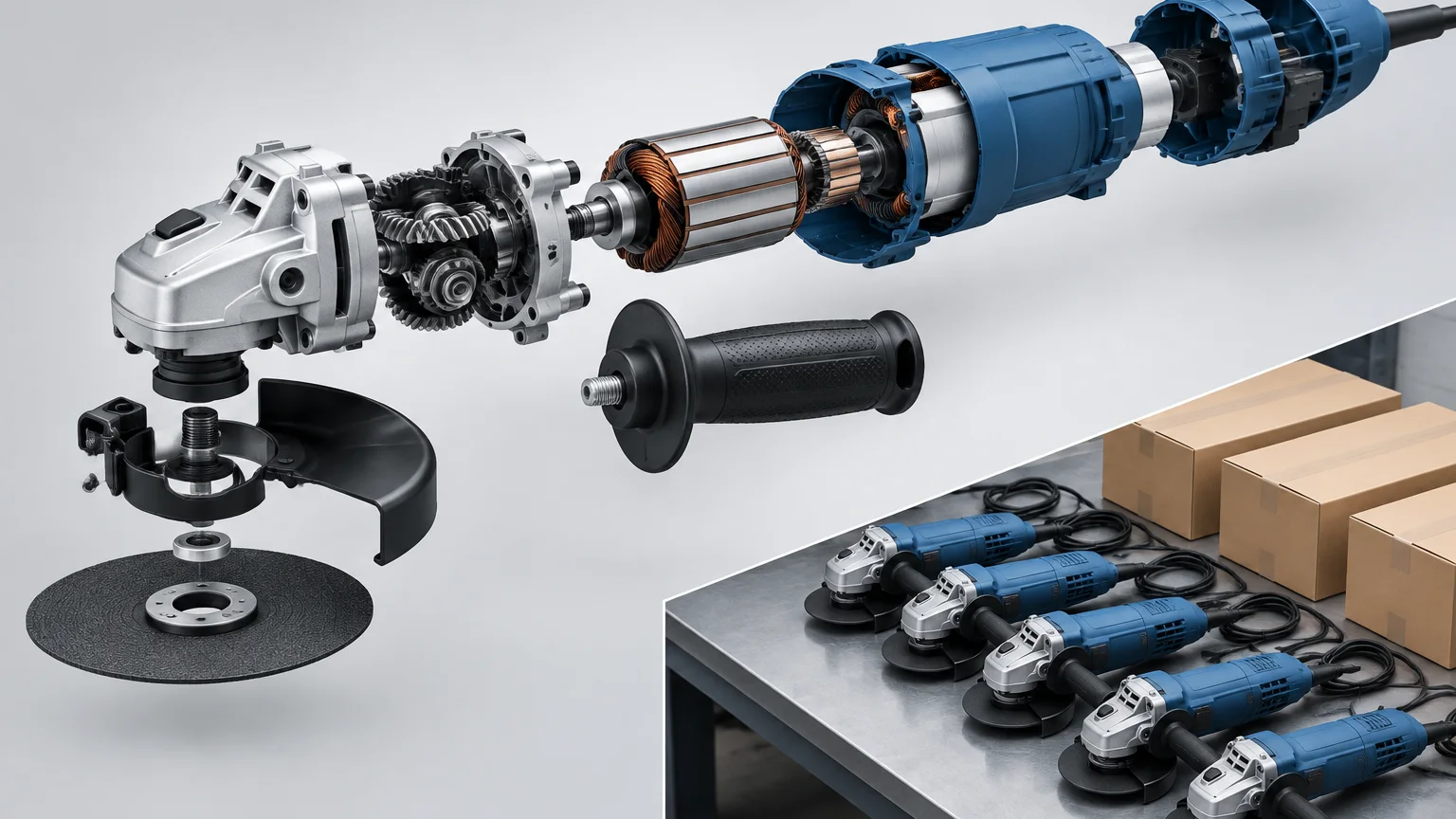
An angle grinder is a very short power train: motor → gearbox → spindle → grinding disc. GroupSumi describes this category as relying on high-speed disc rotation, with common features including a high-power motor, variable speed, an adjustable guard and a lock-off device (source: GroupSumi, third-party distributor viewpoint). Kraft Shop links power output to hard materials such as concrete and metal and to heavy-duty work (source: Kraft Shop, marketing language, no independent verification seen). Both are third-party statements and should be verified against the nameplate and specification sheet from the supplier for the specific model.
| Component stage | What it affects | What to ask when requesting a quote |
|---|---|---|
| Motor (brushed/brushless, rated power) | Load capacity, maintenance frequency, control-circuit cost | What are the rated values and test conditions? Brushed or brushless? Are carbon brushes supplied with the unit? |
| Gearbox and bearings | Noise, heat generation, long-term service life | What gear material and lubrication method? What bearing specifications? |
| Spindle and flange clamping | Disc-change efficiency, clamping reliability | What spindle thread specification? Is there a spindle lock? How many flange types are included? |
| Guard / switch / auxiliary handle | Safety, operator fatigue, accident risk | Can the guard be adjusted and locked securely? What switch type? Is the handle anti-slip and adjustable? |
| Accessories and packaging | Ready-to-use condition on arrival, logistics volume | Which discs, wrenches and chargers are included? What is the packaging method? |
Multiple Destockplus listings use brushless motors as a selling point, claiming maintenance-free operation and longer life than brushed models (source: Destockplus, seller's own claim, requires independent verification). As general engineering common sense: carbon brushes are consumables that need replacement, while a brushless design hands commutation to the controller and shifts the cost into the drive circuit. Which of the two is more economical depends on how labor hours and maintenance costs are accounted for, not on slogans.
Parameter Direction and Tier Logic: Why Quotations Differ by Tier
The table below only indicates the direction in which cost and performance are affected. It does not provide any unverified price figures.
| Parameter | Technical Role | Direction of Quotation Impact |
|---|---|---|
| Rated power (W or A) | Determines sustained output capability under load | As the tier moves up, motor materials and thermal management costs increase; the direction is upward |
| Disc diameter | Determines cutting depth and grinding coverage, and changes the overall tool size | Larger-diameter models require proportionally larger gearboxes, housings and guards; the direction is upward, and packaging volume is also affected |
| No-load speed (RPM) | Together with the disc's rated speed, determines peripheral speed | Higher speeds demand tighter bearing and gear precision and better dynamic balance; the direction is slightly upward |
| Variable-speed function | Allows speed adjustment by material, covering both rough and fine work | Requires additional speed-control circuitry and switch components; the direction is upward |
| Power supply format | Corded models draw continuous power; cordless models rely on a battery pack | Cordless models must account for battery, charger and battery-management costs; at the same specification the direction is usually higher |
| Drive and clamping structure | Transmits power to the spindle and secures the disc | Metal gearboxes and reliable clamping mechanisms cost more than simplified structures; the direction is upward |
Tier logic (20–49 units and 50–99 units): As order quantity rises, suppliers generally factor mould and tooling amortization, material-preparation batch sizes, packaging and full-container shipping efficiency, and inspection sampling arrangements into the unit price, creating tiers. However, the tier thresholds, the magnitude of each step, and whether tax and freight are included must be specified by the supplier in a written quotation. This article sets no figures of its own. When verifying, require the quotation to state clearly: bare-tool price or price with accessories, whether batteries and chargers are included, whether packaging and freight are included, whether inspection and after-sales terms are included, and the quotation's validity period. The quantities of 60 units, 40 + 20 units, 30 units and similar figures mentioned in this article are hypothetical illustrations only and do not represent any actual order.
Application Scenarios: The Same Order Quantity Means Different Specifications for the Workshop and the Jobsite
Scenario 1: Continuous Grinding in a Metal Shop (Fixed Station, Stable Power Supply)
Weld-seam grinding and rust removal at a fixed station running two shifts puts the focus on long-run stability and operator load: whether speed can be adjusted by material, whether the guard and handle suit extended gripping, how easy disc changes are, and what the cooling and maintenance requirements are. Kraft Shop recommends confirming that motor power is sufficient for heavy-duty work or hard materials such as concrete and metal (source: Kraft Shop, buying advice on that site, not independently tested). Standardizing the batch on a single medium disc diameter with a corded, variable-speed model keeps consumables such as grinding discs, carbon brushes and guards uniform in inventory.
Scenario 2: Cutting and Rust Removal on an Outdoor Jobsite (No Stable Power, Allocated per Crew)
Suppose a contractor equips two crews with 30 units each: Crew A cuts rebar and removes rust outdoors, frequently with no power available; Crew B deburrs and polishes in the workshop. The differences lie in the power format (GroupSumi notes that cordless models suit locations without power, though runtime and performance vary by model; source: GroupSumi, to be verified per model), disc diameter and cutting depth, and continuous run time. The correct approach is to split the order into two separate specification sheets for quotation, then compare the total package price — rather than asking for a single uniform unit price with one line that says "angle grinders."
Specification Checklist Before Requesting a Quote
- Confirm the fixed job type and main materials, and set the power range accordingly.
- Fix the disc diameter and power format, and state whether battery voltage and capacity are included in the quote.
- Specify the motor type and how spare parts (carbon brushes, grinding discs) are supplied.
- List structural requirements for the guard, switch and auxiliary handle separately — do not stop at the phrase "standard configuration."
- List the included accessories: grinding discs, wrench, charger and tool case.
- Request tiered pricing based on target volume, and state whether tax, freight and packaging are included.
- Request nameplate photos or test documentation for power, speed and certification claims.
Common Misconceptions and Verification Boundaries
- Low listed prices can be taken directly as bulk supply prices. Most Destockplus listings are negotiated by volume in a clearance context, so the displayed price serves only as an "existence signal"; any quote request must specify the target quantity and delivery terms and require a stated validity period.
- Bundle sets mean the bare tool is a better deal. Kraft Shop sells its 1400W listing as a three-piece set, and the angle grinder inside the set is rated at 1200W (source: Kraft Shop); price each item separately on the basis of the bare tool specification plus the accessory list.
- "Professional-grade", "maintenance-free" and "most powerful" are performance conclusions. Kraft Shop's "prix imbattables" and "la plus puissante", as well as the Destockplus seller's claims about brushless, maintenance-free operation and a five-second brake, are marketing or seller copy with no third-party test support; they should all be downgraded to unverified claims.
- Specifications printed on a page mean they have been checked. Kraft Shop's pages contain self-contradictions such as 12000W/1200W and 125/230/240mm, and one Destockplus KRAFTMULLER listing gives the disc diameter as 25mm for a model rated at 125mm; the nameplate, instruction manual or formal specification sheet should be treated as authoritative. Where these do not match, return the item for correction rather than filling in the gaps yourself. SKIL, Hilti, MAKITA, Bosch and other brands mentioned belong to the original seller or original brand and are unrelated to the manufacturer discussed in this article.
Four-Step Verification Checklist After Receiving a Quote
- Fix the basis: quantity, bare tool or set, whether batteries and grinding discs are included, and whether tax and freight are included.
- Verify parameters: rated power, disc diameter, no-load speed, voltage and frequency, and spindle thread — confirmed against the nameplate.
- Label status: sort information into three categories: "verified", "seller claim", and "pending supplier response".
- Ask the source: whether the price is retail, clearance, or volume-based, and whether there is a minimum order quantity and a validity period.
All category principles and purchasing guidance on this page are drawn from third-party public pages such as GroupSumi, Kraft Shop and Destockplus, and are largely site or seller self-descriptions that have not been independently verified; they contain no measured data, prices or performance conclusions. Unit prices must still be confirmed with suppliers, quote by quote, against a fixed specification.
The Bottom Line: Lock Down the Specification First, Then Ask for Price
Structure your inquiry as four lines: rated power and disc diameter class, power supply type with its voltage/battery configuration, transmission and clamping structure (gearbox type, spindle thread), and the accessory list. Once these four items are fixed, quotes from different suppliers become comparable on the same basis. Each quote should state the target quantity, whether delivery can be split into batches, volume tier pricing and the accessory list, whether tax and freight are included, and the validity period. Only with the specification and the basis of comparison fixed first can prices be compared; until then, no unit price can be used for budgeting.
If you need to confirm supply conditions against a fixed specification, FORZMAX, as a power tool manufacturer, responds to questions related to OEM customization, ODM customization and quality control on the basis of formal specification sheets and quotations. Specific models, parameters, prices, lead times and terms are subject to written documents; you can submit your sourcing requirements to request a factory quotation.