
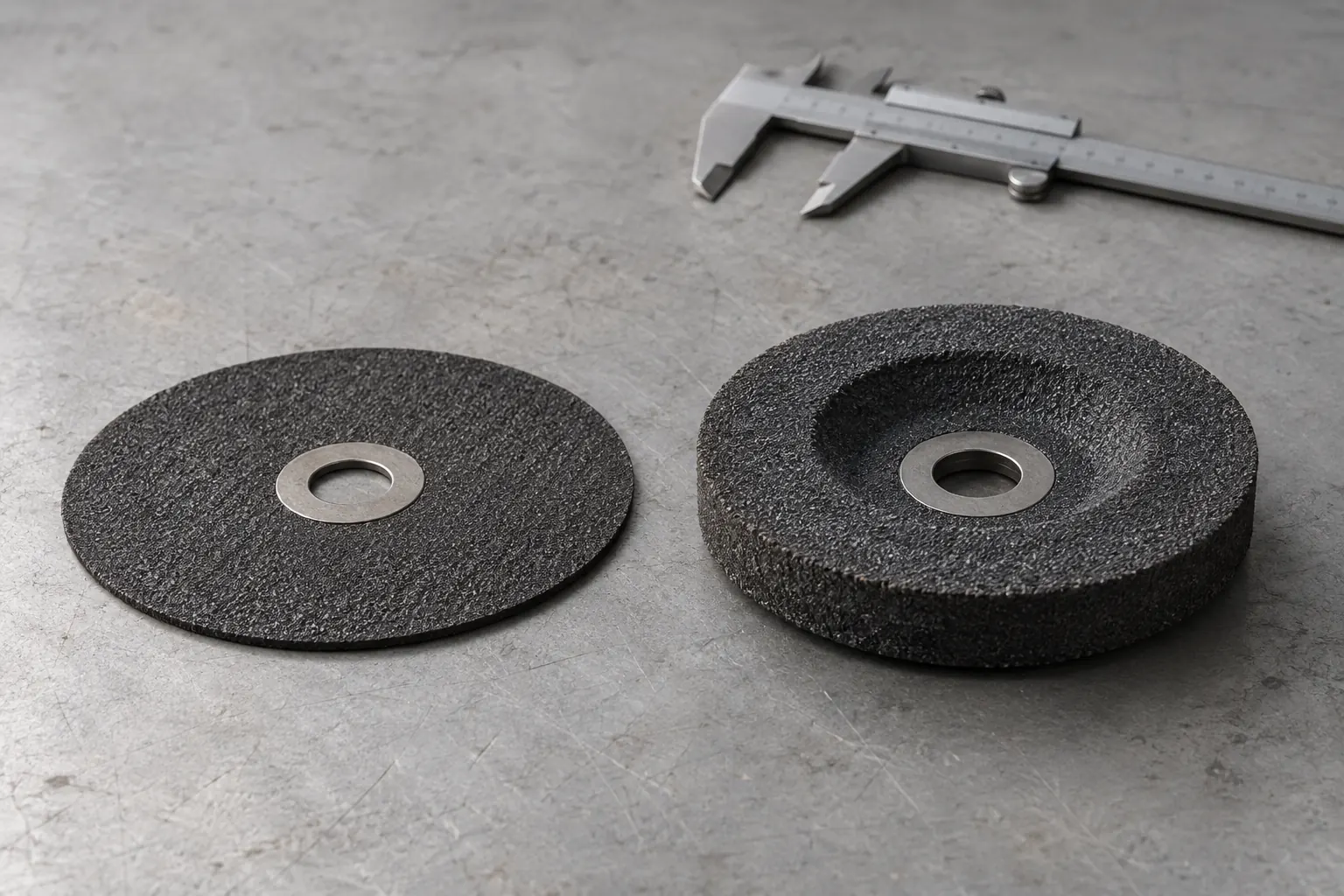
Before approving an angle grinder kit, ask the supplier to identify every included abrasive and its permitted use. Check its dimensions, mounting system, speed rating and required guard against the customer's job and the machine instructions. Fitting the spindle alone does not establish compatibility.
Importers and distributors should resolve these details during sample approval. This guide covers the purchasing checks for common cutting and grinding accessories; operating instructions must come from the manufacturers of the particular tool and abrasive.
Turn a broad request into a specific job
A customer asking for a “metalworking grinder kit” may need to cut sections, dress welds or finish a surface. Treating those requests as one application makes it difficult to specify useful accessories.
Start with three questions: What material is being worked? Is the task cutting or surface treatment? What result does the customer need?
For example, “metalworking” is vague. “A fabrication workshop needs to cut steel sections and separately dress welds” identifies two accessory-selection tasks. This is an example of a clearer brief, not confirmation that a particular machine or disc is suitable.
If the material is unclear, ask for its identification, workpiece photographs and a description of the operation before proposing an accessory bundle.
A cut-off wheel is not a side-grinding wheel
Do not judge an abrasive’s permitted use by thickness alone. In particular, do not use the side of a cutting-only wheel to grind a surface. Bosch’s angle grinder instructions warn that sideways forces can cause cut-off wheels to break. Any combined use must be explicitly supported by the accessory’s markings and the relevant tool instructions, rather than inferred from appearance. Bosch angle grinder instructions
Make this distinction visible in your own product information. Instead of describing everything as a “multi-purpose disc,” identify each accessory by model, intended operation and applicable material.
Check four compatibility details
Dimensions and mounting. Check outside diameter, thickness and mounting system—not diameter alone. Stay within the machine’s specified accessory limits; do not force an accessory into place or alter its mounting hole.
Speed rating. The wheel’s maximum permitted RPM must not be lower than the grinder’s corresponding rated speed. An expectation that customers will avoid full speed is not a basis for approving compatibility.
Guard configuration. Confirm the guarding specified for the operation. A guard included in the box is not automatically suitable for every accessory supplied with it.
Approved application. An accessory that attaches to the tool is not necessarily approved for that tool. Check both manufacturers’ instructions. Bosch application and inspection guidance
In the purchasing record, add a supporting document and the person responsible for confirming each item. This provides a reference when accessories are substituted or a repeat order is placed.
Compare the contents before comparing kit prices
Two quotations labelled “angle grinder kit” may cover different configurations. Ask suppliers to itemize:
- The full machine model and its accessory limitations.
- Each abrasive’s supplier or brand, model, dimensions, application and quantity.
- The specific guard, flanges or locking components and auxiliary handle included.
- Whether pictured abrasives are supplied or shown for illustration only.
- The relationship between manual language, accessory labels and outer packaging.
If a quotation says only “accessories included,” ask the supplier to complete the list above. Check the suitability of any proposed substitute and record its model in the order documents.
Keep a useful sample-approval record
Separate document checks from operational evaluation.
The purchasing team can first photograph the machine nameplate, both sides of abrasive labels, the supplied components and package contents. Compare them with the quotation. Request clarification where labels are unreadable, model numbers differ or important instructions are missing.
Operational evaluation belongs with trained personnel using appropriate protection and the relevant instructions—not improvised overspeed, overload or destructive testing. Norton emphasizes matching abrasives to the application and respecting their speed limits; protective equipment cannot make an unsuitable pairing acceptable. Norton: Proper Protection
Record the actual machine, abrasive, material and operation involved. “Sample passed” alone provides little context, and one sample result should not be treated as evidence for an entire product family.
Give the sales team a practical enquiry form
Use the following fields to collect a clearer brief:
Material: _; operation: cutting / weld dressing / other ; workpiece dimensions: _; angle grinder model: ; required supply: machine / abrasives / complete kit _; destination market and manual language: _. Please attach existing abrasive labels and application photographs.
The sales team can pass the completed form to the person responsible for technical selection. For customers performing several operations, collect separate requirements and check accessories for each job.
Confirm replacement accessories before ordering
Once the machine and supplied accessories are confirmed, keep the abrasive model numbers and application instructions so customers can check future replacement orders.
If you are developing an angle grinder range, explore the FORZMAX grinding and sanding category and send your sourcing requirements, including the material, operation, destination market and proposed kit contents. Confirm the final configuration model by model rather than judging compatibility from product photographs.
The cover is an AI-generated illustration, not a depiction of actual products, dimensions or an approved pairing. Real abrasives must carry complete markings and be checked by model before use.