
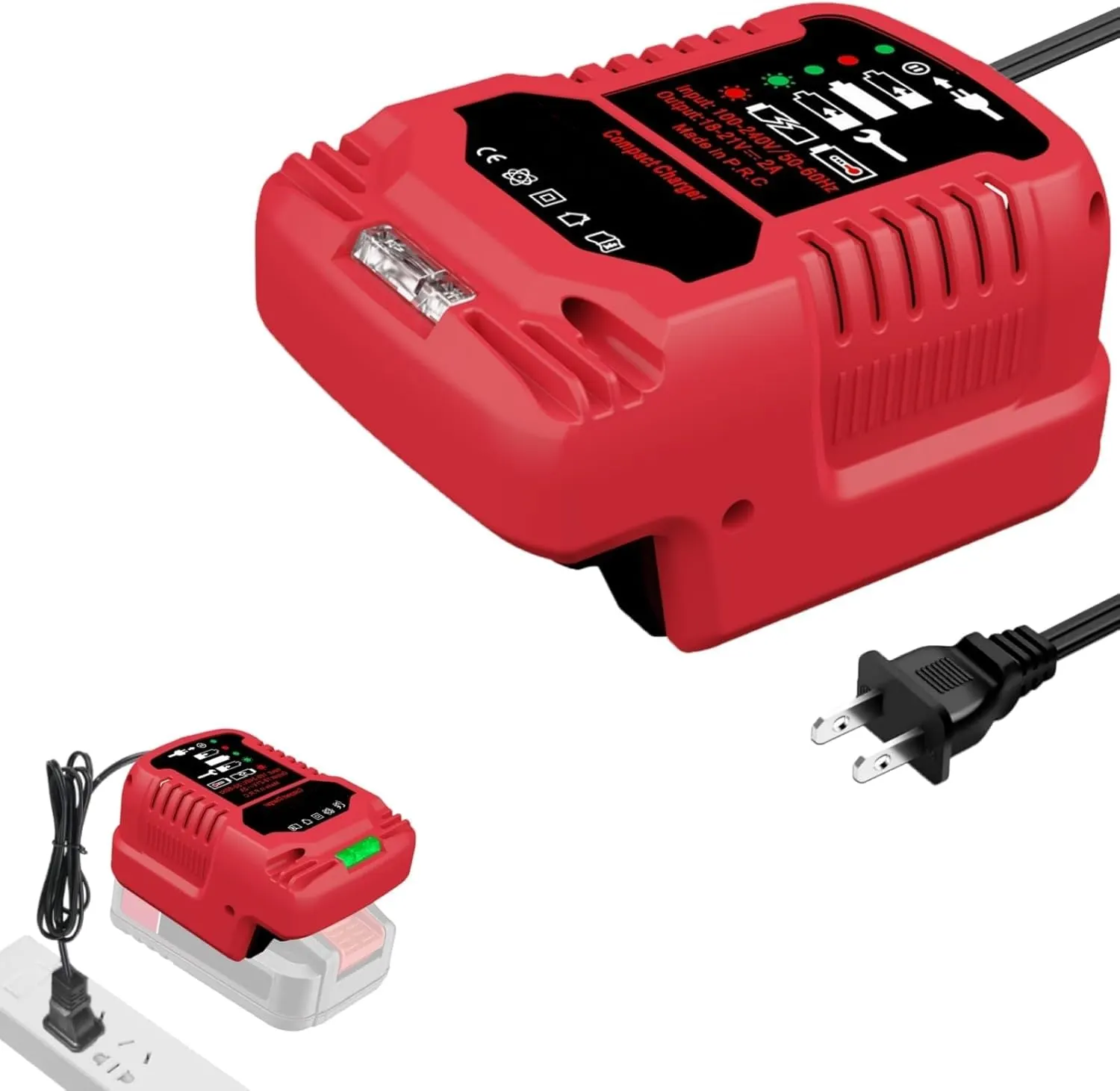
Choose a power-tool charger by its approved battery models, AC input range and destination plug configuration. A plug that fits the socket does not establish electrical compatibility. For a distributor ordering one tool kit for several countries, specify the complete charger version for each destination before approving the quotation.
Start with the quotation line that says 'with charger'
One tool body can end up with one charger description and several destinations. The quotation may hide different charger models or plug versions behind the same phrase. If the destination is still written as 'export' or 'several markets,' stop and ask for the split before comparing prices.

A kit with a charger can share the tool body with a bare-tool offer, but it needs its own kit list and identifier. A bare-tool SKU and a tool-plus-battery-charger-case SKU are not interchangeable.
Use one charger order line per destination. A practical minimum record looks like this:
| Record field | What to write |
|---|---|
| Destination country | The specific market, not a region or 'export' |
| Exact charger model | The supplier's model code for that destination version |
| Charger input | Voltage range, frequency and rated input current or power |
| Plug and cord set | Plug designation, complete cord-set reference and approval status |
| Kit identity | Kit SKU, component list and packaging position |
| Label and manual | Approved label revision and instruction language |
| Approval evidence | Certificate, report, declaration or document reference covering the model |
| Status | Confirmed, pending or rejected for this destination |
Freeze the destination and exact charger model before comparing prices. If a quotation only says 'with charger,' request the model code and market version in writing. The charger record then travels with the quotation, artwork and sample approval, so it does not have to be reconstructed later.
Record the charger model separately from the battery
A platform voltage such as 18 V or 20 V does not identify the destination charger model, its input range or its plug set. Read those fields from the charger label and the approved specification. A shared nominal voltage also does not establish compatibility. A category listing does not establish which charger model and plug version are compatible for each destination. Require both fields in the charger record.
Keep this charger-to-battery check inside the same record as the destination plug and input rating. A later artwork change should not be able to separate the charger model from the battery model it was approved with.
Lock input voltage, frequency and rated input for each destination
For example, a charger labelled 100–240 V AC, 50/60 Hz has a different declared input range from one labelled 220–240 V AC, 50/60 Hz. The second label does not authorize operation on a 120 V supply. A simple plug adapter changes the connector, not the supply voltage. These are label-reading examples, not specifications for a FORZMAX model; use the exact charger manual and nameplate.
Input is the mains electricity entering the charger; output is the electricity supplied to the battery. Match the mains supply to the input rating, then check the manufacturer's approved battery-model list. Neither an 18 V tool label nor matching contacts proves that a charger is suitable.
Specify the destination plug and the complete cord set
State the destination country together with the plug designation. A plug letter alone does not confirm that the complete cord set meets national requirements. The country and the plug belong in the same field.
Record the pin configuration and dimensions, grounding or fuse arrangement, voltage and current rating, certification-mark scope and connector engagement. Compare these with the approved sample, drawing and target-market requirement. Review the complete plug and cord set against the order, destination market, packaging artwork and supporting compliance documents. General plug appearance is not confirmation of compatibility.
Common examples are A/B for the USA and Japan, G for the UK, and I for Australia. These letters identify plug families, not a complete approved cord set. Check the destination-specific standard and drawing. Reference: MAG Kabel.
Some suppliers offer interchangeable plugs or multi-country chargers. Treat them as variants to verify, and confirm which plug is fitted, packed and declared for each destination. Interchangeable plugs do not prove that any plug can be packed for any market.
Approve the label, manual and marks as one variant
Capture the label fields that identify the product being inspected: rated AC input-voltage range, rated input frequency, rated input current and model number. Add product type, model and market language to the product identity.
Agree label content, manual language, warning statements, production-date coding and country-of-origin marking in the written specification. Do not leave those choices to final packaging artwork. Record certification-mark positions on the label and compare the certificate model with the label content during sample review.
Include only marks supported for the exact product and destination. At label review, check three identifiers together: the certificate model, the label revision and the destination version of the charger. Record the evidence reference beside the mark position. A family name or a similar model is not the verification target.
Match the charger to the kit, packaging and sample
Specify every kit component by model, quantity and packaging position. The charger should have its own line even when it is packed inside the same case as the tool and battery. Keep the bare-tool kit list separate from the tool-plus-battery-charger-case version. Do not put the bare-tool packaging description on the charger kit or reuse one SKU for distinct combinations.
Reconcile the model and SKU across the product-body label, retail-box label, approved specification sheet, purchase order, packing list and outer-carton marking. Include the model list, label locations and dimensions, target languages, battery specification, kit contents, case choice, box and carton requirements, barcode data and required evidence in the artwork brief.
For the first sample, compare the unit with the approved sample, purchase order, specification, packaging artwork, bill of materials and target-market requirements. Check the complete plug and cord set, label fields and pack-out, and record results by unit and configuration.
For kits with several plug or accessory variants, count identity as well as quantity. A correct total can conceal the wrong destination part. A routine sample check records observations against approved requirements; it does not replace certification, regulatory approval or formal laboratory testing.
Request approval evidence and control changes before quoting
For EU orders, the European Commission explains that the Low Voltage Directive covers equipment within specified voltage limits and that the manufacturer is responsible for the required conformity assessment. A voluntary certificate alone is not proof of compliance. Check the applicable legislation, declaration, technical documentation and exact product configuration; do not treat a country-to-logo list as a compliance decision. European Commission: Low Voltage Directive guidance.
A practical split-order example
Suppose the same drill kit is ordered for two destinations. Keep the tool and battery references, but give each approved charger-and-cord combination its own kit variant. Compare the plug drawing and label photo against that variant at sample approval. At packing, count each variant separately: the correct total number of chargers can still hide a shipment containing the wrong plug version.
For a quotation, send FORZMAX the destination countries, battery model, intended mains supply and kit quantities through our customization page. Include the required plug or cord-set specification and any local compliance requirements already confirmed with your adviser. Discuss the charger configuration.