
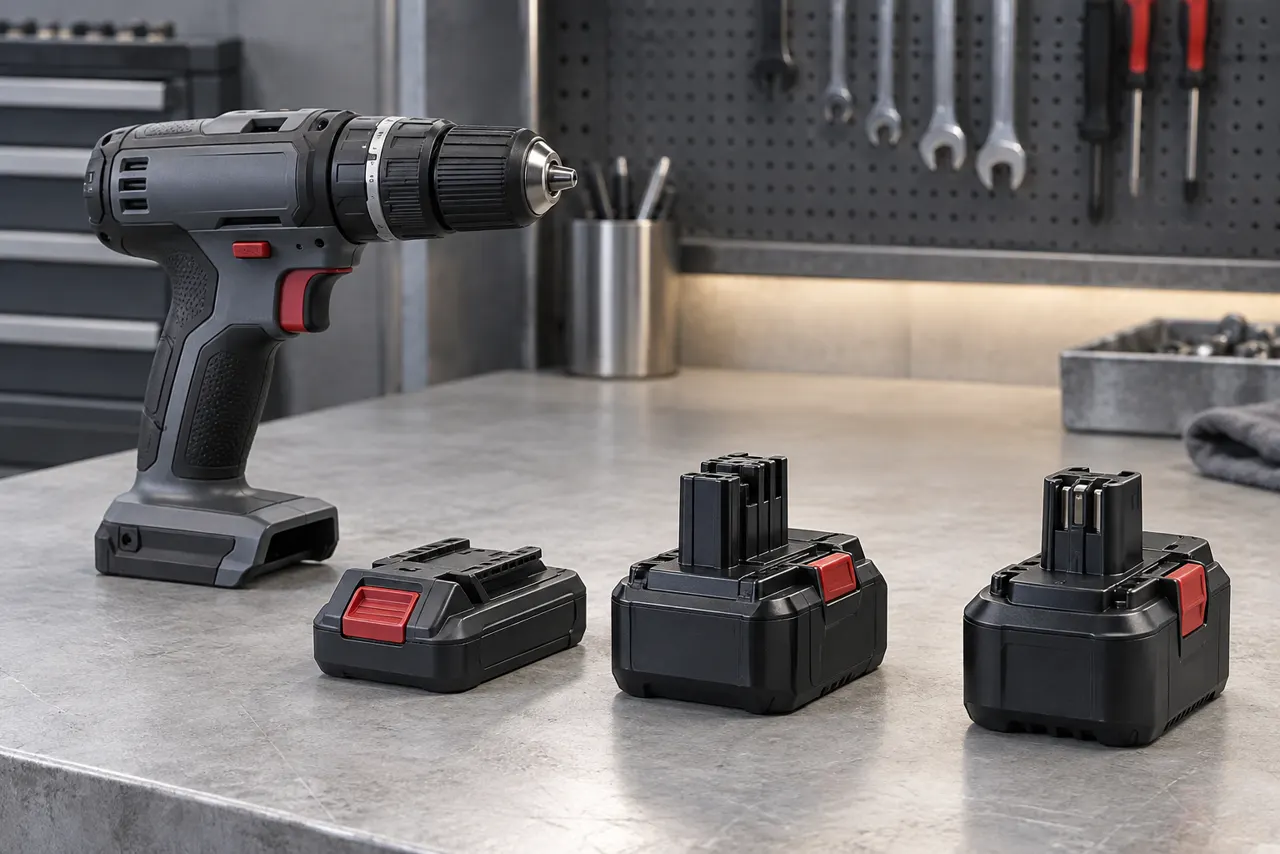
The cover is a concept image, not a photo of a FORZMAX model or a product test.
“21V is stronger than 18V” is a poor starting point for selecting a cordless drill. Labels may use different voltage conventions. Even when two tools carry the same nominal voltage, that alone does not establish equal drilling performance, runtime or battery fit. For importers and distributors building a range of drills, spare batteries and chargers, the useful order is: define what the number means, verify the complete battery platform, then compare tools under equivalent working conditions.
18V and 20V Max can describe different ratings, not different performance tiers
One documented example is DEWALT’s 20V MAX system. DEWALT says 20V is the maximum initial battery voltage measured without a workload, while nominal voltage is 18V. A drill marked 20V Max is therefore not automatically more capable than one marked 18V merely because the first number is larger.
The qualification is this system. Do not infer that every battery labelled 20V or 21V has the same cells, configuration or measurement method. If “21V” appears without explaining whether it is a nominal or maximum figure, request the battery-pack specification rather than supplying your own interpretation.
When comparing two catalogues, put these fields side by side: pack model, nominal voltage, definition and measurement conditions for any maximum voltage, rated capacity in Ah or rated energy in Wh, and charger model. Voltage alone cannot tell you how long a pack will run; load, capacity, tool efficiency and usage pattern also matter.
Why might two “18V” batteries still be incompatible?
A battery platform is a defined system, not just a voltage number. Makita’s official FAQ describes compatibility separately for its CXT, LXT and XGT platforms. The Bosch AMPShare battery manual instructs users to follow the tool manual’s battery recommendations and use recommended chargers. These statements apply to the manufacturers’ specified systems; they do not imply that 18V batteries from different brands are interchangeable.
Check compatibility in three steps:
- Obtain a written compatibility list. Identify the exact drill, battery-pack and charger models, then ask the supplier to confirm each combination. “Both are 18V” is not confirmation.
- Check the interface and controls. Physical fit is only part of the question; terminals, latches and any required protection or communication functions must also be appropriate. A similar-looking connector is not manufacturer approval.
- Check the sales bundle. Bare tools, one-battery kits, two-battery kits and spare packs should use a consistent model list across product pages, cartons, manuals and after-sales parts catalogues.
Do not modify a battery interface to test a combination or try charging with an unapproved charger. The Bosch manual warns that a charger suitable for one battery type can present a fire risk with another. If there is no written compatibility evidence, pause the sales claim and ask the supplier to resolve it.
How to compare two drill samples fairly
Voltage helps identify a battery system; it does not replace the actual drilling task. First define the materials, common bit diameters and frequency of continuous work your customers face. Then test samples in comparable conditions: the same type of bit, material and hole size; batteries with similar rated energy and state of charge; and a record of the drill and pack model used.
A short test log should answer:
- What does each supplier mean by “maximum torque,” and under which conditions was it measured? Do not rank figures obtained by unlike methods.
- Can each tool complete the target operation consistently? Record drilling time and observations such as stoppage or overheating, rather than copying no-load RPM alone.
- Does weight, handling or battery changing affect extended work? Keep the working conditions with every observation; one sample is not a guarantee for an entire production batch.
- Will the same battery, charger and wear parts remain available for after-sales support? This is a product-line decision, not a single drilling score.
This is a comparison method, not a FORZMAX test result or a claim about another brand. For concrete drilling, establish first whether the task calls for a drill, hammer drill or rotary hammer; otherwise a tool-type difference may be misreported as a voltage difference. See our drill, hammer drill and rotary hammer guide.
Six details to put in the inquiry
You need not decide in advance that “18V beats 21V.” A more useful request to suppliers specifies:
- Target work, materials and typical hole diameters.
- Drill models and the name of the intended battery platform.
- Battery count, exact pack models, capacities and spare-pack requirements for each kit.
- Matching charger models, destination-market mains input and plug requirements.
- Whether packaging voltage is nominal or maximum, with matching specifications, labels and manuals.
- The exact models, if any, approved to share batteries with future impact drivers, saws or work lights.
You can shortlist models from FORZMAX drills and fastening tools and batteries and chargers, then send us your intended work and bundle requirements. Being listed in the same category does not establish cross-model compatibility; verify the final drill, battery and charger combination against the project’s model list and specification documents.