
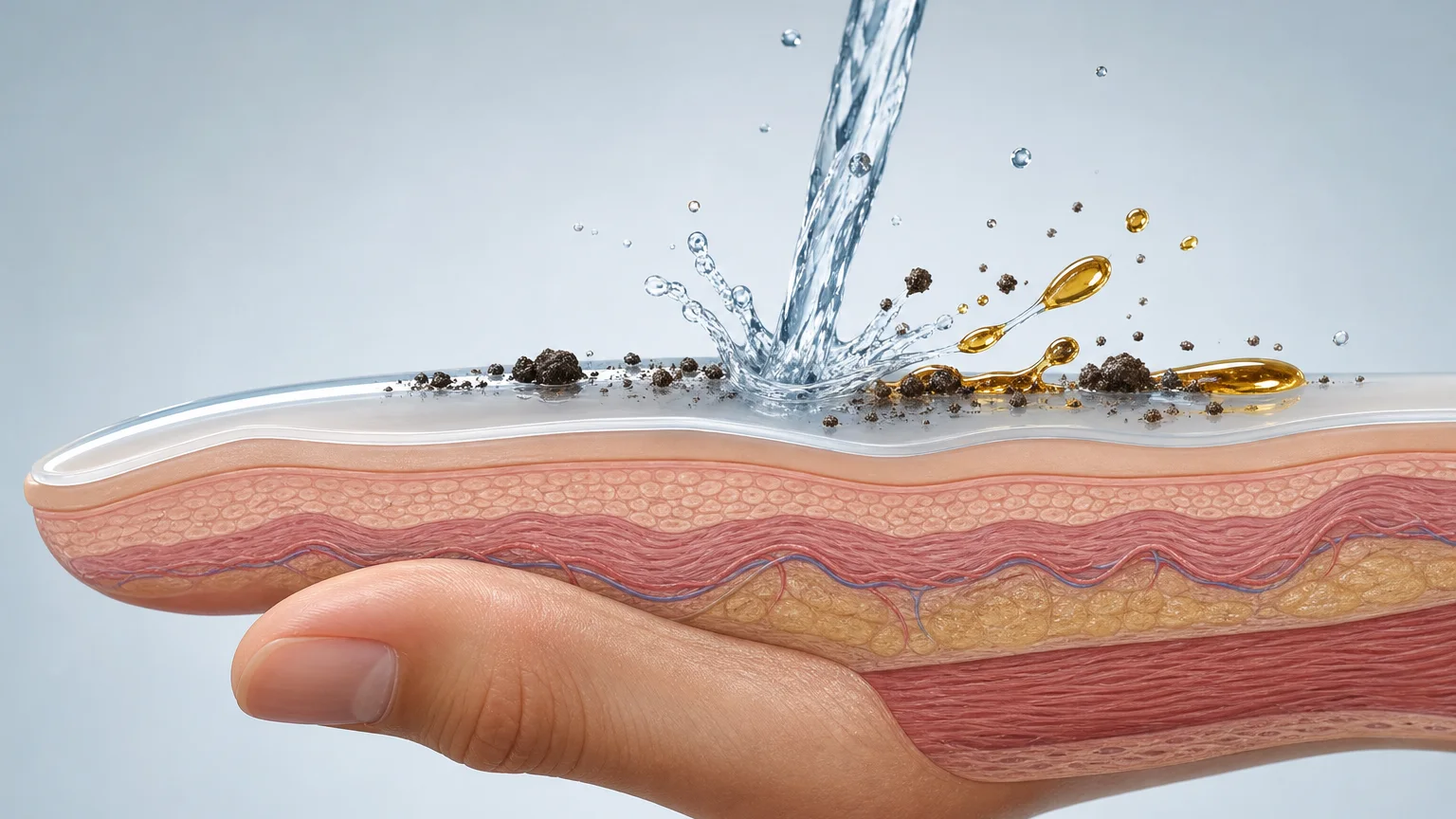
ONWEX barrier gel is an invisible protective layer applied before work that reduces the adhesion of paint, grease, adhesives, and similar substances to the skin. However, according to Tools In Action's public review, it is an auxiliary protective measure and cannot replace gloves. This article explains its principle, usage steps, applicable scenarios, and the boundary between it and gloves, and provides a reusable verification checklist.
How It Works
The product has a water-based formula. According to the reviewer, it dries in about 30 seconds after application, forming a film on the skin that can be rinsed off with water. Stains adhere to the film and are carried away by rinsing with clean water. According to the review, the film is not water-resistant and may come off with sweat inside gloves or after prolonged immersion in water. The water-based formula means the product uses water as the main solvent, making it easy to clean with water and relatively low in odor; however, the protective layer itself is not water-resistant, which is the root of this limitation.
Usage Steps
- Before work, pump out an appropriate amount of gel and apply it evenly to your hands and arms.
- Wait about 30 seconds until it no longer feels sticky, confirming that a protective layer has formed.
- Start working; if you wash your hands midway or the task takes longer, reapply.
- After finishing, rinse with clean water, and stains will come off with the protective layer.
Key Variables and Effects
| Variable | Impact | Recommended Action |
|---|---|---|
| Application amount | Insufficient application can cause missed spots; excessive application prolongs drying time | Test on one hand first, then reapply as needed |
| Coverage uniformity | Fingertip gaps, nail edges, and wrists are easy to miss | Pay special attention to these areas |
| Drying time | Judge by touch until no longer sticky; wait longer in high humidity | Do not rush to start work |
| Sweating and hand washing | Must reapply after washing hands mid-task; sweating under gloves may compromise the protective layer | Check periodically during work |
Applicable Scenarios
Suitable for surface-adhered contaminants such as paint, stains, motor oil, adhesives, epoxy, silicone, and tree sap. Not suitable for operations requiring mechanical or chemical protection, such as high heat, sharp objects, strong acids or alkalis, solvents, or prolonged water immersion.
Decision checklist:
- Is the contaminant a surface-adhered stain? If yes, a gel may be considered; if no, choose gloves.
- Will your hands sweat heavily or come into contact with water? If yes, gel effectiveness may be reduced.
- Is there a risk of cuts, burns, or corrosion? If yes, gel cannot replace protective gloves.
Comparison with Gloves
| Dimension | Barrier Gel | Gloves |
|---|---|---|
| Protection type | Prevents stains from adhering | Cut, abrasion, and chemical resistance |
| Flexibility | No thickness; does not affect touch | Has thickness; fine operations may be restricted |
| Chemical resistance | Water-based; easily comes off with sweat/water | Requires selecting specialized materials based on the chemical |
| Cleaning | Rinses clean with water (reviewer experience) | Requires washing or replacement |
The two can be combined: apply the gel and wait for it to dry, then put on gloves. However, sweating may weaken the gel's effect, so check periodically.
Common Misconceptions
- An “invisible glove” is not a glove: It has no cut, puncture, or chemical resistance certification.
- One application lasts a day: There is no unified standard; reapply after washing hands or sweating.
- It protects against all stains: Evaluations only cover surface-attached stains; strong solvents and corrosive chemicals are not included.
- It makes skin healthier: This is a functional claim that requires SDS and skin test reports to support it.
Pre-Purchase Verification Checklist
- Request the SDS, ingredient composition, and skin irritation test reports from the supplier.
- Confirm the applicable stain list, reapplication interval, and failure conditions.
- Confirm whether the product can be used under gloves and how well it adheres when sweating.
- Confirm whether the product is classified as PPE or only as an auxiliary cleaning product.
- Request third-party test reports rather than relying only on marketing page data.
- Ask whether the product has been dermatologically tested and is suitable for sensitive skin.
- Ask the supplier to explain the adhesion test method used under gloves when sweating.
- Request the recommended reapplication interval and the basis for it.
Three-Step Verification Method
- List the contaminants actually encountered and determine whether they are adherent stains.
- Apply to a small area of skin, contact the target stain, then rinse with water and observe whether any residue remains.
- Retest while wearing gloves or sweating to confirm the protective layer persists.
Frequently Asked Questions
Can ONWEX replace gloves?
No. It has no certification for mechanical strength or chemical permeation resistance; it only reduces stain adhesion.
How long does one application last?
There is no uniform standard. Reapply after washing hands, sweating, or prolonged work; confirm the specific interval with the supplier.
Can it be used on sensitive skin?
Check the SDS and ingredient information first, and test it on a small area of skin.