
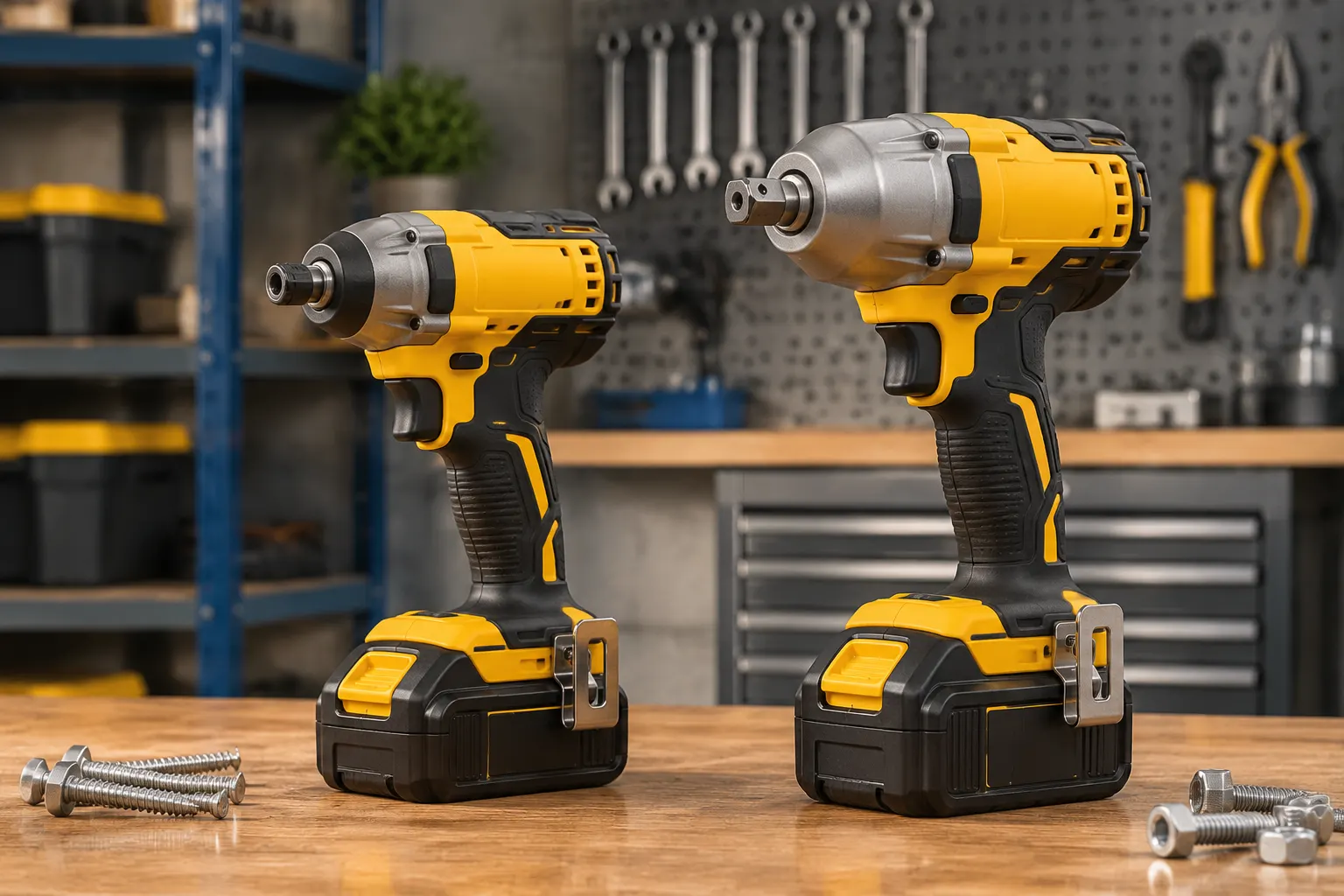

An impact driver and an impact wrench shown side by side. Image for illustration only, not a specific product or performance claim.
When two fastening tools appear on the same quotation, read the holder specification first. A 1/4-inch hex holder accepts driver bits; a square drive accepts sockets. For a wrench, also ask whether the quoted torque is for tightening or loosening.
The split that holds runs in four steps: assign each quoted model to a holder, then to a fastener job, then to a torque claim recorded with its type, unit and test conditions, then to the kit and warranty terms that will travel with it in the dealer sheet. Both families can be stocked on that basis. The family label on its own cannot order the range.
This is a range-review procedure for distributors and buyers, not a model ranking or a workshop procedure for precision tightening. Per-model bit ranges, socket ranges, torque figures and warranty terms still come from the supplier's quotation, sample and documents. The record keeps those documents attached to the model and kit they describe.
Split the quotation by tool holder, not by the word impact
Read the holder before the product name. An impact driver is built around a 1/4-inch hex collet, a spring-loaded chuck that accepts hex-shank driver bits in Phillips, Torx, hex (Allen), flat and Robertson forms. An impact wrench works the other way: a square drive meant for sockets, usually 1/2-inch, though other sizes are sold (AIMS Industrial product guide; RS Components guide).

A hex-shank driver bit being loaded into the 1/4-inch hex collet of a cordless impact driver.
The holder decides whether a line takes bits or sockets, so read it before opening the torque column.
| Family | Output interface | What it accepts | Quick check on the quotation |
|---|---|---|---|
| Impact driver | 1/4-inch hex collet | Hex-shank bits in several head types | Does the line state the collet, or only impact? |
| Impact wrench | Square drive (anvil) | Sockets, extensions, adapters | Is the drive size stated in inches? |
Square drive sizes carry different duty expectations. One trade guide places 3/8-inch with light-duty work and smaller automotive fasteners around M6 to M16, describes 1/2-inch as the usual automotive and general industrial size covering most lug nuts and structural bolts up to M24, puts 3/4-inch into heavy industrial and structural work at M24 and above, and reserves 1-inch for very heavy industrial and mining use. That is one guide's description of the market, not a fixed rule that a given drive size delivers a given torque (AIMS Industrial product guide).
Combination tools exist, so confirm the holder model by model. A product name is not enough. If the job needs sockets for nuts and bolts, the selected tool has to provide the required square-drive connection (BMG impact wrench guide).
Add a status column with two values only: holder-confirmed or holder-pending. A holder-pending line stays on the review sheet but does not enter a torque comparison. The buyer can then go back to the supplier for the holder code, drive size or chuck type.
Assign the fastener job before choosing the model
Build the job list before the model list. The job list is the demand-side document: it shows which family is eligible for each request, while the model list only shows what the supplier offers. For each application the distributor serves, record:
- screw head type and length;
- nut or bolt size across flats;
- the tightening procedure the customer must follow;
- likely removal resistance (new, rusted, previously over-tightened);
- working access and the position the tool is used in.
On the driver side, published trade guides describe screwdriving and small-fastener assembly: deck screws, cabinet installation, furniture assembly, light framing and general repair (Kreg Tool guide), plus long fasteners and jobs with many small, low-torque screws (RS Components guide). Those applications describe where hex-shank driving is the practical interface; they are not a ranking of the families.
A hex-to-square adapter does not turn a driver into a wrench. One trade guide limits adapter use to light work, M6 to M10 bolts in low-torque applications, and notes that adapters are subject to torsional stress when used beyond their rating and can fail unexpectedly. The same guide warns that standard chrome-plated sockets are not rated for impact use (AIMS Industrial product guide). Treat an adapter as an accessory for occasional light socket work, not as the socket solution for a range.
On the wrench side, place socket-based nut and bolt work: wheel nuts, structural fastening, machinery and equipment maintenance, and stubborn or corroded fasteners that need removal torque (Kreg Tool guide; RS Components guide).
Avoid a universal best-tool rule. Write against each quoted model the job it is meant to cover, and flag any customer job that crosses the boundary, such as a light automotive request that turns out to include corroded wheel nuts. If a job needs sockets beyond light duty, do not plan an impact driver with an adapter as the main answer; move it to the wrench side or record it as uncovered.
Plan two accessory ranges: hex bits and impact sockets
Bits and sockets are separate assortments, planned against the jobs above rather than bought as one generic bundle. Keep each accessory line tied to a tool holder and a customer job instead of chasing the longest accessory list.
Driver side. Plan bit head types (Phillips, Torx, hex (Allen), flat and Robertson) and the common 25 mm short and 50 mm long hex-shank lengths as categories, then read the exact per-model range from the catalogue (AIMS Industrial product guide). Not every hex-shank bit is impact-rated, and bits without that rating can shatter in an impact driver (RS Components guide).
Wrench side. Record the socket size in millimetres separately from the drive size in inches. A retail socket listing makes the difference visible: an 8 mm socket is listed with a 1/2-inch shank, and the same 1/2-inch drive range runs up to 32 mm, which shows how far a socket range can extend beyond small fasteners, not a required set (Tork Craft impact sockets). Deep and standard variants share socket size and drive but carry a deep designation, and bit sockets are catalogued by internal hex size and length on a stated drive, such as an H4 hex bit socket at 43 mm on a 1/2-inch drive.

On the wrench side, the socket size is recorded separately from the square-drive size, and the socket itself must be impact-rated.
Sockets must be impact-rated. Standard chrome-plated sockets are not designed for the shock loads of an impact mechanism and can shatter, so impact sockets are the intended accessory for socket work (AIMS Industrial product guide).
Socket size alone is not the check. Confirm drive size, socket type, fastener fit and the pin, ring or other retention method specified for the tool and accessory (BMG impact wrench guide). One sourcing checklist asks for the drive specification, socket retention method, bare-tool weight and vibration data per model (FORZMAX cordless impact wrench guide). That check keeps a socket range from being approved on the strength of a size list alone.
Exact per-model bit ranges, socket ranges and retention systems remain catalogue questions. Neither family has a universal bit set or socket set; both follow the fastener mix the distributor intends to serve.
Record the torque claim with its type, unit and test conditions
A torque number without its claim type cannot be compared. Maximum torque is a peak reading under ideal conditions, breakaway torque is the force required to loosen an already tightened fastener, and tightening torque is the actual capability for tightening work (FORZMAX cordless impact wrench guide). Breakaway is usually the higher figure, so confirm the advertised type before setting two models against each other (KOBOTECH torque guide). A figure can be accurate and still unusable for comparison if its label, unit or test condition is missing.
| Claim on the sheet | Question it answers | What it does not establish |
|---|---|---|
| Maximum or peak torque | Headline output under stated conditions | Working output on a real joint |
| Fastening (tightening) torque | Tightening capability | Removal capability |
| Breakaway (nut-busting) torque | Loosening capability | Equivalent tightening capability |
Do not compare one supplier's fastening claim with another's breakaway claim. If the claim types or test conditions are not comparable, keep the figures in separate columns and mark the comparison incomplete (fastening vs breakaway torque guide).
Record the unit exactly as stated: N·m, ft-lb or in-lb. Keep it consistent across the product table, packaging and dealer material. Where both N·m and ft-lb appear, verify the conversion and retain the same fastening or loosening label beside both values (fastening vs breakaway torque guide).
Then record the test fields behind the number:
- measurement method and instrument, with calibration status where stated;
- test duration, because a short impact burst can differ from a sustained working test;
- joint and fastener condition, including material, washers, thread condition and lubrication;
- socket, accessory and any extension used;
- battery model, capacity and state of charge, or air pressure for pneumatic tools;
- ambient and tool temperature;
- test standard and version where stated;
- exact tool revision and anvil size.
These fields matter because tightening torque changes with impact duration and joint characteristics, and because battery discharge, socket condition, bolt characteristics and extensions all affect fastening performance (fastening vs breakaway torque guide). Cordless output depends on battery voltage, cell condition, state of charge, temperature and electronic current limits, and published figures are comparable only when method, socket, power supply, battery condition and test fastener are similar (PWR Tools torque explainer).
One supplier guide suggests asking whether figures reference IEC 62841-1 or EN 62841-1, and noting the version year, battery charge, ambient temperature and fastener condition (FORZMAX cordless impact wrench guide). Treat that as a question for the supplier, not as proof that the tool meets any standard; the standard text and the model's own manual confirm applicability.
If the supplier cannot state the test conditions, the figure is not comparable and should not be used to rank models.
The same record block can be applied to impact drivers, but published guidance does not document a driver-specific rating convention or test protocol. Ask the supplier how the driver figure was produced rather than assuming the wrench conventions carry over.
Keep final tightening separate. Where a joint has a specified final torque, follow the required torque-control procedure (fastening vs breakaway torque guide); an impact wrench is not a precision fastening tool for that purpose (FORZMAX cordless impact wrench guide). Torque figures and test-condition records for the models a distributor would actually stock belong in the quotation, sample test or inspection record, and the claim record is finished only when its type, unit and condition block can travel with the model into the dealer sheet.
Compare the kit, battery and charger configuration
Two quotations can describe the same tool and still be different products. For each line, record whether it is a bare tool, a complete kit or separately priced SKUs, and list the battery model and capacity, charger, case and accessories (BMG impact wrench guide). Make the kit record specific enough that a buyer does not have to infer contents from a product image.
Torque claims should correspond to the exact combination of tool, battery, charger and accessories being supplied. If a demonstration uses one battery pack and the retail kit includes another, record the difference before accepting the result as evidence for that kit (fastening vs breakaway torque guide).
Battery condition belongs in the evidence too. A fully charged pack and a partly discharged one may produce different results, and tool temperature can affect electronic current limits, lubrication and motor output. When the configuration lines do not align, mark the comparison as a configuration mismatch rather than filling the gap with the headline torque figure. A configuration mismatch is a record status, not a reason to fall back on the brochure number.
Close the range record with warranty, parts and a clear status
The commercial block sits beside the technical one in the same per-model record. For each quoted model and each kit, require written warranty coverage and exclusions, including how damage from misuse and ordinary wear are treated, and ask separately about tool warranty, battery warranty and registration requirements (FORZMAX wholesale supplier checklist). A range-level warranty statement does not settle a line-by-line decision, because coverage has to attach to the model and kit being quoted.
Also confirm:
- the defect remedy (replace, credit or return) and the warranty-claim response time, plus whether the supplier includes a percentage of free spare parts with bulk orders (FORZMAX wholesale supplier checklist);
- whether spare parts are stocked and how quickly they ship, ideally as a written availability commitment;
- who is permitted to fit spare parts.
On the last point, Bosch Professional's South Africa spare-parts page states long-term parts availability even when a tool is no longer in production, and states that spare parts must only be fitted by specialist personnel. That is one manufacturer's after-sales positioning, not a comparison of impact-driver and impact-wrench policies (Bosch Professional SA).
Warranty periods need the same attribution discipline. One checklist states that industry guidance recommends at least 12 months for industrial tools, with premium manufacturers offering 24 to 36 months; that is one site's stated guidance, not a universal rule (FORZMAX manufacturer checklist). A Greenworks impact driver is reported at a 5-year tool warranty and 3-year battery warranty, and the report itself says to confirm the terms with official information (FORZMAX impact driver review). Neither example establishes a warranty or service-part split between the two families. Periods, exclusions, battery coverage, claim handling and parts stocking stay model- and supplier-specific until documented.
Build the one-page range record with these columns:

Generic printed record sheets with blank table and checkbox layouts on a distributor-style desk; an illustrative scene, not an actual supplier document.
| Field | Entry |
|---|---|
| Family and exact model | Driver or wrench, model code, tool revision |
| Actual tool holder | Hex collet or square drive, with size |
| Job served | The fastener application this model covers |
| Bit or socket range | Head types and lengths, or socket sizes plus drive |
| Torque claim | Type, unit, figure |
| Test conditions | Method, duration, joint, battery state, standard and version |
| Kit configuration | Bare tool or kit, battery model and capacity, charger, case, accessories |
| Warranty and parts | Coverage, exclusions, remedy, response time, parts commitment |
| Status | Confirmed or pending, field by field |
Approve the range on the record, not on the family label. If a field is pending, the family comparison is not complete, and the quotation should not be presented as approved. Carry the status column from the first holder check to the last warranty and parts check, so no line is approved on a partial record.
Conclusion
The split between impact driver and impact wrench is a documentation exercise before it is a purchasing one. For each quoted model, write down the actual tool holder, the fastener job it is meant to cover, the bit or socket range beside it, the torque claim type with unit and test conditions, the exact kit and battery configuration, and the warranty and parts terms.
Where a field is unconfirmed, keep it pending rather than filling it from a brochure headline. That record lets a distributor stock both families without comparing unlike claims or promising a capability the documents do not support.
Planning a range that includes both families? Share the target market, the fastener mix you intend to serve, the candidate models, the kit and battery configuration, and the destination requirements, then ask for the torque evidence pack and warranty terms with the quotation.