
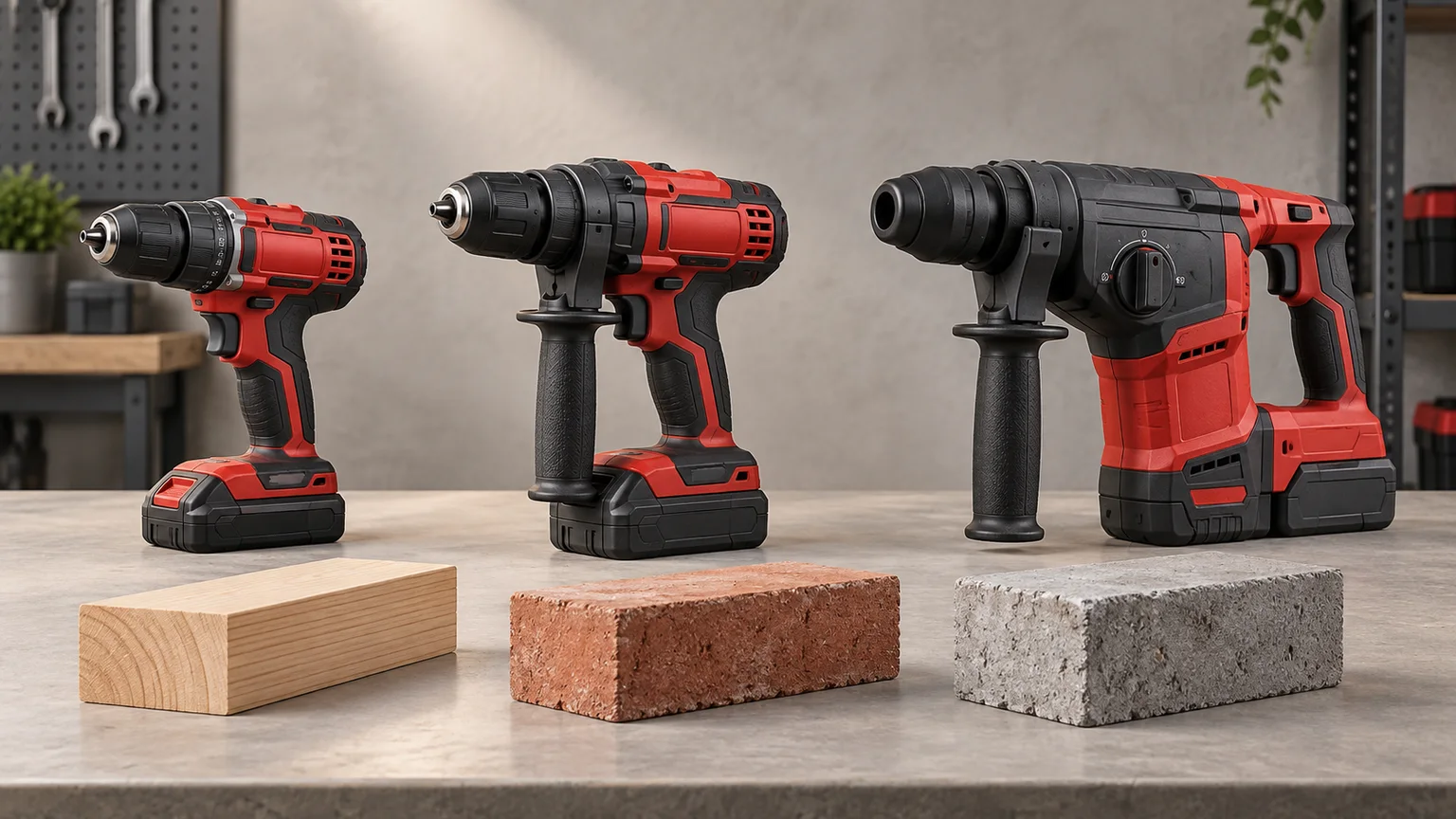
Assembling furniture, fixing a bracket to brick and drilling repeated holes in concrete are different jobs. Start with a drill/driver for general drilling and screws, consider a suitable hammer drill for occasional masonry holes, and prioritise rotary hammers for repeated concrete drilling. Match the material, hole diameter, depth, bit and workload together.
“Cordless” describes the power supply; “hammer” describes an operating mechanism. A cordless tool can also be a hammer drill or a rotary hammer. This FORZMAX guide explains selection principles, not the tested performance of a particular model. The AI-generated cover illustrates tool categories, not actual products offered for sale.
What does each type do?
- Drill/driver: rotates a bit to drill. Models with appropriate modes and a clutch also drive screws. Look at control, chuck capacity and the drilling range specified for each material.
- Hammer drill: adds impacts along the bit’s axis. On switchable models, turn hammer action off for ordinary drilling. Suitability for particular masonry and hole sizes depends on the model.
- Rotary hammer: serves applications such as concrete drilling, commonly with SDS-plus or SDS-max holders. Compare impact energy, recommended drilling range and modes—not housing size. A separate chiselling mode is not universal.
An impact driver is different again: its rotational impacts help drive fasteners. A shared word in the name does not make it a substitute for a concrete-drilling rotary hammer.
Choose around the material
Wood and metal: start with the bit and rotation mode
A drill is usually the starting point for furniture assembly and ordinary wood or metal holes. Use a material-appropriate bit and the specified speed and feed. Adding hammer action does not make these jobs better. For screws, consider clutch control and the correct driver bit; drilling mode is not precision torque control.
Brick: identify the masonry, not just the wall
For occasional holes in solid brick, consider a hammer drill rated for the task. Hollow brick, fragile blocks and finishes need separate attention: the fixing manufacturer may specify drilling without percussion to protect the hole walls. Check the substrate and anchor instructions before choosing a mode.
Concrete: consider diameter, depth and repeated work
A rotary hammer is generally worth prioritising for repeated concrete holes. Ask about the recommended working range, not only the maximum diameter on a label. Reaching a limit occasionally is different from repeating a task all day. If reinforcement or structural elements are encountered, do not force through them; obtain a qualified assessment.
Tile: treat the finish and backing separately
Use a bit suited to the tile type with percussion off at the surface. After the finish, reassess the substrate underneath. One wall may require a change of bit or mode. Follow the bit maker’s cooling and speed instructions.
Five checks that matter more than the biggest number
- Diameter and depth: check ratings by material. A wood capacity is not a concrete capacity. Deep holes also require suitable working length and chip clearance.
- Chuck and shank: three-jaw chucks, hex shanks and SDS holders are different systems. Match the bit to the material, interface and mode.
- Speed, impact rate and impact energy: describe different characteristics. Higher impacts per minute alone do not prove faster concrete drilling; torque alone cannot rank different tool types.
- Position and frequency: overhead, confined-space and repeated work change the importance of weight, length, side handles, vibration control and dust extraction.
- Battery and accessories: compare working weight with the battery installed. Check exact tool, battery and charger compatibility; equal voltage labels do not establish interchangeability.
If progress stops, check the setup—do not push harder
Stop and isolate the tool according to its manual before checking a worn bit, direction, mode, unexpected material or an exceeded working range. More pressure is not a remedy for an unsuitable setup. Stop for binding, abnormal heat or unusual noise and follow the manufacturer’s instructions.
Check for hidden services and structural restrictions before drilling walls. Concrete and masonry drilling can generate respirable crystalline silica dust. Use task-appropriate dust collection and the respiratory, eye and hearing protection required locally. Cleaning afterwards is not a substitute for controlling dust at its source.
Send a useful specification, not just a voltage request
- Substrate and finish: concrete, solid brick or a tiled wall, for example.
- Usual and maximum hole diameter, depth and approximate holes per day.
- Required drilling, screwdriving or chiselling functions.
- Existing bit interfaces, battery platform and local charging supply.
- Working position, weight limits, extraction and included accessories.
“Repeated bracket installation in concrete, typically 8 mm diameter and 50 mm deep, with dust collection” is more useful than “a powerful drill.” These dimensions are an illustrative brief, not a FORZMAX product rating. Actual hole dimensions must follow the fixing instructions and installation design.
Frequently asked questions
Is a hammer drill always the best single tool for home use?
No. For furniture and screws, a manageable drill/driver may be more useful. Occasional suitable masonry work may justify a hammer drill; repeated concrete drilling calls for considering a rotary hammer. Extra functions do not improve every task.
Can a rotary hammer replace a drill?
Some support rotation-only drilling and approved chuck accessories. Check the model’s manual rather than assuming this. Even then, size, weight and control may make it unsuitable for fine assembly.
How do I request a FORZMAX quotation?
Explore drills and fastening tools or rotary hammers and demolition tools, add candidates to your inquiry list and include your material, hole dimensions and workload. A clear job description makes model suitability—not just price—comparable.