
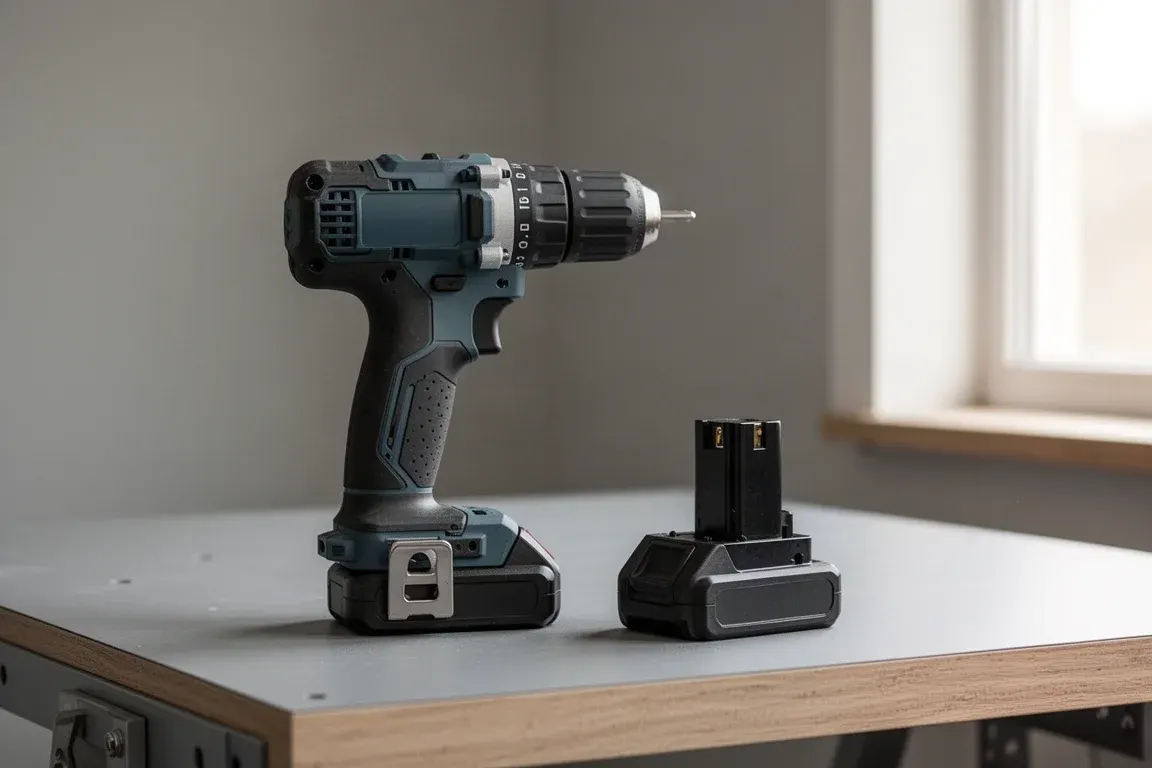
5S means five cell groups in series; 10S means ten. With the same cell chemistry and nominal cell voltage, a 10S pack has twice the nominal voltage of a 5S pack. That does not make it interchangeable, twice as powerful, or twice as long-running. Choose a cordless platform by the tools it supports, their work requirements and the complete battery-and-charger system.
What do S and P mean on a battery specification?
S is the number of series groups. P is the number of cells connected in parallel within each group. A 5S2P pack and a 10S1P pack both contain ten cells, but arrange them differently. The S number alone does not give the total cell count or amp-hour capacity.
For a calculation example using identical cells rated at 3.6 V nominal and 2 Ah, 5S2P gives 18 V and 4 Ah; 10S1P gives 36 V and 2 Ah. Both have 72 Wh of nominal energy. Wh (watt-hours) is nominal voltage multiplied by Ah (amp-hours). These are arithmetic examples, not FORZMAX product specifications, runtime measurements or instructions for assembling a pack.
The cell chemistry and datasheet determine the voltage limits; the pack designer determines the approved operating conditions and protection settings. Do not derive charger suitability from nominal voltage alone. The series/parallel relationships are explained by Texas Instruments and Monolithic Power Systems in the references below.
Texas Instruments: Battery gauging fundamentals; Monolithic Power Systems: Battery characteristics.
Write the range brief before you compare cell counts
| Brief field | What to record |
|---|---|
| Destination market | Country, mains voltage and plug type |
| Target tool categories | Drills, grinders, wrenches, hammers, cutting tools, lights or kits |
| Duty cycle | Light assembly, maintenance, construction or heavier daily use |
| Pack weight | What users will accept in the relevant tool position |
| Existing SKUs | Models or packs already sold in the market |
| Expansion plan | Future tools expected on the same platform |
| Service model | How claims, replacement packs and repair will be handled |
For cost comparison, require separate quoted codes and included-or-optional status for the tool, pack, charger, case and accessories, plus sample, tooling, packaging, testing and freight lines. A low tool price should not hide a different pack count or charger version.
Which platform suits the tools you intend to sell?
For a range centred on assembly drills and compact tools, compare the complete tool weight, balance and available models first. For repeated cutting or grinding, compare output under the intended load, thermal behaviour and battery changes during a defined job. A higher series count does not replace those comparisons. The motor, controller, cells and cooling all affect the result.
For example, if a proposed range includes a drill, grinder and work light, ask for one matrix listing each exact tool with its approved batteries and chargers. A missing grinder combination is a range-planning gap even if the drill sample performs well. Test competing configurations on the same defined task with qualified personnel and the manufacturer’s instructions; record pack size and operating conditions with the result.
Settle the charger, kit and market version before price comparison
Once the platform direction is clear, turn it into exact codes. For every cordless line, record the exact pack and charger codes; equal voltage is not evidence that the pair is approved.
Put these in the inquiry:
- exact pack models and capacities for each kit;
- matching charger models;
- destination-market mains input and plug requirements;
- spare-pack requirements;
- whether chargers for new and legacy SKUs are backward-compatible.
Use the manufacturer’s approved charger-to-pack list by exact model and generation. A matching voltage or a higher advertised charging current is not approval. For destination-market charger selection, check the input rating and plug version as well.
Define kit scope precisely. Treat the battery pack, charger, bits, auxiliary handle, case and spare parts as individual quotation lines, not a generic accessory bundle. State what is included in the quoted kit and what is bare tool or optional.
Decide the first-launch architecture: entry kit, professional kit, bare tool, and separate battery and charger SKUs. Use exact kit codes and include lists. Do not let a tool photo imply a case or second battery that is not in the quotation.
Also settle market version. Ask whether the packaging voltage is nominal or maximum, and make the specification, label and manual agree. The charger input voltage, frequency and plug must match the destination market.
What battery evidence should be checked?
BMS means battery management system. It monitors or controls battery operation and protection; its functions depend on the design. Ask the manufacturer for the exact pack configuration, approved cell specification, protection functions and model-specific test evidence. A generic protection-board brochure does not establish the safety of the finished tool-and-pack combination.
Have qualified technical personnel assess the relevant safety and transport evidence for the exact product and destination. Keep report identifiers and model revisions with the approval file. Sales staff should not open packs, bridge contacts, change protection thresholds or use adapters to test an unapproved combination. Damaged or suspect packs must be isolated from sale and handled under the manufacturer’s safety instructions.
How will replacement batteries be supplied?
List replacement battery and charger codes separately from complete kits. Agree how the supplier will notify you of a discontinued cell, revised pack or changed interface, and who will confirm backward compatibility. Set stock quantities from your installed base, expected demand and replenishment lead time rather than a universal spare-pack percentage.
Turn the answers into a pre-quotation decision record
| Field | Record |
|---|---|
| Platform label | 5S or 10S, with the supplier's own description |
| Cell model | Exact approved cell, not just a brand |
| BMS model | BMS/PCM model and protection report reference |
| Pack capacity | Ah and configuration quoted for each kit |
| Charger model | Exact charger code, input and plug version |
| Kit code | Tool, battery, charger, case and accessories |
| Compatibility list | Exact tool, battery and charger combinations |
| Market inputs | Destination, mains voltage, plug, volume, spare packs, expansion |
| Documents | BMS report, pack tests, safety and transport evidence, traceability |
| Commercial terms | Lead times, buffer stock, sample and tooling costs, warranty evidence |
| Service method | Claims process, replacement parts and quarantine path |
| Status | Confirmed, pending or not applicable |
Compare quotations for a usable range
A platform decision should leave you with approved tool-battery-charger combinations, an agreed sample test and a replacement plan. Compare kit prices on that same basis. If you need a FORZMAX quotation, provide the tool list, intended work, destination and kit quantities, including the batteries and chargers required. For compatibility checks in more detail, use the related guide below.