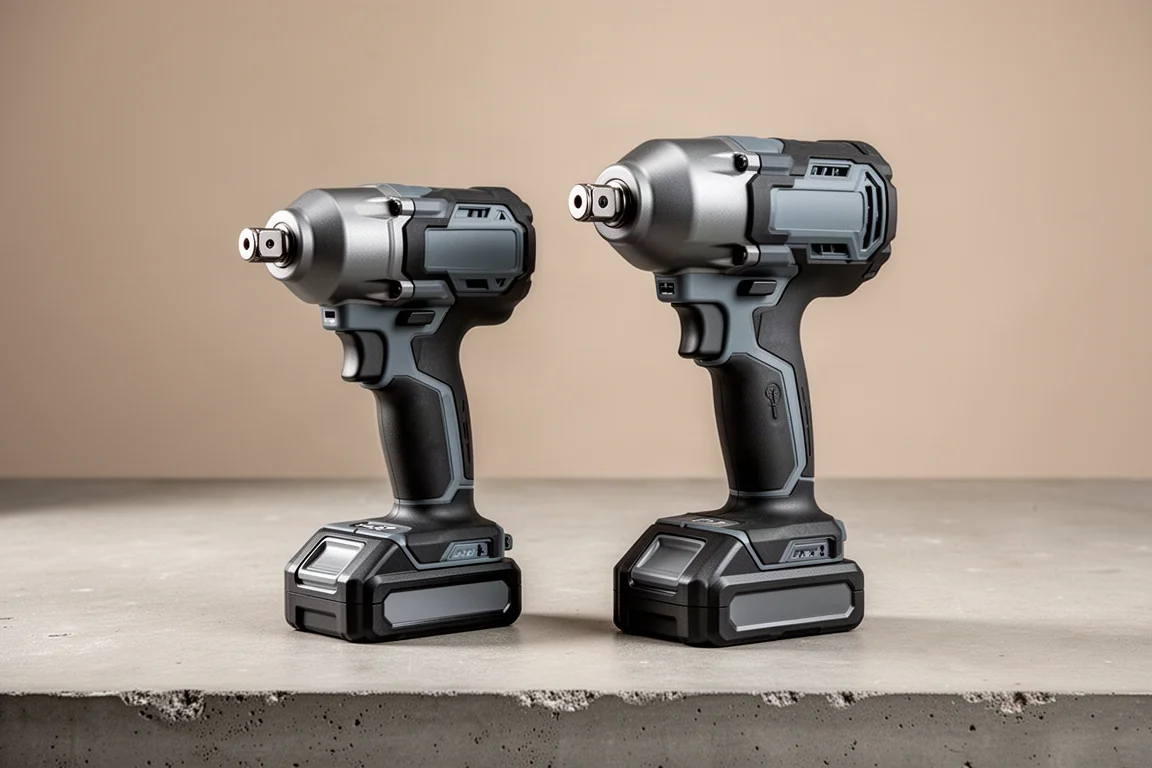

A brand name on the housing is a label decision, not a design fact.
Two quotations sit on your desk for what looks like the same cordless impact wrench: similar voltage class, similar housing shape, comparable kit contents. One carries a brand name your customers recognise and a higher price. The other is a factory brand you have never heard of. The tempting question is which brand is "better".
A brand name on the housing is a label decision, not a design fact. The useful question is narrower: which part of this product is the supplier's own design, which part sits on an existing platform, and what actually changes when the logo changes?
This guide covers external, document-based verification steps you can run before approving a private-label order. It does not decode serial numbers or trace a tool back to its factory floor; it is not an exposé of any named brand, and it is not legal advice. Where a statement comes from a manufacturer's page, a retailer blog or a public forum thread, the text says so, and you should weigh it accordingly.
What rebranding changes, and what it does not
Start with the definition: most of the confusion sits here. One rebranding guide states it directly. Rebranding is replacing the original brand identity on a product with the buyer's own: logo on the housing, name on the manual, brand on the warranty. Everything in that list is an identity layer. None of it tells you who designed the motor, the gearbox or the electronics.

Applying a decorative sticker to a power tool battery demonstrates how visual identity is distinct from the underlying hardware.
Design origin is a separate question, and it is answered by the lane the order sits in. OEM typically means contract manufacturing to the buyer's drawings or specifications, while ODM means the factory modifies, rebrands, or co-develops on its existing platforms. Under OEM the product design and technical parameters rest mainly with the buyer, while under ODM the factory holds ready-made designs or R&D capability.
A rebadged existing model usually sits in the ODM lane: the design work happened before your brand arrived, so the confirmation list for this route is specific. For rebranding existing models, buyers must confirm the existing BOM, configuration, logo, packaging, manuals, MOQ and samples. Two items deserve extra attention: the BOM, so you know what is fixed and what is being changed, and the samples, so you hold a physical reference instead of a rendering.
Do not assume an existing model fits your market. An available design may predate your target market's plug, voltage convention, label or documentation requirements. Size, colour class or "heavy duty" wording on a spec sheet do not confirm any of these. Check each item against the exact model code before treating the design as ready for your channel.
Rebranding an OEM product is legal and standard practice, provided the legal groundwork (brand ownership, contract, compliance documentation) is in place. Part of that groundwork is contractual. An OEM supply agreement should define IP ownership, mold rights, exclusivity and non-compete terms, including whether the factory can sell the same rebadged design to others. Those are clauses to review with legal counsel in your own jurisdiction.
Rebadging in practice: what buyers observe, and why it is not proof
This topic usually reaches buyers through community threads.
Community discussion on The Garage Journal states that some tool companies lack a motor or market for a given tool and have another manufacturer re-brand a model for them, sometimes with custom modifications. The same forum thread reports that Festool and Metabo have produced tools for each other to round out their lineups, with changes made so the re-branded versions were not exactly the same. One reply notes that hand tools and bits are often rebadges, and adds that in some cases cheaper versions share the same core parts with different jackets or cords.
Two practical points hold up from those observations:
- Rebadging happens, including between established brands. It is not by itself a marker of low quality.
- A rebadge is not automatically identical hardware. The observations include custom modifications, and shared core parts under different jackets or cords.
What you cannot read from a forum thread is which specific brand pairings are true today, how often components change versus stay identical, or any prevalence figure for the power-tool sector. These are unverified user posts. No pairing named in such a thread is established fact; do not carry one into a sourcing decision.
A community signal is a reason to ask your supplier a question. It is never a substitute for the supplier's written answer.
Same hardware, different support: what changes after the logo changes
Even when the hardware is identical, the label can matter a great deal for after-sales. The clearest illustration available comes from test-and-measurement equipment, a different product category, so it works only as an analogy.
On a test-equipment forum, a user reports that teardown videos and photos show rebranded devices sharing the same circuitry and components, sometimes with the original manufacturer's name on the PCB. The same forum thread describes a rebranded meter whose firmware bugs could not be fixed by the brand because it had no access to the firmware from the original design owner. Treat both as unverified user posts.
The question for a power-tool buyer is the same: when something fails, who can change the design? If the brand on the housing does not hold the design, then firmware, spare parts, tooling changes and corrective actions all sit somewhere upstream, and your after-sales response depends on that chain working, contract by contract.
A retailer article on the HiKOKI rebranding states that Hitachi and HiKOKI branded tools, accessories, batteries, chargers and spare parts remain fully interchangeable. The same article traces the name change to a corporate transition. KKR, a private equity firm, acquired Hitachi Koki in 2017. Hitachi Koki then announced that it would change its corporate name to Koki Holdings Co., Ltd., and the transformation included rebranding all its power tools under the HiKOKI name. These statements come from a retailer blog, not a primary corporate or regulatory source. Treat them as needing current corroboration before you rely on them in a commercial decision.
Interchangeability is a claim to confirm in writing, not a property to infer from a shared label. For cordless tools, both the battery and charger models should be identified, because matching voltage does not establish compatibility.
Ask who holds the design before you sign. Defects, firmware, spare parts and recalls all depend on the answer.
Document checks: confirm the model, not the series
Design origin is hard to prove from outside. Documents are what a buyer can verify, and two rules do most of the work.
Rule 1: the certificate must name the model you are ordering. When verifying certification documents, buyers must confirm that the model listed on the certificate exactly matches the model being procured, not a "series" or "similar product". A certificate that only states a product category without a specific model carries no evidentiary weight for the unit you are sourcing.
Rule 2: the certificate is the result, the test report is the data. A certification certificate is only the result; the supporting test report is the data, and buyers should request the third-party test reports corresponding to the certificate. Inside the report, check the test items, the sample description and the conclusions, and confirm the sample description matches the configuration you will actually receive.

Verify the exact model code on the product label.
Then extend the same model-level discipline to the design baseline. For a rebrand or an adjusted existing design, ask for the existing BOM and configuration as the reference: what is fixed (motor, gearbox, electronics, battery interface) and what is being changed (logo, housing colour, labels, kit, packaging). Parameters belong to one exact model and one document. A figure from one model does not transfer to another model of the same size or family.
Record fields to fill per model:
| Field | Value | Verification status |
|---|---|---|
| Certificate number / issuing body | ______ | ☐ Confirmed ☐ Pending |
| Model on certificate | ______ | ☐ Matches order ☐ Pending |
| Model ordered (exact code) | ______ | n/a |
| Test report reference | ______ | ☐ Received ☐ Pending |
| BOM / configuration reference | ______ | ☐ Received ☐ Pending |
| Battery and charger codes (kit) | ______ | ☐ Confirmed ☐ Pending |
One supplier-evaluation guide asks whether a batch of finished tools can be traced back to the specific batch of raw materials used, and describes that traceability as critical for managing recalls or quality issues. Ask the factory the same question and record the answer with the order. Do not leave it as a verbal assurance.
Before you approve the private-label order: records to fix in writing
Turn the verification logic into an approval checklist. Not every line is a document request; some are contract clauses to discuss with legal counsel.
First, name the route. Put one question in the brief: is this order rebranding an existing model, adjusting an existing design, or ODM development? Each route has different confirmation items: existing BOM and samples; engineering fees and validation scope; requirement freeze and design files.
Then fix the records. A written process is recommended for keeping repeat orders consistent: keep the approved sample reference, specification revision, artwork and bill of kit contents with the order. Compare the next order against those records, and approve any component or packaging changes in writing before production, not after shipment.

A written specification document on a clipboard amidst office materials.
Keep a physical reference. A supplier-evaluation guide recommends sealing and retaining the approved sample as a physical reference for acceptance of later batches. One rebranding strategy page recommends keeping 2–3 units per batch as reference samples for warranty adjudication. That recommendation comes from a vendor page rather than a verified standard, so set a retention rule that fits your own quality agreement.
Separate what a quotation shows from what it cannot. A quotation alone does not reveal whether the factory can keep delivering to sample standard after mass production begins or whether it will switch component suppliers when supply fluctuates. Whether a factory can "make it once" and whether it can "keep making it to the same standard" are two entirely different questions. Put the consistency questions in the approval record, not in the price comparison.
Set the inspection scope with the order. The exact inspection scope depends on the approved product and commercial agreement. Agree, before shipment, which functions and measurements to check, how results are documented and how a deviation is handled.
For cordless kits, list the codes. Battery model, charger model and kit contents go into the order record by exact code. A shared voltage label is not a compatibility statement.
A compact approval record for a private-label order:
- Design-origin route: rebrand existing model / adjust existing design / ODM development
- Existing BOM and configuration reference: what is fixed, what changes
- Certificate and third-party test report per exact model, with issuing body and reference numbers
- IP, mold-rights, exclusivity and non-compete clauses reviewed by legal counsel
- Approved sample reference, specification revision, artwork and bill of kit contents
- Battery, charger and accessory codes per kit
- Sample-retention rule and batch comparison procedure
- Inspection scope, documentation method and deviation handling
What this method cannot tell you
Keep the checklist in its lane. It answers document questions, not every question.
- No factory-tracing method is covered here. Serial-number decoding, FCC/ID lookups and patent or mold-record searches fall outside these document checks.
- Brand pairings stay unverified. The brand-to-OEM pairings discussed in forum threads are community observations. They illustrate that rebadging occurs; they do not establish any specific pairing, and no frequency or prevalence data exists for the power-tool sector.
- Vendor cost and timeline figures are excluded. Cost tables, price uplifts and lead-time ranges on rebranding marketing pages are unverified claims and are not used here as cost or ROI data.
- Legal specifics belong to counsel. Trademark registration, IP enforcement and contract terms depend on your jurisdiction and your agreement.
- No source shows how any particular supplier records design origin or BOM ownership. Ask your supplier directly, in writing, and record the answer, including for private-label orders where the design predates your brand.
What to put in the next RFQ
A short list you can paste into your next request for quotation:
- Design-origin route per model: rebrand existing / adjust existing / ODM
- Existing BOM and configuration reference for the chosen models
- Certificate and third-party test report per exact model, matched to the ordered code
- IP, mold-rights and exclusivity terms available for review
- Approved sample, specification revision and bill of kit records
- Battery and charger codes for every kit
- Sample-retention and batch-comparison terms
- Inspection scope, documentation method and deviation handling
Need a model, OEM or tooling quotation? Share four items and the review can be specific: target market, application and materials, model and configuration, and quantity per model. Send the brief and request a factory quotation, and use the checklist as the verification template for that order.