
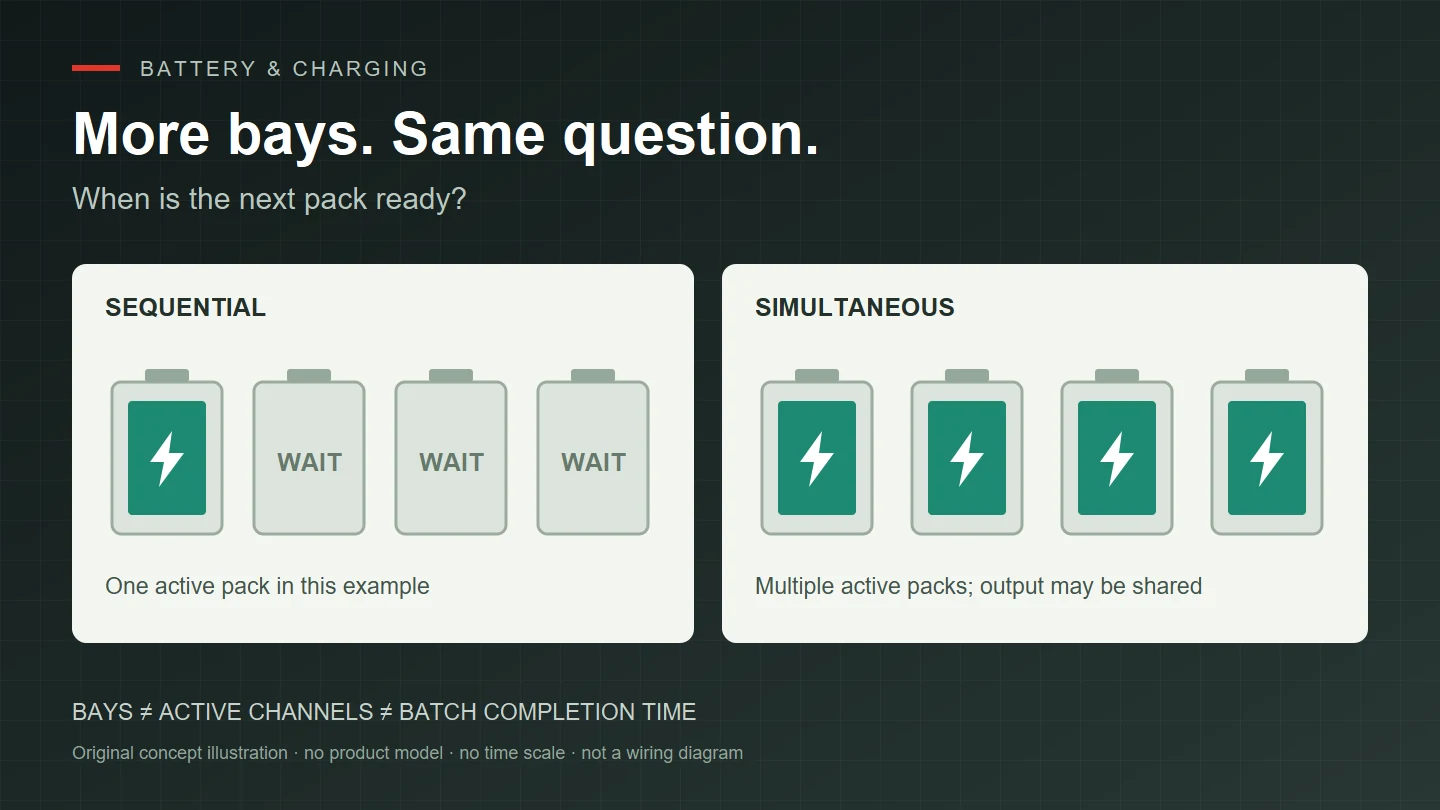
A multiport battery charger should be judged by when a crew gets its next usable pack, not simply by the number of slots. For importers and distributors, a useful comparison starts with the number of packs charging at once, how output is shared under load, and the battery and endpoint behind each charging-time claim. Four slots may charge together or leave some packs waiting. Six slots do not automatically finish a batch sooner than four.
Milwaukee features its M18 / M12 Four Bay Simultaneous Super Charger in its 2026 official news collection. The product brings charging coordination into the buying discussion: a charger affects the crew’s working rhythm, rather than being just an accessory bundled with a tool. This guide uses published Milwaukee and Bosch examples to explain specification checks and sample observations. It is not an independent brand test or a claim that FORZMAX sells those competitors’ models.
Separate physical bays from packs charging at once
“How many batteries does it charge?” can produce an incomplete answer. Ask which bays supply charging output when every slot is occupied. Are other packs waiting, already full, or temporarily unable to charge? Separate physical capacity from active charging capacity on the comparison sheet.
Milwaukee describes two M18-only bays and two hybrid M18 / M12 bays, with adaptive power distribution for simultaneous charging. That does not mean all four accept M12 packs. Nor does the word “simultaneous” establish identical current at every port with every pack combination. Read the official launch description.
Bosch’s GAL 18V6-80 illustrates another strategy. It charges up to six batteries sequentially to approximately 80%, then completes charging to 100%, with a priority button available. This is a two-stage sequence, not six independent full-output channels. Queuing may suit overnight replenishment; crews returning batteries during work need to know when the next pack becomes available. See Bosch’s charging sequence.
Do not compare 80% with 100%
A headline such as “35 minutes” needs its battery and endpoint attached. Milwaukee separately describes selected FORGE packs reaching 80% in about 35 minutes and four specified HD12.0 packs reaching 100% in about 90 minutes. These are different statements. They do not establish a universal 35-minute full charge for any four batteries. Confirm the applicable conditions in the exact model’s documentation for the destination market.
Bosch lists approximately 23 / 37 minutes for a standard 4.0 Ah pack at 80% / 100%. Neither figure is the total time for six packs, or a fair direct comparison with a different platform’s larger battery. Preserve three fields: single pack or batch, initial state, and finishing point. Ask the vendor to supply missing conditions instead of filling them in yourself.
Track two useful outcomes: time until the first pack reaches the agreed usable state, and time until the last reaches the agreed full-charge endpoint. The former supports short-notice swaps; the latter helps plan the next shift. Define usability against the customer’s task and permitted operating conditions, rather than declaring 80% a universal requirement.
Establish whether current is per bay or shared
An “8 A” label needs context. Is it one channel’s output, an upper limit shared across ports, or a rating under another condition? Ask how a full mix of battery capacities affects distribution and what happens when a pack nears completion or cannot charge temporarily. Simultaneous operation alone does not specify each channel’s speed.
Consider an illustrative energy calculation: four packs labelled 18 V and 5 Ah represent approximately 360 Wh of combined nominal energy. That is not the energy actually added from any particular remaining charge, and it is not electricity drawn from the wall. Slot count and Ah alone cannot predict charging time; the relevant charging profile, allocation and input conditions are still needed.
Battery-side output current is also not AC socket input current. When adding chargers to a crew’s setup, check the destination version’s input voltage, frequency and rated input, and have qualified personnel confirm the available supply and connections. Where reels or extension leads are involved, consult our extension-lead matching guide separately. Do not design site wiring from battery-side figures.
Observe the actual battery-return pattern
An illustrative maintenance crew has four batteries returned at different times during the morning and collected again in the afternoon. This is a planning example, not a FORZMAX customer case. Inserting four empty packs together may miss that workflow. Record return order, indicated starting charge and collection deadlines before deciding whether simultaneous charging, sequencing or a priority control is useful.
Identify each sample pack and record its model and condition, insertion time, first charging indication, agreed endpoint and any waiting or warnings. Ask the vendor to explain the indicators so that power-on, queuing and temperature waiting are not all logged as active charging. Check a single pack first, then the customer’s full combination. Such observations are not laboratory certification.
Use only manufacturer-approved batteries and charging conditions. For abnormalities, damage or unexplained fault indications, follow the applicable manual, stop use as directed and refer the equipment to qualified personnel. Never bypass temperature protection, modify interfaces or repeatedly force a start to complete a demonstration. Record temperature waiting separately from faults; one delay does not by itself disprove an advertised charge time.
Confirm the platform, regional version and package
A pack sliding into a slot, or a similar voltage on its packaging, does not independently establish charging compatibility. Specify the complete battery family, model and manufacturer’s compatibility coverage. Hybrid bays, dedicated bays and active cooling can have separate restrictions. Milwaukee, for example, limits its stated active-cooling functionality to batteries with the corresponding capability; it is not a cooling promise for every ordinary pack.
Regional checks extend beyond a plug photograph. Confirm the exact quoted model, nameplate, supply requirements, manual language and whether batteries are included. The Bosch and Milwaukee examples here describe their own published products. They do not imply cross-brand compatibility or prove the charging speed or certification of a FORZMAX charger.
Keep the compatible-pack list, bay layout, active-channel count, charging-time conditions, input specifications, package contents and fault indications in one approval record. That connects the sales promise to what the warehouse supplies. Start with our battery and charger category when comparing existing items, then verify each model; a diagram or similar appearance is not identification evidence.
Compare available packs and waiting time
No bay count suits every customer. Overnight replenishment, rapid work-break swaps and a workshop using several platforms present different tasks. Eliminate incompatible models and unsuitable input versions first. Then compare the batch endpoint, priority access and space requirements with the same pack combination. More slots or one “fastest” figure is not enough to rank the options.
For an enquiry, provide battery-model photographs, quantities, the return pattern, destination supply and collection deadlines. You can send those details when discussing a charging setup with FORZMAX. Compatibility, charging mode and timing remain subject to the actual model’s documentation and confirmation. This is a more workable starting point than asking only for the price of a four-port unit.
Sources were checked on 19 October 2026. Brand examples come from published manufacturer information, not independent charge testing or sales data. The original cover diagram illustrates charging coordination; it is not a real product, wiring drawing or measured charging curve.