
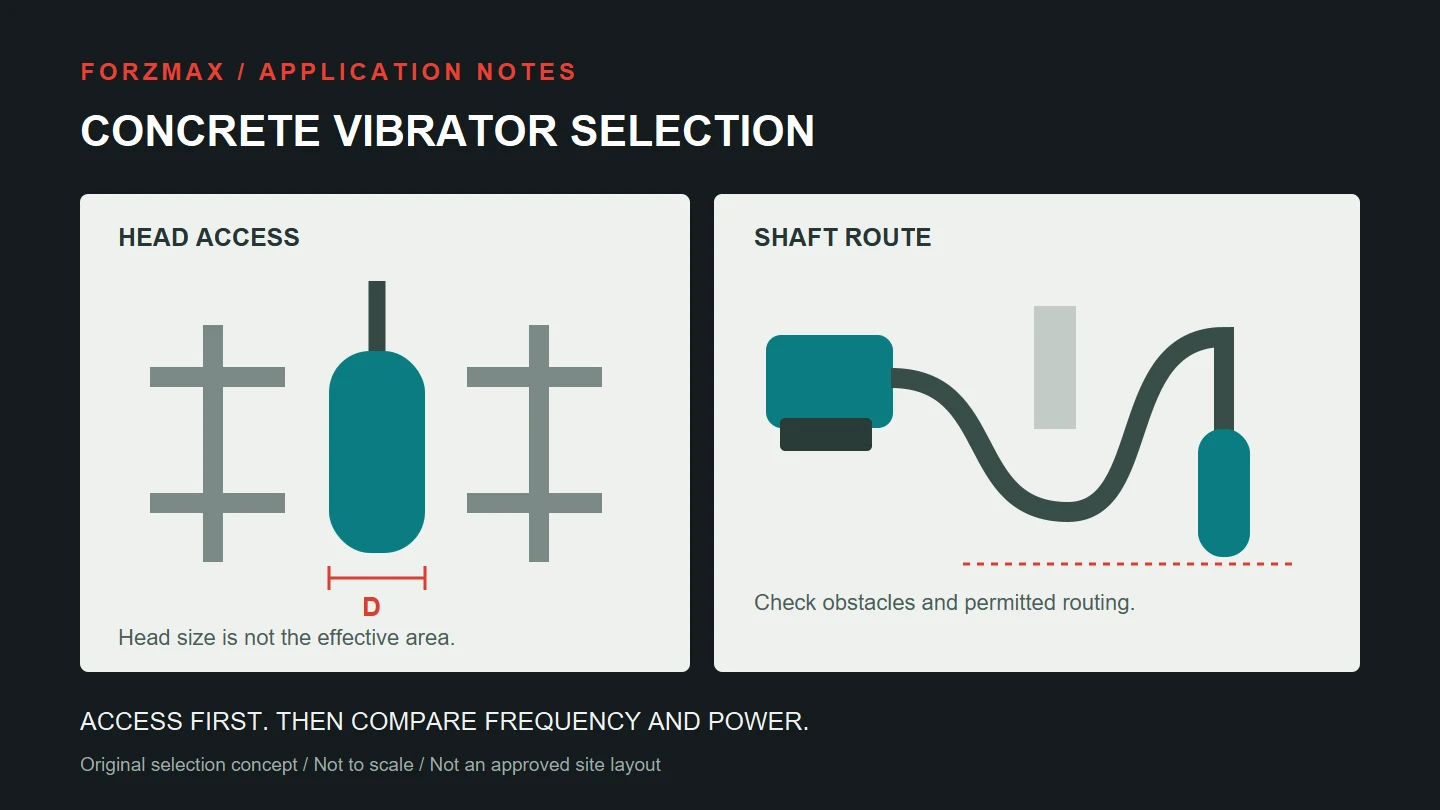
First check whether the vibrator head, the part inserted into the concrete, can reach the working location. Then check the route for the flexible shaft connecting it to the drive unit, followed by power supply and frequency. A higher vibration figure cannot help if the head will not fit or the shaft needs to be forced around a bend.
Supplementary work in a confined area and continuous placement over a large area need different arrangements. Bosch’s October introduction of the GVC18V-25-120D provides a useful example for explaining the numbers commonly found on a specification sheet.
What do 25 mm, 1.2 m and 12,700 vpm tell you?
The following figures appear in Bosch’s UK product documentation. Each answers a different question.
| Specification | Meaning | Selection question |
|---|---|---|
| 25 mm head diameter | Outside diameter of the working head | Can it enter and leave along the planned route? |
| 1.2 m shaft | Nominal shaft length | Where can it reach after positioning the drive? |
| 12,700 vpm | Vibrations per minute | Are units and operating conditions comparable? |
These are specifications for the Bosch model, not FORZMAX performance claims. Bosch also describes the battery-powered tool in its October announcement. It is used here to explain selection, not as an independent brand test.
How does 12,700 vpm relate to 211.7 Hz?
Vpm counts vibrations per minute; Hz counts cycles per second. In this specification, 12,700 ÷ 60 ≈ 211.7. The figures express the same frequency in different units, not two speed settings.
On another machine, check whether a number describes motor speed, head vibration or electrical supply frequency. Similar-looking units do not make those fields interchangeable. Comparing loaded performance also requires the relevant conditions: nominal frequency alone cannot establish which machine works faster in concrete.
Is a larger head better? Check the reinforcement gap first
The 25 mm dimension is the head’s outside diameter, not the diameter of concrete it will consolidate. Confusing the two can lead to unsuitable equipment and mistaken assumptions about placement.
For example, an entrance may look wide enough while crossing reinforcement or an embedded item blocks the route farther inside. The head might enter but fail to reach its destination, or become difficult to withdraw. Check the whole route in and out, not just the opening.
Mark the following on photographs or drawings before arranging equipment:
- The entry point and intended working location.
- Narrow passages and difficult changes of direction.
- Reinforcement, embedded items and formwork that affect access.
A smaller head may solve an access problem without improving overall productivity. Once a size can enter, assess its suitability for the concrete and member. Wacker Neuson’s HMS system description qualifies effective consolidation diameter by operating conditions and recommends a trial pour under actual conditions. An illustrated circle is not a site coverage guarantee.
How much shaft length is enough?
A 1.2 m shaft does not establish suitability for a 1.2 m-deep member. Distance between the drive and entrance, obstacles along the route and the operator’s working position all change the usable insertion length.
Before asking for a longer shaft, sketch the route: where the drive will stand, which side the shaft enters, what it passes around and where the head must finish. Compare that sketch with the specific machine’s instructions to judge both length and routing.
A flexible shaft cannot be bent arbitrarily. Do not force bends, add unapproved extensions or ignore support requirements to gain reach. If the route does not meet the instructions, move the equipment or select another assembly instead of pulling it into place.
For modular equipment, establish that the drive, shaft and head form an approved combination. Similar-looking connections do not prove cross-brand compatibility. Retaining the complete component references also helps avoid mistakes when replacements are ordered.
Corded or cordless: moving work or continuous work?
For frequent moves or temporary access to restricted locations, a battery tool removes the cable running to an external supply. That can simplify setup. Compare weight with the battery and required accessories included, rather than bare-tool weight alone.
For continuous work, plan battery changes, charging and backup equipment. Ah means ampere-hours, a measure of battery capacity; neither this rating nor voltage alone tells you how long a battery will run. Runtime comparisons need the test conditions, and cannot simply be converted into daily concrete output.
A corded machine avoids battery changes but needs suitable supply, cable routing and site protection. If extension cables or reels are involved, our guide to length and load helps prepare the information for the responsible person. Do not infer conductor cross-section solely from machine power.
A customer reports poor consolidation. What comes first?
A customer reporting poor consolidation might mean visible bubbles, honeycombing (pockets of voids among the aggregate), or a locally unconsolidated area. A photograph of the machine cannot establish the cause.
Start by asking whether the head reached the affected location and whether there were alarms or unexpected shutdowns. The construction supervisor can investigate the concrete and working method while equipment personnel check the machine. This separates the two lines of investigation before anyone assumes a larger head or higher frequency will solve the problem.
An after-sales report should retain equipment and component references, photographs of the affected location, an account of the operation and any shutdown or alarm. The next person can continue the investigation instead of starting again with “the machine has no power.”
The responsible personnel determine vibration time, insertion spacing and acceptance requirements for the project, together with the equipment instructions. Online timings and distances should not become a universal operating card. Surface changes alone do not establish acceptable structural quality.
Stop as instructed for abnormal noise, shaft or connection damage, overheating or unexplained shutdowns. Disconnect or isolate energy as required before servicing or disassembly; do not separate powered assemblies or bypass protection. Site precautions must also address wet concrete, noise and operator vibration exposure.
For selection or an enquiry, provide a member sketch, access route, intended assembly and operating environment. To ask FORZMAX for assistance, send those details so available models and actual specifications can be confirmed individually.
Sources checked: 20 October 2026. The cover is an original selection diagram, not a measured consolidation area or approved construction layout.
Reference sources
- Bosch US — October 2026 jobsite measuring, detection and concrete additions
- Bosch UK — GVC18V-25-120D dimensions and vibration frequency
- Wacker Neuson — HMS modular internal vibrator and operating-condition limits
- TMAX reference IDX-357 — background questions only; universal timing and spacing not adopted